




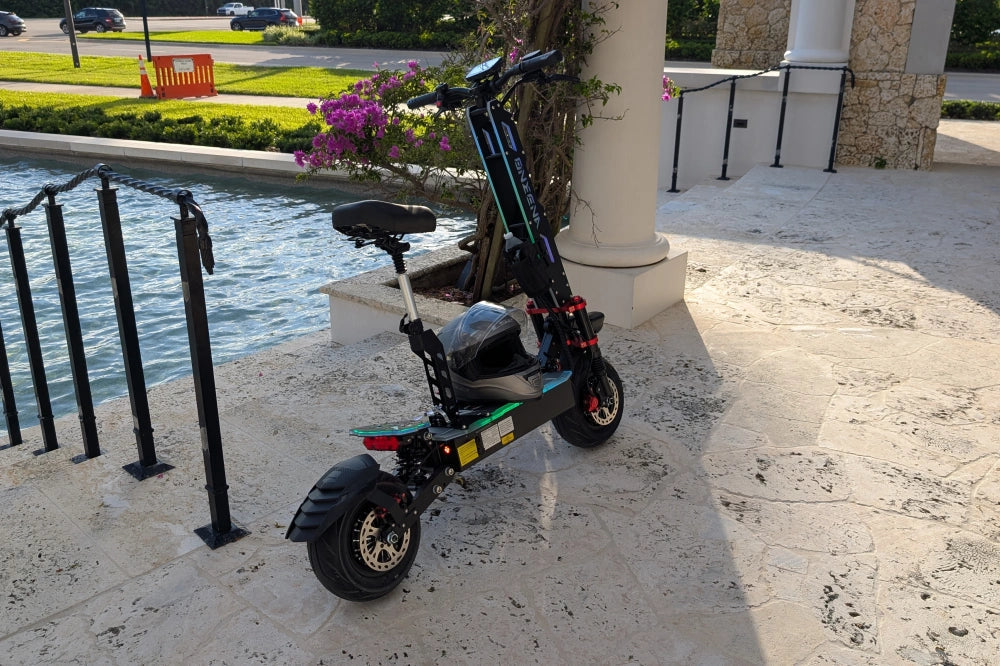
Speed gets attention. Power sells. But when it comes to real-world riding, nothing builds confidence like a reliable escooter brake.
No matter how powerful a scooter is, it is only as good as its ability to slow down — smoothly, predictably, and under control.
Why Brakes Are the Most Important Safety Component
Brakes are not just emergency tools. They define how comfortable you feel riding at speed, how confidently you corner, and how much trust you place in your machine.
On modern electric scooters, especially high-powered models, braking systems must handle far more than casual commuting demands.
Common Types of Escooter Brake Systems
Before choosing a scooter, it helps to understand the main braking technologies available today.
Mechanical Disc Brakes
Mechanical disc brakes use a steel cable to pull brake pads against a rotor. They are simple, proven, and widely used.
These systems are easy to maintain and cost-effective, making them popular on entry and mid-level scooters.
Hydraulic Disc Brakes
Hydraulic brakes rely on sealed fluid systems instead of cables. When you pull the brake lever, hydraulic pressure transfers force directly to the calipers.
The result is stronger, more consistent braking with less hand effort.
Electronic and Regenerative Braking
Some scooters supplement physical brakes with electronic braking, using the motor to slow the wheel while recovering energy.
While helpful, electronic braking is rarely sufficient on its own.
Mechanical vs Hydraulic: The Real Differences
Braking Power
Hydraulic brakes generally provide greater stopping force with less lever pressure. This becomes noticeable at higher speeds and heavier loads.
Brake Feel and Modulation
Hydraulic systems offer smoother modulation, allowing riders to fine-tune braking force rather than relying on on/off pressure.
Mechanical brakes can feel more abrupt, especially as cables wear over time.
Consistency Over Long Rides
Cable stretch and dirt exposure can affect mechanical brakes. Hydraulic systems remain sealed, delivering consistent performance even after extended use.
Maintenance and Long-Term Ownership
Mechanical brakes are easier to service and adjust, making them ideal for riders who prefer simple upkeep.
Hydraulic brakes require less frequent adjustment but may need professional servicing if fluid replacement is required.
Why High-Speed Scooters Demand Better Brakes
As top speeds increase, stopping distance increases exponentially. Powerful scooters need braking systems designed to match their acceleration.
This is where brake quality shifts from convenience to necessity.
Braking Performance Under Load
Rider weight, cargo, and terrain all influence braking effectiveness. Steep descents and off-road conditions amplify these demands.
A well-designed escooter brake system maintains stability even when traction is compromised.
ONECNA's Approach to Braking Design
ONECNA pairs braking systems with motor output and chassis design rather than treating brakes as isolated components.
On performance-oriented scooters like those built around escooter brake configurations, braking balance is engineered alongside suspension and frame rigidity.
Front and Rear Brake Balance
Effective braking is not just about raw stopping power. Balanced front and rear brake distribution improves stability and prevents wheel lock.
This balance is especially critical on dual-motor scooters.
Heat Dissipation and Brake Fade
Repeated hard braking generates heat. Poor heat management can reduce braking efficiency over time.
Hydraulic systems and larger rotors handle heat more effectively, maintaining consistent performance.
Riding Style and Brake Choice
- Urban commuting: reliability and ease of maintenance
- High-speed riding: strong modulation and stopping force
- Off-road terrain: predictable braking under uneven traction
Choosing the Right Brake for Your Scooter
Instead of asking which brake is 'best', riders should ask which brake suits their riding environment.
Scooters like those designed around escooter brake systems focus on controlled deceleration rather than sudden stops.
Confidence at Speed
Strong brakes do more than stop you — they allow you to ride faster with confidence.
Knowing you can slow down precisely changes how you approach corners, traffic, and terrain.
Final Thoughts
A well-designed escooter brake system is not just about specifications. It is about trust.
When braking feels natural and predictable, every ride becomes safer — and more enjoyable.
Share:
How Fast Is a Fast Motorized Scooter in 2025?
Fast Electric Scooters Cheap: Is Real Speed Still Affordable?