




High Speed E Scooter Buying Guide: How to Choose the Right Model

A high speed e scooter isn't just about going fast — it's about matching the right motor, battery, and build to how and where you actually ride. Whether you're commuting across a city, tackling hills, or exploring off-road trails, the "fastest" model on paper isn't always the right one for you. This buying guide compares performance tiers, breaks down real-world pros and cons, and helps you decide which high speed e scooter fits your commute, terrain, and budget — without the sales pressure.
What Counts as a High Speed E Scooter?
The term "high speed" gets used loosely in the e scooter market. Technically, any scooter capable of exceeding 20 mph (32 km/h) starts entering performance territory. But in practical terms, most riders and reviewers use these rough thresholds:
- Standard speed: 15–20 mph — entry-level commuters, shared fleet scooters
- Mid-performance: 20–30 mph — capable commuters with real-world usability
- High speed: 30–45 mph — dual-motor performance scooters for experienced riders
- Extreme performance: 45+ mph — purpose-built machines, not for casual use
For this guide, we're focusing on the 25–50 mph range — the sweet spot where most serious buyers are shopping. These scooters require more thought, more budget, and more awareness of local regulations than a basic commuter model.
Why Speed Matters — and When It Doesn't
Speed is a proxy for capability, not just a number. A scooter that tops out at 40 mph isn't just faster than one that does 20 mph — it's built differently. Higher top speeds require:
- More powerful motors (and usually two of them)
- Larger, higher-voltage battery systems
- Better braking — hydraulic disc brakes become non-negotiable above 30 mph
- Stronger frames and suspension to handle the forces at speed
- Larger tires for stability and grip
So when you're comparing high speed e scooters, you're really comparing entire engineering philosophies — not just motor wattage figures.
When speed doesn't matter: If your commute is under 5 miles on flat, smooth pavement with traffic lights every few blocks, a 40 mph scooter won't make your commute faster — it'll just cost more and weigh more. Speed matters most on open roads, long stretches, and hilly terrain where sustained power makes a real difference.

Performance Tiers Compared: 25 mph vs 40 mph vs 50+ mph
Tier 1: 25–30 mph (Mid-Performance Commuter)
Typical specs: Single motor 800W–1,500W, 48V battery, 20–35 mile range, 10-inch tires, mechanical or entry hydraulic disc brakes.
Who it's for: Daily commuters who want more capability than a budget scooter without the weight and complexity of a full performance machine. These handle moderate hills, mixed pavement, and daily use well.
Trade-offs: Limited off-road capability. On steep hills (10%+ grade), single-motor models in this tier will slow noticeably under heavier riders.
Tier 2: 30–45 mph (Dual-Motor Performance)
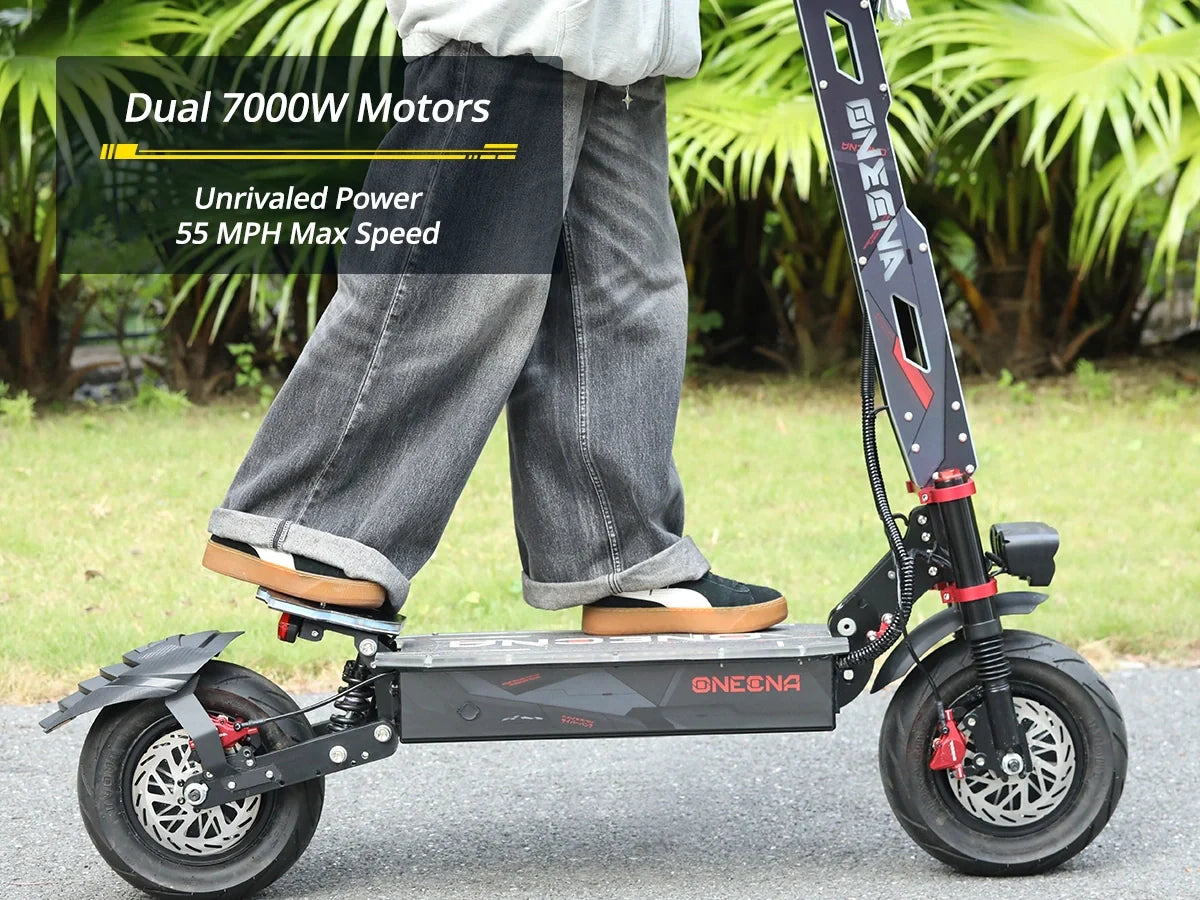
Typical specs: Dual motors 2,000W–6,000W combined, 52V–72V battery, 30–55 mile range, 10–11 inch pneumatic tires, full hydraulic disc brakes, front and rear suspension.
Who it's for: Riders who commute longer distances, deal with hills regularly, or want a scooter that handles mixed terrain confidently. This is the most popular tier among serious adult riders.
The ONECNA GT8 PRO sits in this tier — 6,000W combined dual motor output, 11-inch pneumatic tires, hydraulic brakes, and a 60V battery system. It's a strong example of what this tier delivers: real-world 35–40 mph capability with the suspension and braking to back it up.
Trade-offs: Heavier (typically 65–85 lbs), more expensive, and may exceed legal speed limits in some jurisdictions.

Tier 3: 45–60+ mph (Extreme Performance)
Typical specs: Dual motors 6,000W–12,000W+, 72V+ battery, 12-inch off-road tires, full hydraulic suspension, NFC/app locking, advanced display systems.
Who it's for: Experienced riders who specifically need off-road capability, extreme range, or maximum power for steep terrain. Not a practical daily commuter for most people.
The ONECNA GT9 represents this tier — 12-inch knobby tires, dual high-output motors, and a chassis built for riders who go beyond paved roads.
Trade-offs: Very heavy (85–120+ lbs), expensive, legally restricted in most urban areas, and overkill for typical commuting.

Single Motor vs Dual Motor: Which Is Right for You?
This is the most common comparison question in the high speed e scooter category. Here's an honest breakdown:
| Factor | Single Motor | Dual Motor |
|---|---|---|
| Top Speed | 20–30 mph typical | 30–55+ mph typical |
| Hill Climbing | Moderate (slows on steep grades) | Strong (maintains speed on 20%+ grades) |
| Range | Often better per Wh (less power draw) | Lower in sport mode; better in eco mode |
| Weight | Lighter (35–55 lbs typical) | Heavier (60–90 lbs typical) |
| Price | $500–$1,200 | $1,200–$3,500+ |
| Wet/Traction Control | Basic | Better (AWD-like grip) |
| Best For | Flat urban commuting | Hills, mixed terrain, longer range |
Bottom line: If your route is flat and under 15 miles round-trip, a single motor is likely sufficient and will save you money and weight. If you have hills, carry more weight, or want genuine high-speed capability, dual motor is worth the premium.
Matching Your Scooter to Your Terrain
Terrain is the most underrated factor in scooter selection. Most buyers focus on speed and range, but the surface you ride on determines which specs actually matter.
Smooth Urban Pavement
10-inch pneumatic tires, basic front suspension, and a mid-range motor are sufficient. You don't need 12-inch knobby tires or full hydraulic suspension for city streets — that's extra weight you'll carry for no benefit.
Mixed Urban (Cracks, Curbs, Light Gravel)
Front and rear suspension becomes important here. 10–11 inch pneumatic tires handle this well. Look for scooters with at least spring suspension front and rear, and hydraulic disc brakes for reliable stopping on variable surfaces.
Suburban / Bike Path Riding
Longer range matters more than top speed. A scooter with a 40+ mile range and 25–30 mph capability is more useful than a 50 mph machine with 20 miles of range. Comfort over longer distances — seat compatibility, deck size, suspension quality — becomes a priority.
Hills (10%+ Grade)
Dual motor is strongly recommended. Single-motor scooters lose significant speed and put excessive strain on the motor on sustained climbs. Dual motors distribute the load and maintain speed more consistently.
Off-Road / Trails
12-inch knobby tires, full hydraulic suspension, and high ground clearance are non-negotiable. This is where machines like the GT9 are purpose-built — the engineering is fundamentally different from an urban commuter.

Pros and Cons of High Speed E Scooters
Pros
- Genuine commuting speed: 30–40 mph capability means you can keep pace with urban traffic on many roads, reducing the stop-and-go frustration of slower scooters.
- Hill confidence: Dual-motor high-speed scooters don't slow to a crawl on inclines — they maintain speed and torque where budget models struggle.
- Better build quality overall: High-speed scooters require better brakes, frames, and suspension by necessity — so you get a more durable machine across the board.
- Range: Larger batteries in performance scooters often deliver 40–60 miles of real-world range, making them viable for longer commutes.
- Versatility: Many dual-motor models have riding modes (eco, normal, sport) that let you dial back speed for legal compliance or battery conservation.
Cons
- Weight: High-speed scooters are heavy — 65–90 lbs is common. Carrying them up stairs or loading them into a car is a real consideration.
- Legal restrictions: Many cities cap e scooter speeds at 15–20 mph on public roads. A 45 mph scooter may be legally restricted to the same speed as a $400 budget model in your area.
- Cost: Quality high-speed scooters start around $1,200 and go well past $3,000. The price jump from mid-range to performance is significant.
- Charging time: Larger batteries take longer to charge — 6–12 hours for a full charge is common without a fast charger.
- Overkill for short commutes: If you're riding 3 miles to a train station, a 40 mph dual-motor scooter is expensive engineering you'll never use.
Use Cases: Who Should Buy What
The Daily Urban Commuter (5–15 miles/day, flat terrain)
Best fit: Mid-performance single motor, 25–30 mph, 10-inch tires, 20–35 mile range.
Why: You don't need dual motors for flat city riding. Save the weight and money. Focus on range, portability, and build quality instead.
The Suburban Commuter (15–30 miles/day, mixed terrain)
Best fit: Dual motor, 30–40 mph, 10–11 inch tires, 40+ mile range, full suspension.
Why: Longer distances and mixed surfaces reward the extra power and suspension. The GT8 PRO is a strong fit here — enough speed for open roads, enough suspension for imperfect pavement, and enough range for a full day's commuting.
The Hill Rider (Any distance, significant elevation)
Best fit: Dual motor with high torque rating, 30+ mph, hydraulic brakes.
Why: Hills punish underpowered motors. Dual motor is the practical minimum for sustained climbing. Torque matters more than top speed here.
The Off-Road / Adventure Rider
Best fit: 12-inch knobby tires, full hydraulic suspension, dual high-output motors, 45+ mph capability.
Why: Trail riding requires fundamentally different engineering. The GT9 is built for this — the suspension travel, tire profile, and motor output are calibrated for rough terrain, not city streets.
The Speed Enthusiast (Closed tracks, private land)
Best fit: Extreme performance tier, 50+ mph, maximum motor output.
Why: If you're riding on private property or closed courses where legal speed limits don't apply, maximum performance machines make sense. Not recommended for public road use in most jurisdictions.

The Buying Checklist: 7 Things to Verify Before You Purchase
Before committing to any high speed e scooter, run through this checklist:
- Check your local speed laws. Know the legal limit for e scooters in your city/state before buying a 45 mph machine. Many areas cap at 15–20 mph on public roads.
- Verify real-world range, not spec-sheet range. Manufacturer range figures are measured under ideal conditions (light rider, flat terrain, eco mode). Real-world range is typically 60–80% of the advertised number.
- Confirm the braking system. Above 25 mph, hydraulic disc brakes are strongly recommended. Mechanical disc brakes are acceptable up to 30 mph. Drum brakes are not appropriate for high-speed riding.
- Check the IP rating. If you'll ride in rain or wet conditions, look for IP54 or higher. Many high-speed scooters have adequate water resistance, but verify — not all do.
- Assess your carrying situation. A 75 lb scooter is not practical if you need to carry it up three flights of stairs daily. Weight matters as much as performance for real-world usability.
- Research the brand's parts availability. High-speed scooters need maintenance. Tires, brake pads, and batteries need to be replaceable. Check that the brand has accessible spare parts before buying.
- Test the riding modes. Good performance scooters offer multiple speed modes. Eco mode for legal compliance and battery conservation, sport mode for open roads. Verify the scooter you're considering has this flexibility.
Speed, Laws, and Where You Can Actually Ride
This is the section most buyers skip — and then regret. E scooter regulations vary significantly by country, state, and city. Here's what you need to know:
United States
Regulations are set at the state and city level. Most states that have legalized e scooters cap them at 15–20 mph on public roads. Some states classify high-speed e scooters as motor vehicles, requiring registration and insurance. California, for example, caps e scooters at 15 mph on bike paths and 25 mph on roads. Always check your specific state and city laws.
European Union
Most EU countries cap e scooters at 25 km/h (15.5 mph) on public roads. High-speed models above this limit are typically classified as mopeds or motorcycles, requiring registration, insurance, and a license. Riding a 40 mph scooter on public roads in most EU countries is illegal without proper registration.
United Kingdom
As of current regulations, privately owned e scooters are not legal on public roads or pavements in the UK. Only rental scooters in approved trial areas are permitted. This may change, but verify current law before purchasing.
The Practical Takeaway
A high-speed e scooter with multiple riding modes gives you flexibility. You can ride in eco/legal mode on public roads and use full performance on private property. This is why riding mode flexibility is on the buying checklist — it's not just a convenience feature, it's a legal compliance tool.
Frequently Asked Questions
What is the fastest legal e scooter you can ride on public roads?
This depends entirely on your location. In most US states, the legal limit is 15–25 mph on public roads. In the EU, it's typically 25 km/h (15.5 mph). A scooter capable of 40 mph can still be ridden legally if it has a mode that limits speed to the local legal maximum — many performance scooters include this.
Is a 40 mph e scooter safe?
At 40 mph, safety depends heavily on the scooter's engineering — specifically its braking system, suspension, tire size, and frame rigidity. A well-engineered 40 mph scooter with hydraulic disc brakes and full suspension is safer at speed than a poorly built 25 mph scooter. Rider gear (helmet, gloves, protective clothing) is non-negotiable at these speeds.
How far can a high speed e scooter go on one charge?
Real-world range for high-speed dual-motor scooters typically falls between 25–55 miles depending on battery size, rider weight, terrain, and speed. Riding at maximum speed significantly reduces range — eco mode can extend range by 30–50% compared to sport mode.
Do I need a license to ride a high speed e scooter?
In most US states, no license is required for e scooters under 30 mph. Above that threshold, or in states that classify high-speed scooters as motor vehicles, a license may be required. EU regulations are stricter — scooters above 25 km/h are typically classified as mopeds. Always check local law.
Single motor or dual motor for hills?
Dual motor, without question, for sustained hill climbing. A single-motor scooter will slow significantly on grades above 10–15% and puts excessive heat stress on the motor over time. Dual motors distribute the load and maintain speed on inclines that would challenge a single-motor machine.
How do I compare high speed e scooters fairly?
Compare: combined motor wattage (not peak, but continuous), battery capacity in Wh (not just voltage), real-world range at normal speed, braking system type, suspension configuration, tire size, weight capacity, and IP rating. Don't compare top speed figures in isolation — a 50 mph scooter with poor brakes is more dangerous than a 35 mph scooter with hydraulic discs.
What's the best high speed e scooter for commuting?
There's no single best — it depends on your commute distance, terrain, and local laws. For most suburban commuters with mixed terrain and 15–25 mile daily distances, a dual-motor scooter in the 30–40 mph range with full suspension and 40+ mile range is the practical sweet spot. Models like the ONECNA GT8 PRO represent this tier well — enough performance for real-world commuting without the extreme weight and cost of off-road machines.
Are high speed e scooters worth the extra cost over budget models?
For casual, short-distance urban riding: probably not. For daily commuting over 10 miles, hilly terrain, or riders over 180 lbs: yes, the engineering difference justifies the price. The cost-per-mile calculation over 2–3 years often favors a quality performance scooter over replacing a budget model every 12–18 months.
Share:
How Much Is an E Scooter? Average Prices by Type and Features
How Fast Can an E Scooter Go? Everything You Need to Know Before Buying