




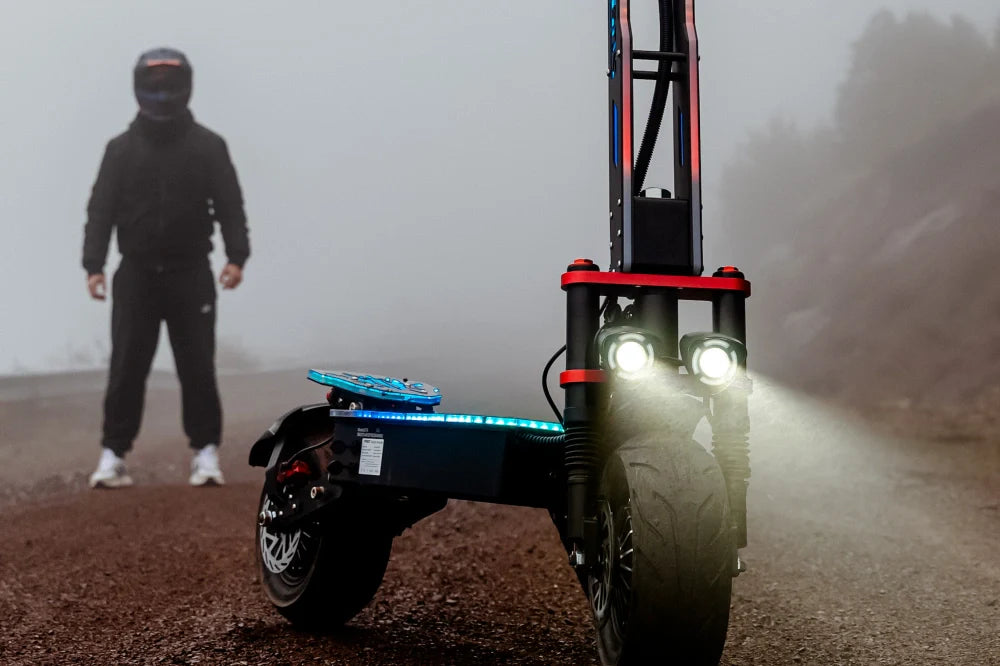
Hoverboards promise effortless balance and futuristic control, but their design tells a different story once real-world riding begins. By placing hoverboards and electric scooters side by side, this guide explains where each excels—and why most adult riders ultimately move on. ⚙️
1. What Is a Hoverboard?
When people search what is a hoverboard, they are often reacting to the name itself. Despite popular belief, a hoverboard does not hover. It is a compact, self-balancing electric platform with two wheels positioned side by side.
Movement is controlled entirely through weight distribution. Lean forward to go forward. Shift pressure to turn. Lean back to slow down.
This design prioritizes balance automation over rider input.
2. How Hoverboards Work
Hoverboards rely on a closed-loop control system made up of gyroscopes, accelerometers, and motor controllers.
The system constantly corrects rider imbalance. In simple terms, the hoverboard is always reacting—never anticipating.
This distinction becomes important when comparing it to an electric scooter.
3. Structural Limits of Hoverboards
Because hoverboards lack a vertical steering column, the rider has no secondary control point.
All corrections must happen through foot pressure alone.
This leads to three unavoidable constraints:
- Limited stability at speed
- Low tolerance for uneven terrain
- Minimal recovery margin when balance is lost
4. What Is an Electric Scooter?
An electric scooter is built around mechanical stability first, electronics second.
Instead of relying solely on balance algorithms, scooters use:
- Handlebars for directional control
- Braking systems independent of balance
- Larger wheels for obstacle management
This design philosophy fundamentally separates scooters from hoverboards.
5. Balance vs Control: A Core Difference
Hoverboards automate balance. Electric scooters distribute responsibility between rider and machine.
At low speeds, both feel manageable. As speed increases, scooters scale better.
This is why scooters are favored for commuting and outdoor riding.
6. Speed and Power Comparison
Hoverboards are intentionally speed-limited. Their platform size and stance make high-speed riding unsafe.
Electric scooters, especially dual-drive designs, manage power differently.
For riders exploring high-performance platforms such as a what is a hoverboard alternative built for adults, acceleration and braking are decoupled from balance.
7. Terrain Adaptability
Hoverboards require smooth, predictable surfaces.
Electric scooters are designed to handle variation—cracks, slopes, loose gravel.
Wheel diameter, suspension, and frame geometry all contribute to this advantage.
8. Safety Architecture
Hoverboard safety depends on rider posture and software response.
Electric scooters add redundancy:
- Mechanical brakes
- Wider stance options
- More predictable stopping behavior
This layered safety approach is better suited for adult riders.
9. Learning Curve Over Time
Hoverboards feel intuitive on day one.
Scooters feel intuitive on day thirty.
As riding scenarios grow more complex, scooters reward skill development rather than penalizing it.
10. Who Hoverboards Are Really For
Hoverboards work best for:
- Short recreational sessions
- Indoor or flat outdoor use
- Younger riders under controlled conditions
11. Why Adults Outgrow Hoverboards
Adult riders typically want consistency.
They care about:
- Predictable handling
- Longer range
- Adaptability to real environments
This naturally pushes them toward electric scooters.
12. Power Delivery and Dual Drive
Modern scooters often use dual-motor configurations to balance traction and torque.
Platforms designed as what is a hoverboard alternatives demonstrate how power can be applied smoothly rather than reactively.
13. The Role of Design Maturity
Hoverboards represent an early stage of personal electric mobility.
Electric scooters reflect iterative refinement based on real-world use.
14. When a Hoverboard Still Makes Sense
Hoverboards remain useful as entry-level devices.
They teach balance and spatial awareness.
But they are rarely end-stage solutions.
15. Final Perspective
Understanding what a hoverboard is also means understanding what it is not.
It is not a long-distance vehicle. It is not terrain-flexible. It is not designed for evolving rider needs.
Electric scooters fill those gaps—and that is why most riders eventually make the transition. 🚀
Share:
Top 5 Fastest Electric Scooters for Adults in 2026: A Real-World Speed Test
Why more adults are switching to seated electric scooters for their daily rides