




Table of Contents
- What Does "Best Value" Actually Mean for an E Scooter?
- E Scooter Price Tiers: What You Get at Each Level
- Speed vs. Price: Where the Real Trade-Offs Are
- The 6 Specs That Determine Real Value
- Budget vs. Mid-Range vs. Performance: Side-by-Side Comparison
- Which Type Is Right for You? Use Case Breakdown
- Hidden Costs That Change the Value Equation
- Step-by-Step Buying Guide
- FAQ
What Does "Best Value" Actually Mean for an E Scooter?
The fastest cheapest e scooter isn't always the one with the lowest sticker price — it's the one that delivers the most usable performance, durability, and ride quality per dollar over its actual lifespan. A $300 scooter that needs $150 in repairs within six months and tops out at 12 mph on flat ground is not a good value. A $900 scooter that runs reliably for three years, handles hills, and gets you to work without anxiety is.
This distinction matters because the e scooter market is flooded with products that compete on price while cutting corners on the components that determine long-term reliability: battery cells, motor windings, brake systems, and frame construction. Understanding where manufacturers cut costs — and where those cuts actually affect your ride — is the foundation of a smart buying decision.
This guide is structured around four questions:
- What separates a genuinely fast, affordable scooter from a cheap one that just looks fast on paper
- Why certain specs matter more than others for value buyers
- How to compare models across price tiers without getting lost in spec sheets
- When it makes sense to spend more — and when the budget option is genuinely sufficient

E Scooter Price Tiers: What You Get at Each Level
The e scooter market breaks into four fairly distinct price bands, each with its own performance ceiling and reliability profile.
Under $300: Entry-Level / Commuter Basics
At this price point, you're looking at single motors in the 250–350W range, solid tires (no suspension), and battery packs that deliver 10–15 miles of real-world range. These scooters are adequate for short, flat commutes — think college campuses or last-mile transit connections on smooth pavement. Top speeds are typically 15–18 mph.
Who it's for: Riders with flat routes under 5 miles, light body weight, and access to charging at both ends of the commute.
Where it falls short: Hills above 5%, rough pavement, heavier riders, and anyone who needs consistent daily reliability over 12+ months.
$300–$700: Mid-Entry / Upgraded Commuters
This range opens up pneumatic tires, basic front suspension, and motors in the 500–800W range. Real-world range improves to 20–30 miles. Build quality is noticeably better, and you start seeing hydraulic or mechanical disc brakes instead of drum brakes. Top speeds reach 20–25 mph.
Who it's for: Daily commuters with mixed terrain, moderate hills, and routes up to 15 miles round-trip.
Where it falls short: Sustained hill climbing, heavier riders (200+ lbs), and riders who want performance headroom for recreational use.
$700–$1,500: Mid-Range Performance
This is where the value equation shifts significantly. Dual motors become available, full suspension (front and rear) is standard on better models, and battery capacity supports 30–50 miles of real-world range. Build quality jumps noticeably — aluminum alloy frames, IP65 water resistance, and app connectivity appear at this tier. Top speeds reach 35–50 mph on performance models.
Who it's for: Riders who want a single scooter that handles commuting, recreational riding, and mixed terrain without compromise.
Where it falls short: Weight (these scooters are heavier, 50–70 lbs), which makes carrying them impractical.
$1,500+: High-Performance / Enthusiast
Flagship territory: 5,000–7,000W+ dual motors, 60V+ battery systems, 50–60 mph top speeds, and premium suspension components. These are purpose-built performance machines. The value proposition here is different — you're paying for capability and longevity, not just speed.
Who it's for: Enthusiasts, off-road riders, heavy riders, and anyone whose route demands sustained high-power output.
Speed vs. Price: Where the Real Trade-Offs Are
"Fastest cheapest" is a phrase that requires careful unpacking, because speed and price interact in non-obvious ways in the e scooter market.
Advertised Top Speed vs. Sustained Speed
Many budget scooters advertise impressive top speeds that are only achievable under ideal conditions: flat ground, light rider, full battery, cool motor. In real-world use — with hills, a 180 lb rider, and a battery at 60% charge — that same scooter may deliver 60–70% of its advertised speed. This is called speed derating, and it's more pronounced in single-motor, lower-wattage designs.
Dual-motor scooters maintain their speed more consistently across conditions because the load is distributed between two motors, reducing thermal stress on each. This is one of the most underappreciated advantages of dual-motor designs for value buyers.
Motor Wattage: Peak vs. Continuous
Manufacturers often advertise peak wattage, which is the maximum output the motor can sustain for a few seconds. Continuous wattage — what the motor can sustain indefinitely — is typically 50–60% of peak. A scooter advertised as "1,000W" may have a continuous output of 500–600W. When comparing models, look for continuous wattage ratings, not peak.
Battery Capacity and Real-World Range
Range claims are almost universally optimistic. A useful rule of thumb: expect 60–70% of the advertised range under real conditions (hills, wind, stop-and-go, rider weight). A scooter claiming 40 miles will typically deliver 25–28 miles on a mixed urban route. For value buyers, battery capacity (measured in Wh, not just miles) is a more reliable comparison metric than advertised range.
The 6 Specs That Determine Real Value
When comparing e scooters for value, these six specifications have the highest impact on your actual riding experience:
1. Motor Configuration (Single vs. Dual)
Dual-motor scooters offer better hill climbing, more consistent speed, and better traction in wet conditions. For value buyers on mixed terrain, a dual-motor scooter in the $800–$1,200 range often outperforms a single-motor scooter at $400–$600 when total cost of ownership is considered.
2. Battery Chemistry and Capacity
Look for lithium-ion cells from established manufacturers (Samsung, LG, Panasonic). Generic cells degrade faster and deliver less consistent performance. Battery capacity in Wh (watt-hours) is the most useful comparison metric: 500Wh is adequate for 20–25 mile real-world range; 1,000Wh+ supports 40–60 miles.
3. Suspension Type
No suspension: acceptable only on smooth, maintained pavement. Spring suspension: basic improvement, adequate for light urban use. Hydraulic suspension: significantly better comfort and control on rough surfaces. For daily commuters on anything other than perfect pavement, hydraulic front forks are worth the price premium.
4. Brake System
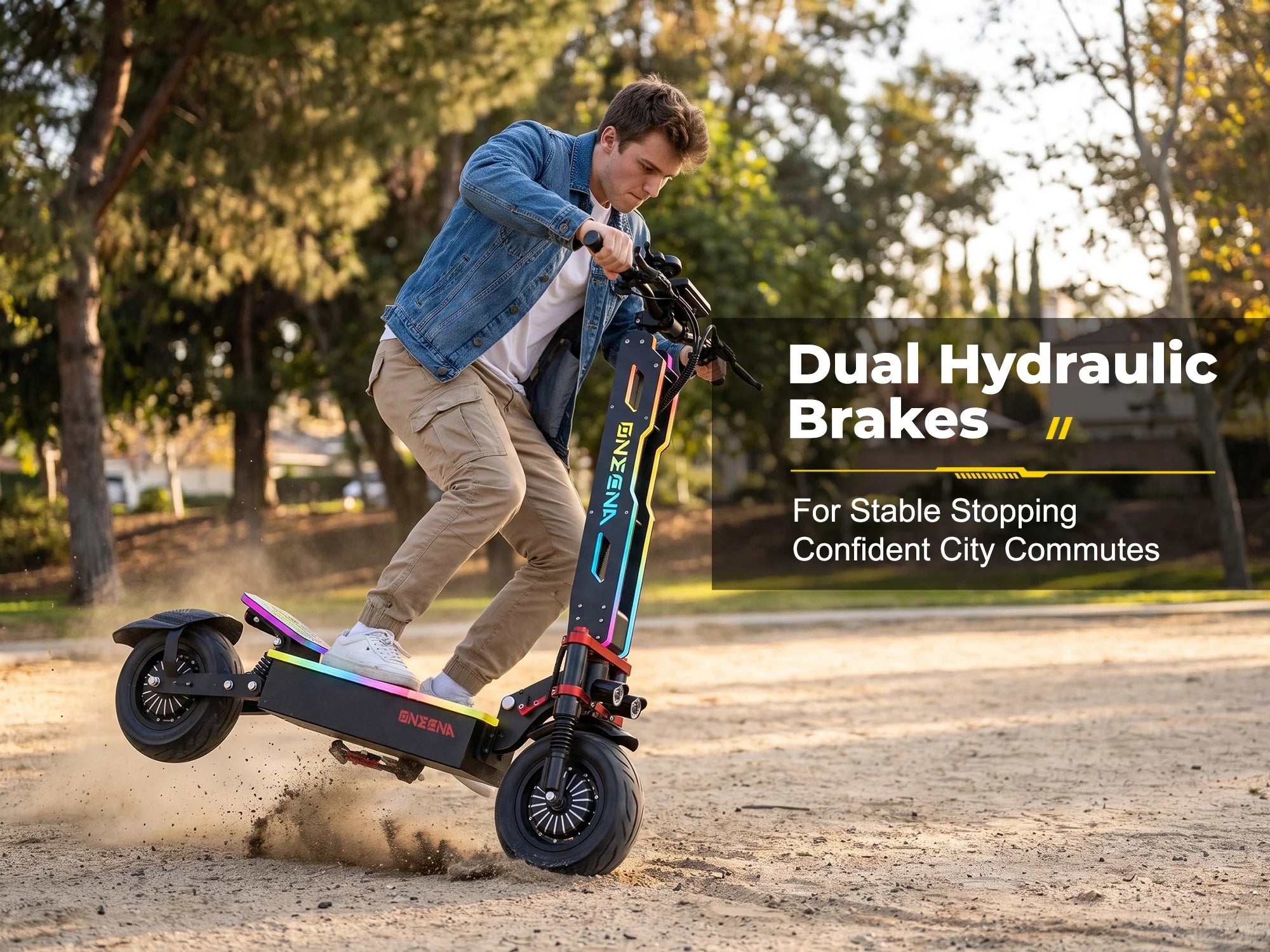
Drum brakes: adequate for low speeds, poor performance in wet conditions. Mechanical disc brakes: good stopping power, require periodic adjustment. Hydraulic disc brakes: best stopping power and wet-weather performance, self-adjusting. For speeds above 20 mph, hydraulic disc brakes are the appropriate choice.
5. Tire Type and Size
Solid tires: zero maintenance, but transmit all road vibration and have poor traction on loose surfaces. Pneumatic tires: better comfort and traction, require occasional inflation. 10-inch pneumatic tires are the practical minimum for mixed urban use; 11–12-inch tires provide meaningfully better performance on rough terrain.
6. IP Rating (Water Resistance)
IP54: splash-resistant, adequate for light rain. IP65: water-resistant, suitable for regular outdoor use including rain. IP67+: submersion-resistant, appropriate for wet climates. For daily commuters, IP65 is the minimum worth specifying.
Budget vs. Mid-Range vs. Performance: Side-by-Side Comparison
| Spec | Budget (<$400) | Mid-Range ($700–$1,200) | Performance ($1,200+) |
|---|---|---|---|
| Motor | 250–500W single | 1,000–3,000W dual | 5,000–7,000W+ dual |
| Top Speed | 15–20 mph | 30–45 mph | 45–60 mph |
| Real Range | 10–18 miles | 25–40 miles | 40–70 miles |
| Suspension | None or basic spring | Dual hydraulic | Full hydraulic |
| Brakes | Drum or basic disc | Hydraulic disc | Dual hydraulic disc |
| Tires | Solid or 8–10" pneumatic | 10–11" pneumatic | 11–12" off-road pneumatic |
| Weight | 20–30 lbs | 45–65 lbs | 65–90 lbs |
| Hill Climbing | Up to 10–15° | Up to 30–40° | Up to 45°+ |
| IP Rating | IP54 or unrated | IP65 | IP65–67 |
| Expected Lifespan | 1–2 years | 3–5 years | 4–6+ years |
| Cost per Year* | $150–$250 | $180–$300 | $200–$350 |
*Estimated purchase price divided by expected lifespan, excluding maintenance and repairs.
Which Type Is Right for You? Use Case Breakdown
📍 Flat Urban Commute, Under 8 Miles Round-Trip
Best fit: Mid-entry ($400–$700) with pneumatic tires and basic suspension.
Why: You don't need dual motors or 40-mile range. Spending more buys capability you won't use. Spending less risks reliability on daily use.
Watch out for: Solid tires on rough pavement — they make short commutes genuinely uncomfortable.
📍 Mixed Terrain, Hills, 10–20 Miles Round-Trip
Best fit: Mid-range ($800–$1,200) with dual motor and full suspension.
Why: Single-motor scooters will thermal throttle on sustained grades. Dual motors handle hills without stress and maintain consistent speed.
Watch out for: Weight — if you need to carry the scooter on transit, 55+ lbs becomes a real constraint.
📍 Recreational + Commuting Hybrid Use
Best fit: Mid-range to performance ($1,000–$1,500) with adjustable speed modes.
Why: You want a scooter that's legal and comfortable for daily commuting but can also deliver performance on private property or off-road trails on weekends.
Watch out for: State classification rules — scooters capable of 40+ mph may require registration in some states.
📍 Off-Road / Trail Riding
Best fit: Performance tier ($1,200+) with 11–12-inch off-road tires and dual hydraulic suspension.
Why: Off-road riding puts significantly more stress on motors, suspension, and tires than pavement use. Budget and mid-entry scooters are not designed for this use case and will fail prematurely.
Watch out for: Tire pressure management — off-road pneumatic tires require more frequent checks than road tires.
📍 Heavy Riders (200+ lbs)
Best fit: Mid-range or performance with a rated load capacity of 265+ lbs and dual motors.
Why: Rider weight directly affects range, hill-climbing ability, and motor thermal load. A scooter rated for 220 lbs ridden by a 200 lb rider is operating near its limit — choose a model with meaningful headroom above your actual weight.
Watch out for: Budget scooters often overstate their load ratings. Look for models with documented real-world testing at stated weight limits.
Hidden Costs That Change the Value Equation
The purchase price is only part of the total cost of owning an e scooter. These hidden costs frequently tip the value calculation in favor of spending more upfront:
Battery Replacement
Lithium batteries degrade over charge cycles. Budget scooters often use lower-quality cells that lose 20–30% capacity within 300–500 cycles (roughly 1–2 years of daily use). Replacement batteries for budget models can cost $150–$300 — a significant fraction of the original purchase price. Mid-range and performance scooters typically use higher-quality cells that maintain capacity longer and are more likely to have replacement batteries available from the manufacturer.
Tire Replacement and Maintenance
Pneumatic tires require occasional replacement (typically every 1,500–3,000 miles depending on terrain and riding style). Inner tube replacements on budget scooters with non-standard tire sizes can be difficult to source. Before buying, verify that replacement tires and tubes are readily available for the specific model.
Brake Maintenance
Mechanical disc brakes require periodic cable adjustment and pad replacement. Hydraulic disc brakes are largely self-adjusting but require occasional fluid bleeding. Budget scooters with drum brakes have lower maintenance costs but also lower performance — a trade-off that becomes more significant at higher speeds.
Repair Availability and Parts
One of the most overlooked value factors is parts availability. A $400 scooter from a brand with no U.S. service network and no available spare parts becomes a $400 paperweight when a controller fails. Before purchasing, verify that the manufacturer has a documented warranty process, available spare parts, and a support channel that actually responds.
Charging Costs
E scooter charging costs are minimal — typically $0.02–$0.08 per full charge depending on battery size and local electricity rates. This is rarely a meaningful factor in the value calculation, but it's worth noting that larger batteries cost proportionally more to charge.
Step-by-Step Buying Guide
Use this framework to narrow your options systematically rather than getting overwhelmed by spec sheets:
Step 1: Define Your Route
Map your actual commute or primary riding route. Note the round-trip distance, maximum grade (use Google Maps elevation profile), and surface type. This single step eliminates most of the wrong choices before you look at a single product listing.
Step 2: Set Your Real Budget
Your real budget is your purchase price plus estimated first-year maintenance and any accessories (helmet, lock, lights). A $500 scooter with $100 in accessories and $80 in first-year maintenance has a real first-year cost of $680 — which may overlap with a $700 mid-range model that needs nothing additional.
Step 3: Determine Your Non-Negotiables
Based on your route analysis, identify the specs you cannot compromise on. Common non-negotiables:
- Dual motor if your route has grades above 8%
- Pneumatic tires if your route includes rough pavement
- IP65 if you ride in rain or near the coast
- Under 35 lbs if you need to carry the scooter on transit
- 265+ lb load rating if you're a heavier rider
Step 4: Compare Within Your Tier
Once you've established your tier and non-negotiables, compare 3–5 models on: battery capacity (Wh), continuous motor wattage, suspension type, brake system, IP rating, and manufacturer warranty terms. Ignore advertised top speed and range as primary comparison metrics — use them only as rough indicators.
Step 5: Verify Parts and Support Availability
Before finalizing, confirm: Does the manufacturer have a U.S. warranty process? Are replacement batteries available? Are tires and tubes standard sizes? Is there a support channel with documented response times? This step alone eliminates a significant portion of the budget market.
Step 6: Check Legal Requirements for Your State
If the scooter you're considering has a top speed above 30 mph, verify your state's classification rules. In California, scooters capable of more than 30 mph require a driver's license and registration. In Texas, the threshold is 35 mph. This is a legal requirement, not a suggestion.
Frequently Asked Questions
What is the fastest cheapest e scooter available?
The answer depends on how you define "cheapest" — lowest purchase price, or lowest total cost of ownership. In terms of purchase price, scooters in the $600–$900 range from established manufacturers offer the best combination of speed (30–45 mph), range (25–40 miles real-world), and reliability. Below $400, top speeds rarely exceed 20 mph in sustained real-world use, and reliability drops significantly. Above $1,200, you're paying for performance headroom that most commuters don't need.
Is a $300 e scooter worth buying?
For very specific use cases — flat routes under 5 miles, light riders, smooth pavement, and access to charging at both ends — a $300 scooter can be adequate. For most riders with mixed terrain, hills, or routes over 8 miles round-trip, a $300 scooter will underperform and likely require replacement within 12–18 months. The total cost of ownership often makes a $700–$900 mid-range scooter more economical over a 3-year period.
How fast can a cheap e scooter actually go?
Budget scooters (under $400) typically achieve their advertised top speed only under ideal conditions: flat ground, full battery, light rider. In real-world use with a 170–180 lb rider on mixed terrain, expect 60–75% of the advertised speed. A scooter advertised at 20 mph will typically sustain 14–16 mph on a mixed urban route. Dual-motor mid-range scooters maintain their speed more consistently because the load is distributed between two motors.
What's the most important spec for value buyers?
Motor configuration (single vs. dual) has the highest impact on real-world performance for value buyers. Dual-motor scooters handle hills, maintain speed under load, and distribute thermal stress more effectively than single-motor designs. For riders on anything other than flat, smooth pavement, the jump from single to dual motor is the most impactful upgrade available at any price point.
How long do budget e scooters last?
Budget scooters (under $400) typically last 1–2 years with regular use before requiring significant repairs or battery replacement. Mid-range scooters ($700–$1,200) from established manufacturers typically last 3–5 years. Performance scooters ($1,200+) with quality components can last 5–7+ years with proper maintenance. The primary failure points are battery degradation, controller failure, and tire wear — all of which are more pronounced in budget models using lower-quality components.
Should I buy a single-motor or dual-motor e scooter for the best value?
For flat urban commutes under 8 miles, a single-motor scooter in the 500–800W range offers good value. For mixed terrain, hills, or routes over 10 miles, dual-motor scooters offer significantly better real-world performance and are worth the price premium. The dual-motor advantage is most pronounced on grades above 8% and for riders over 180 lbs, where single-motor scooters frequently thermal throttle under sustained load.
What hidden costs should I budget for when buying an e scooter?
Plan for: a quality helmet ($50–$150), a secure lock ($30–$80), front and rear lights if not included ($20–$50), and first-year maintenance (tire inflation, brake adjustment, approximately $30–60 in consumables). For budget scooters, also budget for potential battery replacement within 18–24 months ($150–$300). These costs are often overlooked in initial purchase comparisons but significantly affect the total value equation.
Share:
E Scooter Speed Limit: How Fast Can You Legally Ride?
How to Make an E Scooter Faster: What Really Improves Performance?