




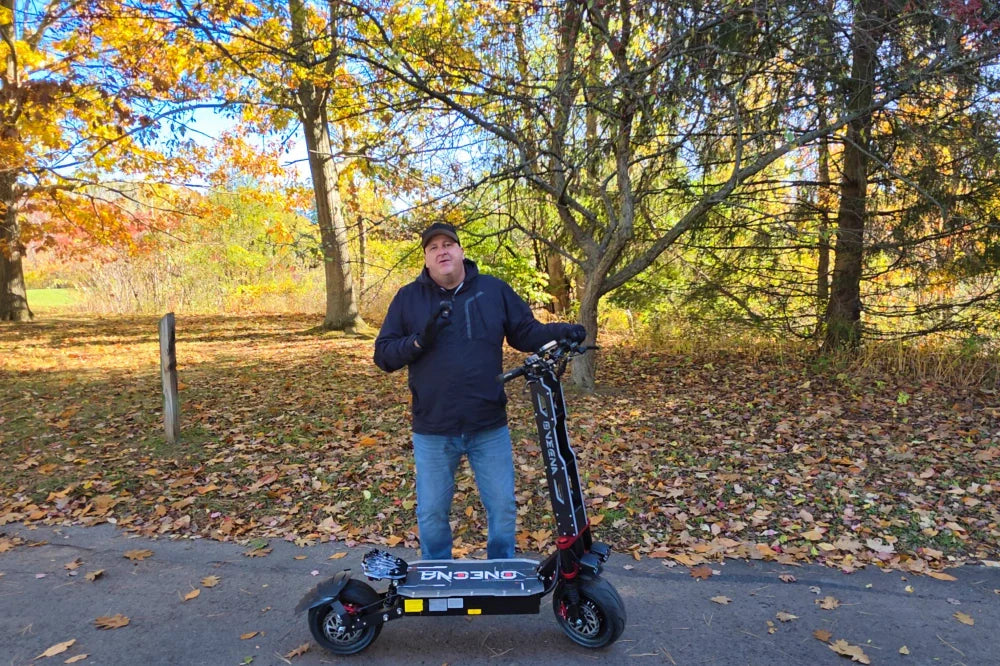
Table of Contents
- What Makes an Electric Scooter Truly Off-Road Capable?
- GT9 Overview: The Case for Calling It Ultimate
- Motor and Power: 7000W Peak and What It Actually Means
- Tires and Suspension: The Off-Road Foundation
- Range and Battery: 75 Miles Claimed, What’s Real?
- Braking and Safety at High Speed
- Use Cases: Where the GT9 Excels and Where It Doesn’t
- Pros and Cons
- Who Should Buy the GT9?
- How It Compares to Other Off-Road Scooters
- FAQ
What Makes an Electric Scooter Truly Off-Road Capable?
Why the GT9 is the ultimate off-road electric scooter comes down to a specific combination of engineering choices that most scooters — even expensive ones — don’t get right simultaneously. Off-road capability isn’t a single feature. It’s the intersection of motor torque, tire size and tread pattern, suspension travel, braking performance, and structural rigidity. A scooter can have a powerful motor but inadequate tires and become dangerous on loose terrain. It can have great tires but poor suspension and transmit every impact directly to the rider. Genuine off-road capability requires all of these systems to work together.
Most electric scooters marketed as “off-road” are really urban scooters with slightly larger tires. They handle light gravel and smooth dirt paths, but they struggle on anything more demanding — steep grades, loose rock, wet roots, deep gravel, or sustained rough terrain. The distinction matters because riders who buy an “off-road” scooter expecting genuine trail capability and get an overpowered commuter instead are likely to be disappointed, or worse, find themselves in a dangerous situation on terrain the scooter can’t handle safely.
This guide examines what genuine off-road capability looks like in practice, how the GT9 delivers it, and who this scooter is actually built for.
GT9 Overview: The Case for Calling It Ultimate

The GT9 sits at the top of ONECNA’s lineup, and the specs justify that position. But specs alone don’t tell the full story. What matters is how those specs translate into real-world riding on the terrain that actually challenges a scooter: steep grades, loose surfaces, wet conditions, and sustained rough terrain where lesser scooters either slow to a crawl or become unstable.
Key specifications at a glance:
- Motor: Dual motor, 3500W combined rated (7000W peak)
- Top speed: 62 mph (100 km/h)
- Battery: 72V 35Ah (2520Wh)
- Advertised range: Up to 75 miles (120 km)
- Tires: 12-inch pneumatic off-road
- Suspension: Dual (front + rear)
- Brakes: Dual hydraulic disc
- Weight: ~88 lbs (40 kg)
- Max load: 330 lbs (150 kg)
- IP rating: IP54 (splash resistant)
The combination of 7000W peak power, 12-inch tires, dual hydraulic brakes, and a 2520Wh battery puts the GT9 in a category that very few scooters occupy. The question isn’t whether it’s powerful — it clearly is — but whether that power is usable and controllable on the terrain it’s designed for.
Motor and Power: 7000W Peak and What It Actually Means
The GT9’s dual-motor system produces 3500W combined at rated output and 7000W at peak. To put that in context: most high-performance off-road scooters in this price range produce 3000–5000W peak. The GT9’s 7000W peak is at the upper end of what’s available in the consumer scooter market.
Peak wattage is a burst figure — it’s the maximum power the motors can produce for short periods, typically during hard acceleration or when climbing steep grades. Sustained (rated) output is what the motors can maintain continuously. The GT9’s 3500W sustained output is the more practically relevant figure for off-road riding, where you’re often maintaining power through extended climbs rather than just accelerating from a stop.
Why Dual Motors Matter for Off-Road
Single-motor scooters drive only one wheel. On loose or uneven terrain, this creates a traction problem: the driven wheel can spin out while the undriven wheel provides no power. Dual-motor setups drive both wheels simultaneously, which distributes traction across both contact patches. On gravel, dirt, wet grass, or loose rock, this makes a significant practical difference — the scooter maintains forward momentum where a single-motor setup would spin out or stall.
The GT9’s dual motors also provide better hill-climbing capability. On grades above 30%, single-motor scooters typically struggle to maintain speed. The GT9’s dual-motor system handles grades up to approximately 45% — steep enough to cover most real-world trail and mountain road scenarios.
Torque Delivery and Control
Raw power is only useful if it’s controllable. The GT9 offers multiple riding modes (eco, standard, sport, turbo) that adjust throttle response and power delivery. For off-road riding on technical terrain, using a lower power mode provides more precise throttle control — you can modulate power more accurately when navigating loose surfaces or tight turns. Turbo mode is best reserved for open terrain where maximum acceleration is safe to use.
Tires and Suspension: The Off-Road Foundation

12-Inch Off-Road Tires
Tire size is one of the most important factors in off-road capability, and it’s one of the most commonly underspecified features in scooters marketed as off-road capable. Most “off-road” scooters use 10-inch tires. The GT9’s 12-inch tires provide three meaningful advantages:
- Larger contact patch: More tire surface in contact with the ground means better traction on loose surfaces
- Greater air volume: More air in the tire absorbs impacts better and provides a more forgiving ride on rough terrain
- Better obstacle clearance: Larger diameter tires roll over rocks, roots, and ruts more easily than smaller tires
- Deeper tread: Off-road tread patterns channel mud and loose material away from the contact patch, maintaining grip where smooth tires would slip
The practical difference between 10-inch and 12-inch off-road tires is noticeable on challenging terrain. The larger tires maintain traction and stability on surfaces where smaller tires would require the rider to slow significantly or dismount.
Dual Suspension System
The GT9 uses a dual suspension system — independent front and rear suspension — rather than the front-only suspension found on most scooters in this class. This matters for off-road riding in two ways:
First, rear suspension absorbs impacts from the rear wheel independently of the front. On rough terrain, the rear wheel frequently hits obstacles that the front wheel has already cleared — without rear suspension, these impacts are transmitted directly to the deck and the rider. With rear suspension, the rear wheel can move independently, absorbing the impact before it reaches the rider.
Second, dual suspension keeps both wheels in contact with the ground more consistently on uneven terrain. When a wheel loses contact with the ground, it loses traction. Suspension that allows each wheel to follow the terrain independently maintains traction more effectively than a rigid setup where one wheel lifting means the other bears all the load.
The GT9’s suspension travel is sufficient for moderate off-road use — trail riding, gravel roads, packed dirt, and light single-track. It’s not designed for extreme downhill mountain biking-style terrain, but for the vast majority of off-road electric scooter use cases, it’s more than adequate.
Range and Battery: 75 Miles Claimed, What’s Real?
The GT9’s 75-mile advertised range is measured under optimal conditions: flat road, light rider, moderate speed, full battery, moderate temperature. Real-world off-road range will be lower — sometimes significantly lower — because off-road riding is more demanding than flat pavement riding in almost every way.
Real-World Off-Road Range Estimates
- Moderate trail riding (packed dirt, light gravel, 170 lb rider, 20–25 mph): 40–50 miles
- Challenging terrain (steep grades, loose surfaces, 170 lb rider, mixed speeds): 28–38 miles
- High-speed road riding (40+ mph sustained, 170 lb rider): 30–40 miles
- Cold weather (below 50°F) moderate trail riding: 32–42 miles
Even at the lower end of these estimates, the GT9’s 2520Wh battery provides more range than most riders will need for a single off-road session. The larger battery also means the range penalty from cold weather, heavier riders, or aggressive riding is proportionally less impactful than on smaller-battery scooters.
Battery Management
The GT9’s battery management system (BMS) protects the battery from overcharge, over-discharge, and thermal extremes. For off-road use where the battery is working harder than in urban commuting, a robust BMS is important for long-term battery health. Avoid charging to 100% for daily use — charging to 80–90% and not discharging below 15–20% extends battery longevity significantly.
Braking and Safety at High Speed
Off-road riding at speed requires braking systems that perform consistently on surfaces with variable grip. The GT9 uses dual hydraulic disc brakes — a meaningful upgrade over the mechanical disc brakes found on most scooters in this class.
Hydraulic vs. Mechanical Disc Brakes
Mechanical disc brakes use a cable to actuate the caliper. Cable stretch, contamination, and wear reduce braking performance over time and require regular adjustment. Hydraulic disc brakes use fluid pressure to actuate the caliper — they provide more consistent braking force, require less hand effort, and are more resistant to performance degradation from contamination and wear.
For off-road riding where braking surfaces may be wet, muddy, or contaminated with debris, hydraulic brakes maintain more consistent performance than mechanical alternatives. At the GT9’s top speed of 62 mph, reliable braking is not optional — it’s the difference between a controlled stop and a crash.
IP54 Water Resistance
The GT9’s IP54 rating means it’s protected against dust and water splashing from any direction. This is adequate for riding in light rain and through puddles, but not for submersion or riding through deep water. For off-road use in wet conditions, IP54 provides reasonable protection for the electrical components. Avoid riding through standing water deeper than a few inches, and dry the scooter after wet rides before storing or charging.
Use Cases: Where the GT9 Excels and Where It Doesn’t
Where the GT9 Excels
- Gravel and packed dirt trails: The 12-inch tires and dual suspension handle these surfaces confidently at speeds that would be uncomfortable or unsafe on smaller-tired scooters
- Mountain roads and steep grades: The dual-motor system maintains speed on grades up to ~45%, covering most real-world mountain road scenarios
- Mixed terrain commuting: Riders who commute on a combination of pavement, gravel, and unpaved paths will find the GT9 handles all of these without requiring speed adjustments
- Heavier riders: The 330 lb max load and powerful motors mean heavier riders (200–280 lbs) experience less performance degradation than on lower-powered scooters
- Long-distance off-road riding: The 2520Wh battery provides enough range for extended off-road sessions without mid-ride charging anxiety
- Night riding: The GT9’s lighting system — including the ambient RGB system and angel-eye headlights — provides good visibility for night riding on trails and roads
Where the GT9 Has Limitations
- Portability: At ~88 lbs, the GT9 is not a scooter you carry up stairs or onto public transit. It’s a point-to-point vehicle, not a last-mile solution
- Extreme technical terrain: The GT9 is not designed for downhill mountain biking-style terrain with large drops, extreme rock gardens, or deep mud. It’s a high-performance all-terrain scooter, not a purpose-built off-road machine
- Urban maneuverability: The GT9’s size and weight make it less nimble in tight urban environments than lighter commuter scooters
- Charging time: The large battery takes 10–12 hours to charge with the standard charger. For daily use, overnight charging is the practical approach
- Legal restrictions: At 62 mph top speed, the GT9 exceeds legal limits for electric scooters in most jurisdictions. Check local regulations before riding on public roads
Pros and Cons
Pros
- 7000W peak dual-motor system provides genuine off-road traction and hill-climbing capability
- 12-inch pneumatic off-road tires are among the largest available on consumer electric scooters
- Dual suspension (front + rear) absorbs impacts effectively on rough terrain
- Dual hydraulic disc brakes provide consistent stopping power in wet and contaminated conditions
- 2520Wh battery delivers 40–50 miles of real-world off-road range
- 330 lb max load accommodates heavier riders without significant performance penalty
- IP54 water resistance handles light rain and wet trail conditions
- Multiple riding modes allow power delivery to be matched to terrain and rider preference
- RGB ambient lighting and angel-eye headlights provide good visibility for night riding
Cons
- ~88 lbs makes the GT9 one of the heavier scooters in its class — not portable in any meaningful sense
- 10–12 hour charge time with standard charger requires overnight charging for daily use
- Top speed of 62 mph exceeds legal limits in most jurisdictions — requires responsible use
- Higher price point than mid-range off-road scooters — the GT9 is a premium product
- Not suitable for extreme technical terrain (large drops, deep mud, extreme rock gardens)
- Requires more storage space than compact commuter scooters
Who Should Buy the GT9?
The GT9 is the right scooter for a specific type of rider. It’s not the right choice for everyone, and being honest about that is more useful than overselling its capabilities.
The GT9 is a strong fit if you:
- Regularly ride on gravel, packed dirt, mountain roads, or mixed terrain where a commuter scooter would struggle
- Need a scooter that handles steep grades (above 20%) without significant speed loss
- Are a heavier rider (200–280 lbs) who has found lighter scooters underperform under your weight
- Want 40+ miles of real-world off-road range without mid-session charging
- Ride in conditions where hydraulic brakes and dual suspension are genuinely useful rather than just impressive on paper
- Have secure storage for an 88 lb scooter and don’t need to carry it
- Are comfortable with a premium price point for a scooter that will last and perform over time
The GT9 is probably not the right fit if you:
- Primarily commute on smooth urban pavement — the GT8 PRO or GT7 are better matched to that use case
- Need to carry the scooter regularly — 88 lbs is not manageable for most people
- Are a newer rider who hasn’t developed the skills to manage a 62 mph scooter safely
- Have a budget constraint — the GT9 is a premium product and there are capable off-road scooters at lower price points
- Ride exclusively on legal public roads where the GT9’s top speed creates regulatory issues
How It Compares to Other Off-Road Scooters
The GT9 doesn’t exist in a vacuum. Understanding how it compares to other options in the high-performance off-road scooter market helps clarify whether it’s the right choice for your specific needs.
GT9 vs. GT8 PRO (Within the ONECNA Lineup)
The GT8 PRO is the natural comparison point within the same lineup. The GT8 PRO produces 5600W peak (vs. 7000W for the GT9), uses 11-inch tires (vs. 12-inch), and has a 1800Wh battery (vs. 2520Wh). In practice, the GT8 PRO handles moderate off-road terrain — gravel, packed dirt, light trails — very capably. The GT9’s advantages become meaningful on more challenging terrain: steeper grades, looser surfaces, and situations where the extra power headroom and larger tires make a real difference. For riders whose off-road use is moderate, the GT8 PRO may be the better value. For riders who regularly push into more demanding terrain, the GT9’s additional capability justifies the premium.
GT9 vs. Generic High-Power Off-Road Scooters
The market for high-power off-road scooters includes many options from brands with varying levels of quality control, customer support, and component sourcing. When comparing the GT9 to generic alternatives at similar power levels, the key differentiators are build quality consistency, hydraulic brake quality, suspension tuning, and after-sale support. A scooter with similar specs but lower-quality hydraulic components or inconsistent suspension tuning will perform differently in real-world conditions than the spec sheet suggests.
| Feature | GT9 | GT8 PRO | Typical 6000W Generic |
|---|---|---|---|
| Peak Power | 7000W | 5600W | 6000W |
| Tire Size | 12-inch off-road | 11-inch off-road | 10–11-inch |
| Suspension | Dual (front + rear) | Dual (front + rear) | Dual (varies) |
| Brakes | Dual hydraulic disc | Dual hydraulic disc | Mechanical or hydraulic |
| Battery | 2520Wh | 1800Wh | 1200–1800Wh (varies) |
| Max Load | 330 lbs | 265 lbs | 220–265 lbs (varies) |
| Weight | ~88 lbs | ~75 lbs | 70–90 lbs |
FAQ — GT9 Off-Road Electric Scooter
Is the GT9 actually good for off-road riding, or is it just a powerful commuter?
The GT9 is genuinely capable off-road, not just a powerful commuter with marketing language. The combination of 12-inch pneumatic off-road tires, dual suspension, dual hydraulic brakes, and 7000W peak dual motors addresses the actual requirements of off-road riding rather than just maximizing top speed. That said, it’s an all-terrain scooter, not a purpose-built trail machine — it handles gravel, packed dirt, mountain roads, and moderate single-track well, but it’s not designed for extreme downhill or deep mud conditions.
How does the GT9 handle steep hills?
The GT9’s dual-motor system handles grades up to approximately 45% without significant speed loss for a 170 lb rider. For heavier riders (220–280 lbs), expect the effective grade limit to be somewhat lower — approximately 35–40%. This covers the vast majority of real-world hill-climbing scenarios, including most mountain roads and trail grades.
What is the real-world range of the GT9 off-road?
On moderate off-road terrain (packed dirt, light gravel, mixed grades) at 20–25 mph with a 170 lb rider, expect 40–50 miles of real-world range. On more challenging terrain with steeper grades and more aggressive riding, range drops to 28–38 miles. At high speeds on flat pavement, range is 30–40 miles. The 2520Wh battery provides enough capacity that even at the lower end of these estimates, most off-road sessions won’t require mid-ride charging.
Can the GT9 handle rain and wet trails?
The GT9’s IP54 rating provides protection against water splashing from any direction, making it suitable for riding in light rain and on wet trails. The hydraulic disc brakes maintain more consistent performance in wet conditions than mechanical alternatives. Avoid riding through standing water deeper than a few inches, and dry the scooter after wet rides. The 12-inch off-road tires provide better wet-surface traction than smooth tires, but wet loose surfaces (wet clay, wet leaves) still require reduced speed and increased caution.
How does the GT9 compare to the GT8 PRO for off-road use?
For moderate off-road use — gravel roads, packed dirt, light trails, grades up to 25% — the GT8 PRO is capable and costs less than the GT9. The GT9’s advantages become meaningful on more demanding terrain: steeper grades (above 25%), looser surfaces, heavier riders, and situations where the extra 1400W of peak power and larger 12-inch tires make a practical difference. If your off-road riding is primarily moderate, the GT8 PRO may be the better value. If you regularly push into more challenging terrain, the GT9’s additional capability is worth the premium.
Is the GT9 legal to ride on public roads?
This depends entirely on your jurisdiction. The GT9’s 62 mph top speed exceeds legal limits for electric scooters in most US states and many other countries. In most jurisdictions, electric scooters are limited to 15–25 mph on public roads. The GT9 can be ridden in lower speed modes that comply with local limits, but the scooter itself is capable of speeds that are illegal in most public road contexts. Check your local regulations before riding on public roads, and use the GT9’s speed modes to stay within legal limits where applicable.
What maintenance does the GT9 require?
The GT9 requires regular tire pressure checks (pneumatic tires lose pressure over time), periodic brake fluid checks and replacement for the hydraulic system, chain or belt inspection if applicable, and general cleaning after off-road use to prevent debris buildup in the suspension and brake components. The hydraulic brake system requires less frequent adjustment than mechanical brakes but does require periodic fluid replacement — typically every 1–2 years depending on use. Battery maintenance follows standard lithium-ion best practices: avoid full discharge, don’t charge to 100% for daily use, and store at 50–60% charge during extended non-use periods.
How heavy is the GT9 and can I transport it?
The GT9 weighs approximately 88 lbs (40 kg). It folds for storage and transport, but at 88 lbs it requires two people to lift safely or a vehicle with a ramp or lift. It fits in most SUV cargo areas and truck beds. It is not practical to carry up stairs or onto public transit. If portability is a priority, the GT7 (~38 lbs) or GT8 PRO (~75 lbs) are more manageable, though they sacrifice off-road capability in exchange.
Share:
Comparing the Speed and Range of GT7, GT8 PRO, and GT9
Choosing Between High-Performance and Commuter E-Scooters