




Table of Contents
- Why Maintaining Your Electric Scooter for Longevity Matters
- Battery Care: The #1 Factor in Electric Scooter Longevity
- Tire Maintenance by Model
- Brake System Inspection & Upkeep
- Motor & Drivetrain Health
- Suspension & Frame Checks
- Seasonal Storage & Weather Protection
- ONECNA Model Spec Comparison
- Recommended Maintenance Schedule
- FAQ
Why Maintaining Your Electric Scooter for Longevity Matters
Maintaining your electric scooter for longevity is the single most cost-effective decision any rider can make. A well-serviced scooter doesn't just last longer — it performs better, stays safer, and retains resale value. Whether you ride a commuter model like the ONECNA T3 or push the limits on an off-road flagship like the GT9, consistent upkeep separates a two-year machine from a five-year one.
Electric scooters have fewer moving parts than gas-powered vehicles, but that doesn't mean they're maintenance-free. Batteries degrade, tires wear, brake pads thin, and connectors corrode. The good news: most of these issues are entirely preventable with a simple routine.
This guide is built specifically around ONECNA's electric scooter lineup — from the entry-level T2 to the flagship GT9 — so every tip is grounded in real specs, real components, and real riding conditions.

Battery Care: The #1 Factor in Electric Scooter Longevity
The battery is the most expensive component on any e-scooter and the primary determinant of long-term performance. Lithium-ion cells degrade with every charge cycle, but the rate of degradation is almost entirely within your control.
Key Battery Maintenance Rules
- Never fully discharge. Keep charge above 20% whenever possible. Deep discharges accelerate cell degradation.
- Avoid 100% charge for storage. Store at 50–80% if the scooter won't be ridden for more than a week.
- Use the OEM charger. ONECNA GT8 PRO uses a 67.2V 3A charger with a 6–8 hour charge window. Third-party chargers with mismatched voltage can damage the BMS.
- Charge at room temperature. Charging below 0°C (32°F) or above 40°C (104°F) stresses cells significantly.
- Don't leave on charge overnight repeatedly. Once the BMS cuts off, continued trickle input generates heat.
Battery Specs by Model
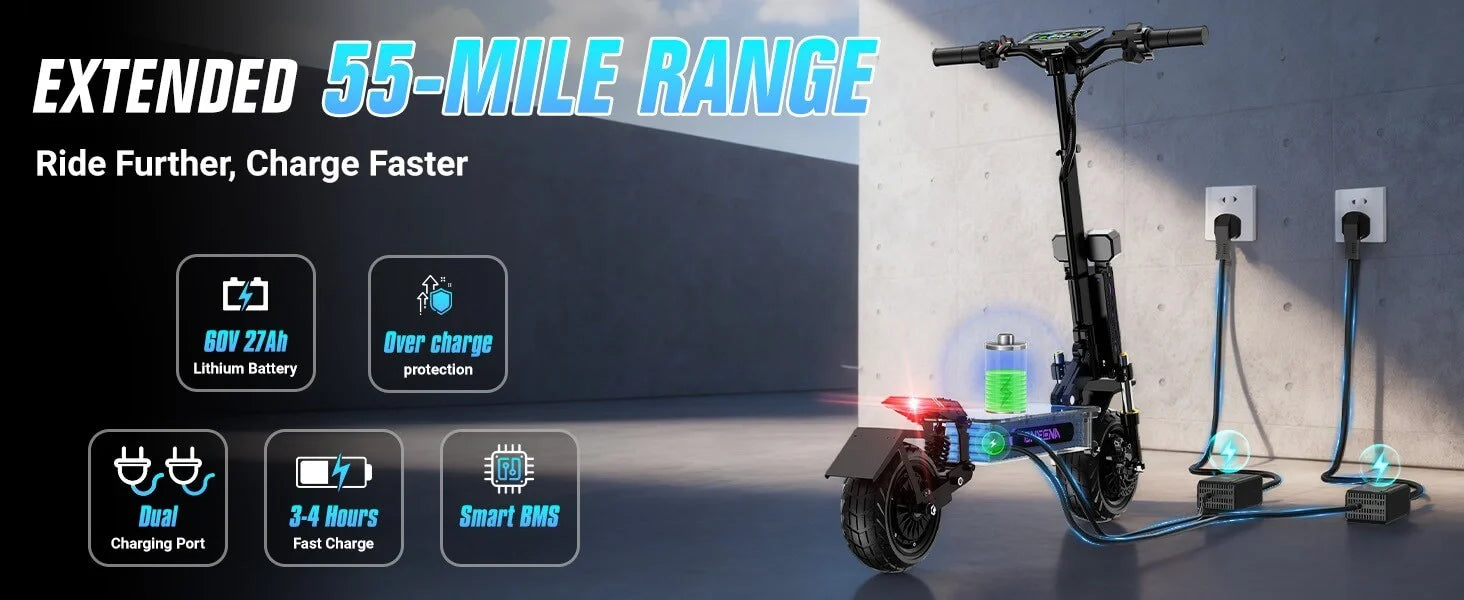
- GT7: 60V 27Ah — ~55-mile range
- GT8 PRO: 60V 33Ah — ~60-mile range
- GT9: 60V 38Ah — ~70-mile range
- T3: 48V 18.2Ah — ~40-mile range
- T4: 52V 25Ah — ~50-mile range
Larger packs (like the GT9's 38Ah) are more tolerant of partial cycles, but the same rules apply across all models.
Tire Maintenance by Model
Tire condition directly affects range, handling, and safety. Under-inflated tires increase rolling resistance (reducing range by up to 15%) and accelerate sidewall wear. Over-inflated tires reduce grip and increase puncture risk on rough terrain.
Tire Size Reference
- GT7 / GT8 PRO: 11" pneumatic off-road tires
- GT9: 12" pneumatic tires — larger contact patch, better stability at 55 MPH
- T2 / T3 / A2: 10" tires
- T4: 10.5" tires
Tire Maintenance Checklist
- Check pressure before every ride (or at minimum weekly)
- Inspect tread depth monthly — replace when tread is visibly worn flat
- Look for sidewall cracking, especially after winter storage
- After off-road use on the GT7/GT8 PRO/GT9, remove embedded debris from the tread
- Carry a portable pump and tire sealant for longer rides
Brake System Inspection & Upkeep
All ONECNA GT-series scooters use a Hydraulic + EABS (Electronic Anti-lock Braking System) — a dual-layer system that provides both mechanical stopping power and electronic modulation. This is one of the most capable brake setups in the consumer e-scooter market, but it requires periodic attention.
Hydraulic Brake Maintenance
- Check brake fluid level every 3 months. Low fluid = reduced lever feel and longer stopping distances.
- Bleed the brakes annually or if you notice a spongy lever feel.
- Inspect brake pads every 500 miles. Replace when pad material is under 1.5mm.
- Check rotor for warping — a pulsing sensation when braking is a telltale sign.
EABS System
- The EABS engages automatically during hard braking — no user adjustment needed.
- If the display shows a brake error code, inspect the wheel speed sensor and wiring harness before assuming motor failure.
For the commuter series (T2, T3, A2, T4), brake systems are simpler but still require pad inspection every 300–500 miles given the lighter build and urban stop-start riding patterns.
Motor & Drivetrain Health
ONECNA's GT series runs dual-motor configurations with Single/Dual drive mode switching. The motors themselves are brushless and largely maintenance-free, but the surrounding components need attention.
What to Check
- Motor connectors: Inspect for corrosion or looseness every 6 months. A loose phase wire causes stuttering acceleration.
- Wheel bearings: Spin each wheel by hand — any grinding or roughness means the bearing needs replacement.
- Drive mode switching: Test Single ↔ Dual mode transitions periodically. Failure to switch cleanly can indicate a controller issue.
- Heat management: After sustained high-speed runs (especially in Dual mode on the GT9 at 55 MPH), allow the motors to cool before the next ride.
Suspension & Frame Checks
All GT-series models feature hydraulic suspension — a significant upgrade over spring-only systems found on budget scooters. Hydraulic dampers absorb impact more consistently but can develop oil leaks over time.
Suspension Maintenance
- Inspect fork seals and rear shock body for oil weeping every 3 months
- Check preload adjustment — heavier riders (approaching the 550 LBS max load on GT models) should increase preload
- Tighten all stem and deck bolts to spec after the first 50 miles (new scooter settling) and every 6 months thereafter
- If you've replaced rear shocks, ONECNA offers model-specific rear shock absorbers for GT7, GT8 PRO, and GT9
Frame Inspection
- Check the folding mechanism latch monthly — a loose latch is a safety hazard at speed
- Inspect the aluminum frame for stress cracks around weld points, especially after impacts
- Apply a light coat of silicone spray to exposed metal joints to prevent corrosion
Seasonal Storage & Weather Protection
If you're in a region with harsh winters, proper storage is as important as in-season maintenance.
Winter Storage Protocol
- Charge battery to 60–70% before storage
- Store indoors at 10–25°C (50–77°F) — never in an unheated garage below freezing
- Top up charge to 60% every 4–6 weeks during storage
- Cover the scooter to prevent dust accumulation on connectors
- Lubricate the folding joint and brake levers before storage
Wet Weather Riding
- ONECNA GT-series scooters have water resistance, but are not waterproof — avoid deep puddles and standing water
- After wet rides, dry the deck, connectors, and display with a cloth before charging
- Never pressure-wash — direct water ingress into the controller or battery enclosure causes irreversible damage
ONECNA Model Spec Comparison
Understanding your scooter's specs helps you tailor maintenance intervals. Higher-power, higher-speed models demand more frequent checks on brakes, tires, and motor connectors. Browse the full ONECNA electric scooter collection to compare models.
GT Series
| Specification | GT7 | GT8 PRO | GT9 |
|---|---|---|---|
| Peak Power | 5600W | 6000W | 7000W |
| Battery | 60V 27Ah | 60V 33Ah | 60V 38Ah |
| Top Speed | 45 MPH | 50 MPH | 55 MPH |
| Range | 55 Miles | 60 Miles | 70 Miles |
| Climbing Angle | 40° | 40° | 45° |
| Tire Size | 11" | 11" | 12" |
| Max Load | 550 LBS | 550 LBS | 550 LBS |
| Suspension | Hydraulic | Hydraulic | Hydraulic |
| Brake System | Hydraulic + EABS | Hydraulic + EABS | Hydraulic + EABS |
| Drive Mode | Single / Dual | Single / Dual | Single / Dual |
| Positioning | Best Value Off-Road | Balanced Flagship | Ultimate Flagship |
Commuter Series
| Specification | T2 | T3 | A2 | T4 |
|---|---|---|---|---|
| Peak Power | 1200W | 2800W | 3000W | 3500W |
| Battery | 48V 13.5Ah | 48V 18.2Ah | 48V 20Ah | 52V 25Ah |
| Top Speed | 28 MPH | 28 MPH | 35 MPH | 40 MPH |
| Range | 30 Miles | 40 Miles | 45 Miles | 50 Miles |
| Max Load | 265 LBS | 265 LBS | 265 LBS | 330 LBS |
| Climbing Angle | 20° | 25° | 30° | 40° |
| Tire Size | 10" | 10" | 10" | 10.5" |
| Best For | Budget Commuters | Daily Commuters | Dual-Motor Commuters | Premium Commuters |
Recommended Maintenance Schedule
| Interval | Task |
|---|---|
| Before every ride | Check tire pressure, test brakes, inspect folding latch |
| Weekly | Wipe down frame, check battery charge level, inspect tires visually |
| Monthly | Tighten all bolts, inspect brake pads, check suspension for leaks |
| Every 3 months | Check brake fluid, inspect motor connectors, lubricate joints |
| Every 6 months | Full brake bleed (GT series), wheel bearing check, frame weld inspection |
| Annually | Battery capacity test, full drivetrain inspection, replace worn pads/tires |
FAQ — Maintaining Your Electric Scooter for Longevity
How often should I charge my electric scooter battery?
Charge after each ride if the battery drops below 30%. For storage, maintain 50–70% charge and top up every 4–6 weeks. Avoid leaving the battery at 0% or 100% for extended periods.
How long do ONECNA electric scooters last?
With proper maintenance, ONECNA GT-series scooters are built to last 5+ years. Battery packs typically retain 80% capacity after 500–800 charge cycles. Commuter models like the T3 and T4, with lighter use patterns, can exceed this with consistent care.
Can I ride my ONECNA scooter in the rain?
Light rain is generally manageable, but ONECNA scooters are water-resistant, not waterproof. Avoid puddles, standing water, and heavy rain. Always dry connectors and the display before charging after a wet ride.
How do I know when to replace the brake pads?
Replace hydraulic brake pads when the friction material is under 1.5mm thick, or if you notice increased lever travel, reduced stopping power, or a metallic grinding sound. On GT-series models, inspect every 500 miles.
What's the difference in maintenance between the GT series and commuter series?
GT-series scooters (GT7, GT8 PRO, GT9) require more frequent brake and suspension checks due to higher speeds (45–55 MPH) and off-road use. Commuter models (T2, T3, A2, T4) have simpler brake systems and lighter frames, but still need regular tire and pad inspections given urban stop-start riding.
Where can I buy replacement parts for ONECNA scooters?
ONECNA sells model-specific accessories and replacement parts directly. You can find rear shock absorbers for GT7, GT8 PRO, and GT9, kickstands, and other components in the accessories section of the store.
Is it worth servicing an electric scooter myself?
Basic maintenance — tire pressure, bolt tightening, cleaning, and visual inspections — is well within DIY territory. Hydraulic brake bleeding and motor connector work are best left to someone with mechanical experience. ONECNA provides assembly and maintenance video resources with select products.
Share:
ONECNA Launches the GT7: Full Off-Road Capability at the Most Accessible Price in the GT Series
Best Practices for Safe Night Riding on Electric Scooters
1 comment
Squeaky turning noise . And get stuck turning sometimes