




Table of Contents
- What “Foldable” Actually Means on an Electric Scooter
- Why Folding and Portability Matter More Than Most Riders Expect
- How to Fold Your Electric Scooter: Step-by-Step
- How to Carry a Folded Electric Scooter Efficiently
- Taking Your Scooter on Public Transit
- Storage Solutions at Home, Work, and in Vehicles
- When Portability Should Drive Your Buying Decision
- Folded Dimensions & Weight: ONECNA Model Comparison
- FAQ
What “Foldable” Actually Means on an Electric Scooter
Knowing how to fold and carry your electric scooter efficiently starts with understanding what the folding mechanism actually does — and what it doesn’t. Nearly every adult electric scooter on the market today is described as “foldable,” but the word covers a wide range of designs, fold quality, and resulting portability. A scooter that folds in 3 seconds and fits in a car trunk is a fundamentally different tool from one that technically folds but still weighs 77 lbs and requires two people to lift.
The Three Types of Folding Mechanisms
- Stem-fold (most common): The handlebar stem folds down toward the deck, reducing the scooter’s height by roughly 50%. This is the standard design on commuter scooters. It’s fast (under 5 seconds), requires no tools, and is generally reliable with regular maintenance.
- Stem + handlebar fold: The stem folds down and the handlebars fold inward, reducing both height and width. This design is more compact when folded and fits more easily into tight spaces like car trunks or office corners.
- Full-frame fold: Less common on consumer scooters, this design folds the entire frame at a midpoint, creating a more compact package. It’s typically found on ultra-portable models where minimum folded size is the primary design goal.
What Folding Doesn’t Change
Folding reduces height and sometimes width, but it doesn’t change weight. A 55 lb scooter is still 55 lbs when folded. This is the most important thing to understand before assuming a “foldable” scooter is automatically portable for your specific situation.
Why Folding and Portability Matter More Than Most Riders Expect
Most riders think about folding as a parking feature — fold it up, lean it against the wall, done. But for anyone using a scooter as part of a multi-modal commute (scooter + subway, scooter + bus, scooter + car), portability becomes a daily operational requirement, not a nice-to-have.
The Last-Mile Problem
Electric scooters solve the “last mile” problem — the gap between a transit stop and your actual destination. But that solution only works if you can bring the scooter with you on the transit leg. A scooter that’s too heavy to carry up subway stairs, or too large to fit in a bus luggage area, breaks the chain. Portability determines whether your scooter is a true commuting tool or just a recreational vehicle.
Storage at the Destination
Most offices, cafes, and public spaces don’t have scooter parking. A folded scooter that fits under a desk or in a coat closet is one you can bring inside. One that doesn’t fold compactly enough gets left outside — exposed to weather and theft risk.
Vehicle Transport
For riders who drive part of their commute, the scooter needs to fit in the car. A folded commuter scooter typically fits in a sedan trunk. A heavier off-road model may require an SUV or a hatchback with the rear seats folded. Knowing your folded dimensions before you buy prevents an expensive mismatch.
How to Fold Your Electric Scooter: Step-by-Step
The exact folding sequence varies by model, but the general process for a stem-fold scooter is consistent across most designs. Here’s the standard procedure:
Standard Stem-Fold Sequence
- Come to a complete stop and power off the scooter. Never attempt to fold while moving or with the motor engaged.
- Locate the folding latch or lever. On most scooters, this is a spring-loaded lever or a clamp collar at the base of the stem, just above the deck hinge point.
- Release the latch. Squeeze or lift the latch mechanism to disengage the stem lock. Some designs require pressing a button while pulling the lever simultaneously.
- Lower the stem forward. With the latch released, push the stem forward and down toward the rear wheel. The stem should pivot smoothly at the hinge point.
- Engage the folded lock. Most scooters have a secondary hook or clip that secures the folded stem to the rear fender or frame. Engage this to prevent the scooter from unfolding unexpectedly during transport.
- Fold the handlebars inward (if applicable). On models with folding handlebars, press the handlebar clamp release and fold each side inward before or after folding the stem.
Common Folding Mistakes
- Not engaging the secondary lock: A folded scooter without the secondary latch engaged can spring open when lifted, causing injury or damage.
- Forcing a stiff latch: If the latch is hard to operate, it needs lubrication — not force. Forcing a stiff mechanism can damage the hinge or latch components.
- Folding with the kickstand down: Retract the kickstand before folding. Folding with it extended can bend the kickstand or prevent the stem from lying flat.
- Skipping the power-off step: On scooters with electronic throttle locks, the motor can engage unexpectedly if the scooter is powered on during folding.
Maintaining the Folding Mechanism
The folding hinge and latch are high-wear components. Inspect them monthly for play, corrosion, or cracking. Apply a light coat of silicone lubricant to the hinge pivot and latch mechanism every 3 months. A loose or worn latch is a safety issue — replace it before it fails completely.
How to Carry a Folded Electric Scooter Efficiently

Carrying technique matters more than most riders realize. Poor carrying posture with a heavy scooter leads to back strain, dropped scooters, and damaged components. The right technique depends primarily on the scooter’s weight class.
Weight Classes and What They Mean for Carrying
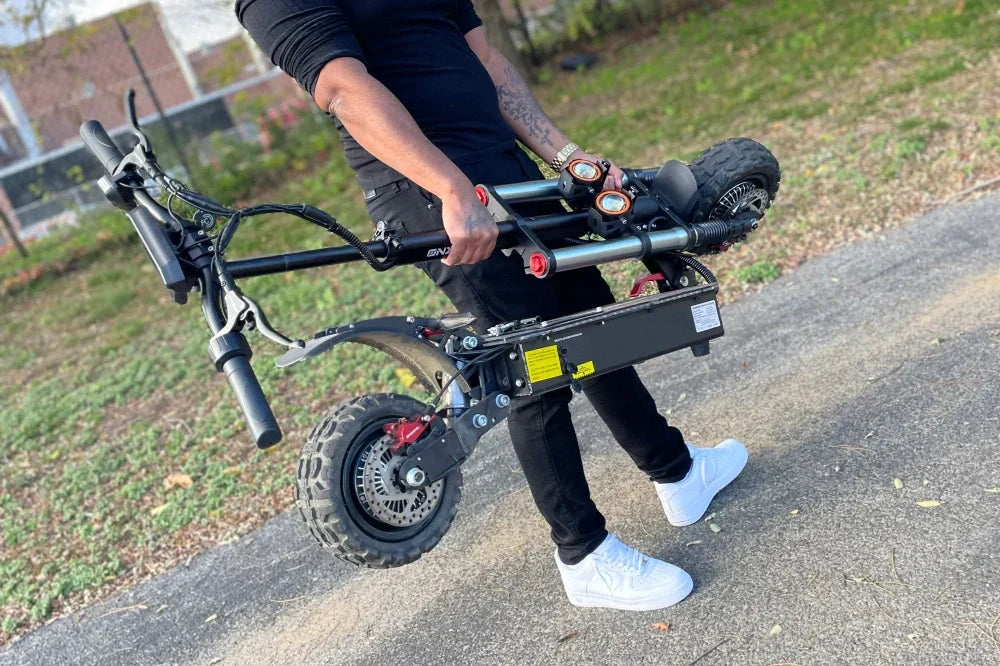
- Under 30 lbs (ultra-portable): Can be carried one-handed by the stem or deck. Fits in overhead luggage compartments on most trains. Manageable for most adults for distances up to a few hundred feet.
- 30–45 lbs (mid-weight commuter): Requires two hands or a shoulder carry. Most people can manage stairs and short distances, but it’s tiring over longer carries. A carrying strap makes a significant difference.
- 45–65 lbs (heavy commuter / light off-road): Two-person carry recommended for stairs. Manageable solo on flat surfaces with a proper grip. Not practical for regular subway or bus use without elevator access.
- 65+ lbs (performance off-road): Requires two people for any significant carry. These scooters are designed for riding, not carrying — portability is a secondary consideration.
Carrying Techniques by Situation
- Short flat carry (under 50 feet): Grip the folded stem with one hand and the rear frame or fender with the other. Keep the scooter close to your body to reduce leverage strain on your arms.
- Stairs: Lead with the front wheel going up, rear wheel going down. Keep the scooter tilted slightly toward you so the weight is over your center of gravity, not pulling you forward.
- Longer carries: Use a dedicated scooter carrying strap (available for most models) that distributes weight across your shoulder. This frees one hand and significantly reduces fatigue.
- Loading into a vehicle: Slide the scooter in rear-wheel first on its side. Protect the deck and display from scratches with a blanket or foam pad if transporting frequently.
Grip Points to Use — and Avoid
Always grip structural frame components — the stem, deck frame, or rear fender brace. Avoid gripping cables, brake lines, throttle assemblies, or the display housing. These components are not designed to bear the scooter’s weight and can be damaged or pulled loose.
Taking Your Scooter on Public Transit
Rules for electric scooters on public transit vary significantly by city and transit authority. Before assuming you can bring your scooter on a subway or bus, check the specific rules for your transit system.
General Transit Rules (US)
- Subway systems: Most US subway systems (NYC MTA, Chicago CTA, DC Metro) allow folded scooters during off-peak hours. Some require the scooter to fit within a specific size envelope (typically 22" x 14" x 9" for overhead storage). Check your local authority’s website for current rules.
- Buses: Policies vary widely. Some systems allow folded scooters in the luggage area or under the seat; others prohibit them entirely. Call ahead or check the transit authority’s website.
- Commuter rail: Generally more permissive than urban transit. Most commuter rail systems allow folded scooters in the vestibule or luggage area during off-peak hours.
- Rideshare (Uber/Lyft): No formal policy — at driver discretion. A folded scooter that fits in the trunk is generally accepted; a heavy off-road model may be refused.
Practical Transit Tips
- Fold before entering the station or boarding — don’t fold in the aisle or on the platform
- Keep the scooter between your legs or against the wall, not blocking the aisle
- Use off-peak hours when possible — crowded trains make carrying a scooter significantly more difficult and less welcome
- A scooter bag or cover signals to other passengers and transit staff that you’re treating the scooter as luggage, not a vehicle
Storage Solutions at Home, Work, and in Vehicles
At Home
- Vertical wall mount: The most space-efficient option for apartments. Wall-mounted hooks or dedicated scooter mounts hold the scooter vertically against the wall, taking up minimal floor space. Suitable for scooters up to about 50 lbs.
- Under-desk storage: A folded commuter scooter (under 40 lbs, compact folded dimensions) can stand upright under most standing desks or in a closet corner.
- Dedicated storage area: For heavier models, designate a corner of a garage, hallway, or storage room. Use a scooter cover to protect from dust and UV exposure.
At Work
- Check with building management about scooter storage policies before assuming you can bring it inside
- A folded scooter under your desk is the most secure option — it’s with you and protected from weather
- If indoor storage isn’t possible, use a high-quality U-lock through the wheel and frame, plus a cable lock through the folded stem. Two locks significantly increase theft deterrence.
In Vehicles
- Measure your trunk or cargo area before purchasing a scooter if vehicle transport is part of your plan
- Use non-slip matting under the scooter to prevent sliding during transit
- For SUVs and trucks, a folded scooter can be secured with cargo straps to prevent movement
- Avoid leaving the scooter in a hot car for extended periods — temperatures above 104°F (40°C) can damage the battery
When Portability Should Drive Your Buying Decision
Not every rider needs a portable scooter. If you ride point-to-point and park at your destination, weight and folded dimensions are secondary to range, speed, and ride quality. But if any of the following apply to you, portability should be a primary selection criterion:
- You use public transit for part of your commute
- You live in an apartment without dedicated scooter storage
- You regularly transport the scooter in a car
- You need to carry the scooter up stairs at home or at work
- You travel with the scooter (hotels, vacation rentals)
For these riders, a scooter under 35 lbs with a compact folded footprint is worth prioritizing over raw performance specs. For riders who don’t need to carry the scooter regularly, a heavier performance model with better range and speed may be the better trade-off.
Folded Dimensions & Weight: ONECNA Model Comparison

To illustrate how weight class affects real-world portability, here’s how the ONECNA lineup breaks down across the portability spectrum:
| Model | Weight | Top Speed | Range | Portability Class | Best Carry Scenario |
|---|---|---|---|---|---|
| T2 | ~54 lbs | 32 MPH | 28 miles | Heavy commuter | Car trunk, ground-floor storage |
| T3 | ~38 lbs | 30 MPH | 40 miles | Mid-weight commuter | Car trunk, office storage |
| A2 | ~44 lbs | 35 MPH | 45 miles | Heavy commuter | Car trunk, ground-floor storage |
| T4 | ~68 lbs | 45 MPH | 50 miles | Performance (two-person carry) | Car trunk, elevator access |
| GT8 PRO | ~99 lbs | 50 MPH | 60 miles | Performance (two-person carry) | SUV/truck, ground-floor only |
Note: Weights are approximate and may vary by variant configuration. Always verify current specs on the product page before purchasing.
FAQ — Folding and Carrying Electric Scooters
How long does it take to fold an electric scooter?
On most modern commuter scooters with a stem-fold mechanism, folding takes 3–8 seconds once you’re familiar with the latch. The first few times may take 15–30 seconds while you learn the sequence. Unfolding is typically faster — lift the stem, click the latch, done.
Can I carry my electric scooter on the subway?
It depends on your transit authority’s rules and your scooter’s folded size and weight. Most US subway systems allow folded scooters during off-peak hours, but size limits apply. Check your local transit authority’s website for current policy. A scooter under 35 lbs with compact folded dimensions is the most transit-friendly option.
What’s the best way to carry a heavy electric scooter up stairs?
For scooters over 45 lbs, two-person carry is the safest approach on stairs. If carrying solo, grip the stem with your dominant hand and the rear frame with your other hand. Lead with the front wheel going up, rear wheel going down. Take it one step at a time and don’t rush. A carrying strap helps distribute weight on longer carries.
Will my electric scooter fit in my car trunk?
It depends on both the scooter’s folded dimensions and your car’s trunk size. Most commuter scooters (under 45 lbs) fit in a standard sedan trunk when folded. Heavier performance models typically require an SUV or hatchback with rear seats folded. Measure your trunk opening and compare to the scooter’s folded dimensions before purchasing.
How do I secure a folded scooter in a car?
Lay the scooter on its side in the trunk on a non-slip mat or blanket. For longer trips, use cargo straps to prevent the scooter from sliding. Protect the display and deck from scratches with a foam pad or scooter bag. Avoid placing heavy items on top of the scooter, especially on the battery housing.
How do I maintain the folding mechanism?
Inspect the hinge and latch monthly for play, corrosion, or cracking. Apply silicone lubricant to the hinge pivot and latch every 3 months. Tighten any loose bolts at the hinge point. If the latch feels loose or doesn’t click firmly into place, replace it before it fails — a failed latch during riding is a safety hazard.
Is it safe to fold an electric scooter while it’s powered on?
No. Always power off the scooter before folding. On scooters with electronic throttle systems, the motor can engage unexpectedly if the throttle is accidentally activated during folding. Power off, wait for the display to go dark, then fold.
Share:
Understanding Scooter Battery Life and Extending Range
Top Features to Look for in High-Performance E-Scooters