




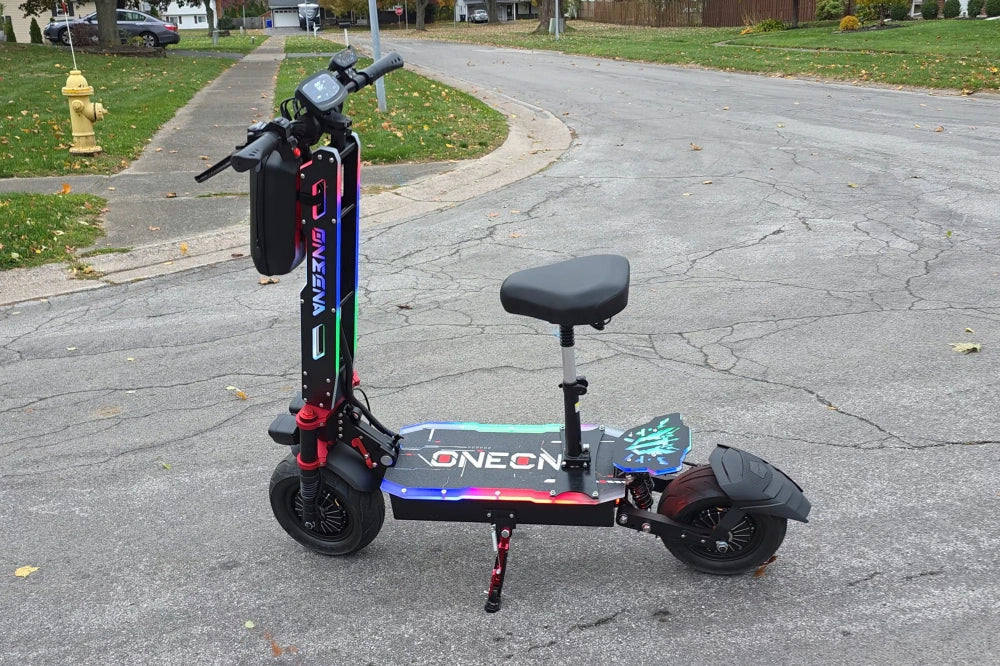
If you’ve been researching a suspension scooter, chances are you already know one thing: speed and power alone don’t define ride quality. Once terrain becomes unpredictable—gravel, potholes, forest trails, uneven pavement—suspension stops being a “nice to have” and becomes the system that determines whether a scooter feels controlled or chaotic.
This guide is written for adult riders who care about real off-road usability, not spec sheets alone. Instead of repeating marketing claims, we’ll break down how suspension systems actually work, how they affect safety and comfort, and how to choose the right setup for your riding style.
Why Suspension Matters More Than You Think
Without proper suspension, impact energy from rough terrain transfers directly into your arms, knees, and spine. Over time, this leads to fatigue, reduced control, and lower confidence—especially at speed.
A well-designed suspension scooter does three critical things:
- Maintains tire contact with the ground for better traction
- Absorbs impact energy to reduce rider fatigue
- Stabilizes steering geometry at higher speeds
Types of Suspension Systems Explained
Spring Suspension
Spring-based suspension is common on entry-level scooters. While simple and affordable, it often rebounds too quickly, creating a bouncy feeling on uneven surfaces.
Best for: Urban riding, lighter riders
Limitations: Poor damping, limited off-road control
Hydraulic Suspension
Hydraulic suspension uses oil-filled dampers to control compression and rebound speed. This results in smoother impact absorption and far greater stability on rough terrain.
Best for: Off-road riding, heavier riders, higher speeds
Dual Suspension (Front & Rear)
True off-road suspension scooters almost always use both front and rear suspension. Front suspension stabilizes steering, while rear suspension absorbs major impacts.
Suspension Travel: Why Numbers Matter Less Than Tuning
Suspension travel is often advertised as a selling point, but travel alone doesn’t determine ride quality. Two scooters with the same travel can feel completely different due to spring rate, damping calibration, rider weight compatibility, and frame geometry.
Well-tuned suspension feels progressive—it absorbs small bumps smoothly without bottoming out on larger hits.
How Suspension Affects Safety at Speed
At higher speeds, suspension directly impacts braking distance and cornering control. When wheels lose contact with the ground, traction disappears—even for a moment.
This is why powerful scooters without proper suspension often feel unstable. Power is only useful when it can be controlled.
Matching Suspension to Rider Profiles
Urban-to-Trail Hybrid Riders
Riders who commute on weekdays and explore trails on weekends benefit from balanced hydraulic dual suspension that performs consistently across surfaces.
Heavy Riders or Cargo Carriers
Heavier riders require stiffer springs paired with hydraulic damping to prevent bottoming out under load.
Performance-Focused Riders
For riders who prioritize speed and acceleration, suspension becomes a safety requirement rather than a comfort feature.
Real-World Examples of Suspension Design
Scooters like the ONECNA GT9 are built around aggressive dual-hydraulic suspension designed to remain stable at speed on loose terrain.
Models such as the GT8 Pro balance off-road capability with urban usability, while the GT7 offers high power with suspension support suitable for riders upgrading from entry-level scooters.
You can explore ONECNA’s full lineup at onecnascooter.com .
Suspension Isn’t About Comfort—It’s About Control 🚀
Suspension determines how confidently you brake, how precisely you steer, and how long you can ride without fatigue. For adult off-road riders, suspension quality often matters more than raw motor wattage.
What to Look for When Buying a Suspension Scooter
- Will you ride on uneven terrain regularly?
- Do you ride at higher speeds?
- Is your weight within the suspension’s effective range?
- Is the suspension properly damped or tunable?
Final Thoughts
A true suspension scooter isn’t defined by how soft it feels during a short test ride. It’s defined by how stable, predictable, and confidence-inspiring it feels after extended riding on rough terrain.
Understanding suspension systems allows you to make smarter purchasing decisions—and avoid being distracted by specs that don’t translate into real-world performance.
Share:
Maintaining Your Electric Scooter: A Valentine’s Day Guide
Off Road eScooter: What Really Defines a Capable All-Terrain Electric Scooter