




Best E Scooter for Big Guys: Top Picks for Power, Comfort and Stability
Finding the best e scooter for big guys isn't just about picking the most powerful model on the market. It's about matching the right weight capacity, deck geometry, motor output, and suspension setup to your actual body and riding style. If you're over 220 lbs — or closer to 300 lbs — most entry-level scooters simply aren't engineered for you. This guide cuts through the noise and gives you a clear, honest breakdown of what actually matters.
Table of Contents
- Why Standard Scooters Fall Short for Heavier Riders
- What to Look For: The 5 Key Specs That Actually Matter
- Weight Capacity vs. Rated Capacity: The Gap Nobody Talks About
- Motor Power: How Much Do You Actually Need?
- Deck Size, Handlebar Height & Ergonomics for Big Riders
- Suspension Systems Compared: Spring vs. Hydraulic vs. Air
- Top E Scooter Picks for Big Guys (2025 Comparison)
- Buying Guide: How to Match a Scooter to Your Weight & Use Case
- Use Cases: Which Rider Type Are You?
- Pros and Cons Summary
- FAQ
1. Why Standard Scooters Fall Short for Heavier Riders
Most consumer electric scooters are designed with a "standard" rider in mind — typically someone around 165–185 lbs. The frame geometry, motor torque curves, and suspension tuning all reflect that assumption. When a 250 lb or 280 lb rider steps on, several things happen that the spec sheet won't warn you about:
- Range drops significantly. A scooter rated for 30 miles at 165 lbs might deliver 18–22 miles at 250 lbs. Physics doesn't negotiate.
- Acceleration feels sluggish. A 500W motor that feels peppy for a lighter rider will struggle to pull meaningful torque for a heavier one, especially on inclines.
- Suspension bottoms out. Budget spring forks aren't tuned for higher loads. You'll feel every crack in the pavement.
- Deck flex creates instability. Narrow or thin decks flex under load, which reduces confidence at speed and on turns.
- Braking distance increases. More mass means more momentum. Drum brakes or single disc setups that work fine at 165 lbs become genuinely dangerous at 280 lbs.
None of this means big guys can't ride electric scooters — it means you need to shop smarter and look at specs that most reviews gloss over.
2. What to Look For: The 5 Key Specs That Actually Matter
Before comparing any specific models, internalize these five criteria. They're the filter through which every recommendation in this guide is made.
① Weight Capacity (and the Safety Buffer Rule)
Never buy a scooter where your body weight is within 20% of the rated maximum. If a scooter is rated for 265 lbs and you weigh 240 lbs, you're operating near the structural limit. Look for a rated capacity at least 30–40 lbs above your actual weight, ideally more.
② Motor Power (Continuous vs. Peak)
Manufacturers often advertise peak wattage, which is the maximum output for a few seconds. What matters for sustained hill climbing and load-bearing is continuous rated power. For riders over 220 lbs, look for at least 1,000W continuous (dual motor setups are ideal).
③ Deck Width and Length
A wider, longer deck gives you a more stable stance. For big guys, a deck under 8 inches wide starts to feel cramped and unstable. Look for decks 8.5" or wider, with a length of at least 20 inches.
④ Suspension Type and Adjustability
Hydraulic or air suspension is significantly better than basic coil springs for heavier riders. Adjustable preload is a bonus — it lets you tune the suspension to your weight rather than accepting a factory setting designed for someone 80 lbs lighter.
⑤ Braking System
Dual hydraulic disc brakes are the gold standard for heavier riders. They provide consistent stopping power regardless of load and don't fade under repeated use the way mechanical disc or drum brakes can.
3. Weight Capacity vs. Rated Capacity: The Gap Nobody Talks About
Here's something most buying guides skip: the rated weight capacity on a scooter spec sheet is a structural limit, not a performance limit. A scooter rated for 300 lbs will hold a 300 lb rider without breaking — but it won't perform well at that weight. Range, speed, and hill-climbing ability all degrade as you approach the rated maximum.
A practical rule of thumb used by experienced riders: treat the rated capacity as a ceiling, and aim to be at least 15–20% below it for real-world performance. So if you weigh 260 lbs, look for scooters rated at 300 lbs or higher.
This is why scooters with 330 lbs or 400 lbs rated capacities are worth paying attention to — they're not just for extremely heavy riders. They're for anyone who wants performance headroom.
4. Motor Power: How Much Do You Actually Need?
Let's be direct: for riders over 220 lbs, a single 500W motor is the bare minimum for flat urban riding, and it will struggle on any meaningful incline. Here's a practical breakdown:
| Rider Weight | Minimum Motor (Flat) | Recommended (Hills + Load) | Ideal Setup |
|---|---|---|---|
| 180–220 lbs | 500W single | 800W–1,000W single | Dual 1,000W |
| 220–260 lbs | 800W single | 1,500W–2,000W single | Dual 1,500W+ |
| 260–300 lbs | 1,500W single | Dual 2,000W+ | Dual 2,800W+ |
| 300+ lbs | Dual 2,000W | Dual 3,000W+ | Dual 4,000W+ |
Dual motor setups aren't just about top speed — they provide dramatically better torque at low speeds, which is exactly what heavier riders need for smooth starts and hill climbing.
5. Deck Size, Handlebar Height & Ergonomics for Big Riders
Ergonomics matter more than most reviews acknowledge. A scooter that's technically powerful enough but physically uncomfortable will be miserable to ride — and potentially unsafe.
Deck Considerations
- Width: 8.5"–10" is the sweet spot for big guys. Wider than 10" starts to affect your natural stance.
- Length: 20"–24" gives you room to shift your weight without feeling cramped.
- Surface: Anti-slip grip tape or textured rubber is non-negotiable. Smooth decks become dangerous when wet.
- Ground clearance: At least 5" to handle curbs, speed bumps, and uneven terrain without scraping.
Handlebar Height
Most scooters have adjustable handlebars, but the range matters. For riders 6'0" and taller, look for a maximum handlebar height of at least 47"–50" from the ground. Riding hunched over for 30 minutes is not just uncomfortable — it affects your balance and reaction time.
Stem Strength
The folding stem is often the weakest structural point on a scooter. For heavier riders, look for stems made from aircraft-grade aluminum or reinforced steel, with a locking mechanism that doesn't rely solely on a single bolt or latch.
6. Suspension Systems Compared: Spring vs. Hydraulic vs. Air
Suspension is where budget scooters cut corners most aggressively — and where heavier riders feel the difference most acutely.
| Suspension Type | Performance for Heavy Riders | Adjustability | Maintenance | Typical Price Range |
|---|---|---|---|---|
| Basic Coil Spring | Poor — bottoms out easily | None | Low | Budget ($300–$800) |
| Dual Spring (front + rear) | Fair — better than single | Limited | Low | Mid ($800–$1,500) |
| Hydraulic Shock | Good — consistent damping | Some models adjustable | Medium | Mid-High ($1,200–$2,500) |
| Air Suspension | Excellent — tunable to weight | High | Medium-High | High ($2,000+) |
For riders over 220 lbs, hydraulic suspension front and rear is the minimum worth considering. Air suspension is ideal if your budget allows — the ability to tune preload to your exact weight makes a noticeable difference in ride quality and stability.
7. Top E Scooter Picks for Big Guys (2025 Comparison)
The following comparison focuses on scooters that genuinely perform well for heavier riders — not just ones that technically list a high weight capacity.
Category 1: Best for Riders 220–260 lbs — Urban + Suburban Use
What to prioritize: Range, comfort, manageable weight, dual motor for hills.
Scooters in this category should offer at least 30 miles of real-world range at your weight, dual motor output of 2,000W–4,000W peak, and a deck wide enough for a comfortable two-foot stance. Hydraulic brakes are strongly preferred over mechanical disc at this weight range.
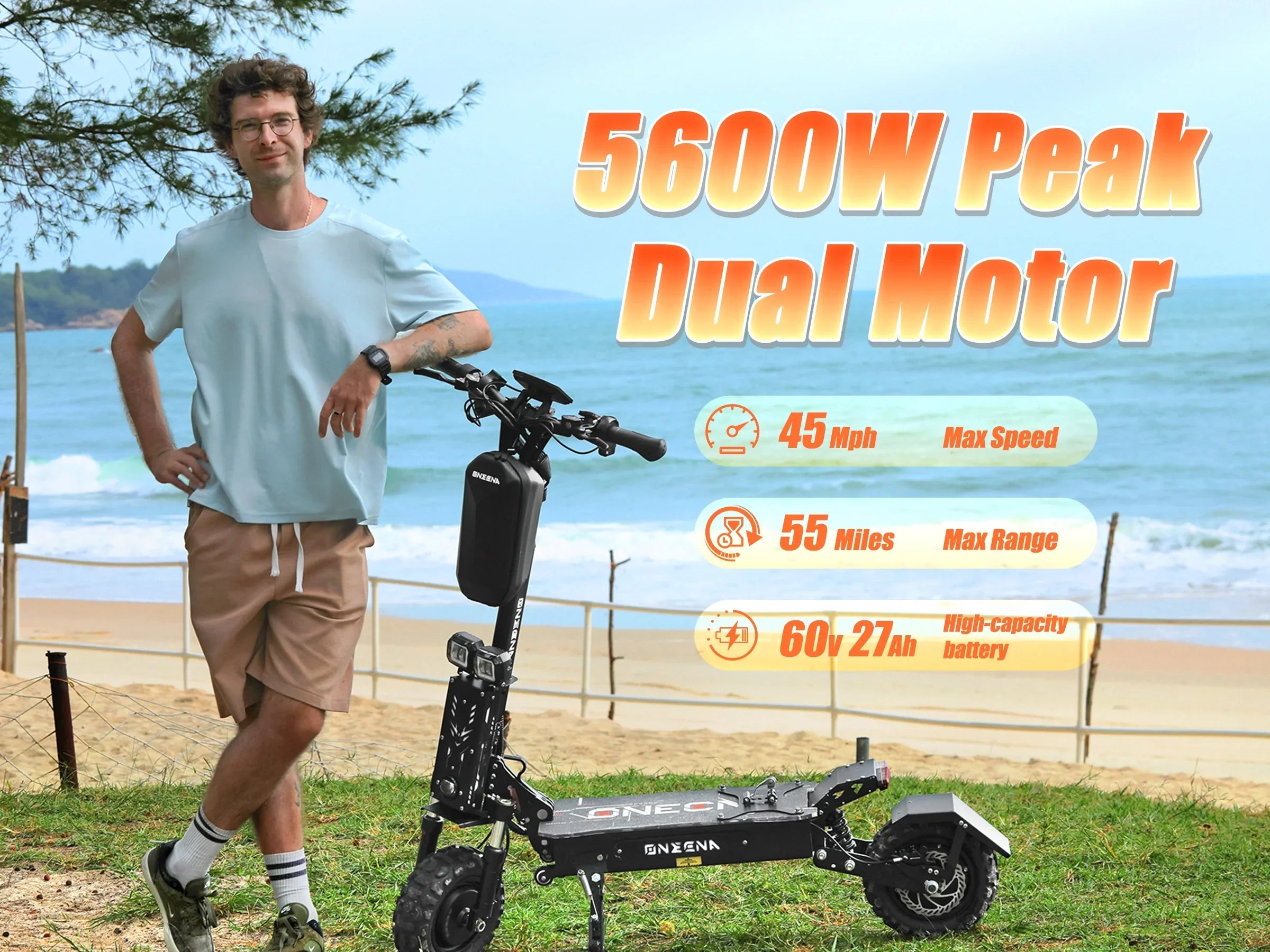
The ONECNA GT7 fits well here — its dual 5,600W peak motor system, 60V 27Ah battery, and 11" pneumatic tires give heavier riders genuine range and traction without the scooter feeling like it's working against you. The wide deck and front/rear suspension make it a practical daily rider for someone in the 220–260 lb range.
Category 2: Best for Riders 260–300 lbs — Mixed Terrain
What to prioritize: High torque, robust suspension, large tires, strong braking.
At this weight range, you need a scooter that was engineered for performance, not just rated for it. Look for dual hydraulic disc brakes, front and rear hydraulic or air suspension, and tires 10" or larger for stability on mixed surfaces.
The ONECNA GT8 PRO is a strong contender here. With a 6,000W peak single motor (or dual motor configuration), 60V 33Ah battery, and a 40° max uphill grade rating, it handles the kind of real-world terrain — hills, rough pavement, gravel paths — that lighter scooters simply can't manage at 270+ lbs. The dual hydraulic brakes provide the stopping confidence that heavier riders need.
Category 3: Best for Riders 300+ lbs — Performance / Off-Road
What to prioritize: Maximum structural integrity, highest motor output, widest tires, most robust suspension.
At 300+ lbs, you're in territory where most scooters — even ones marketed as "heavy duty" — start to show their limits. You need a scooter built from the ground up for high-load performance. Frame construction, weld quality, and component sourcing matter as much as the spec sheet numbers.
Scooters in this tier typically feature dual motors with 8,000W–12,000W peak output, 11"–13" off-road tires, and full hydraulic suspension front and rear. They're heavier (often 80–120 lbs), which affects portability, but they deliver the structural confidence and performance headroom that 300+ lb riders need.
8. Buying Guide: How to Match a Scooter to Your Weight & Use Case
Use this decision framework before you buy:
Step 1: Establish Your Weight Bracket
Be honest. Use your actual weight, not your "I'm planning to lose weight" weight. Add 10–15 lbs for gear, a backpack, or anything you typically carry.
Step 2: Define Your Primary Use Case
- Urban commuter: Flat roads, bike lanes, occasional curbs. Prioritize range, portability, and comfort.
- Suburban mixed-use: Some hills, varied pavement quality. Prioritize motor torque, suspension, and tire size.
- Off-road / adventure: Trails, gravel, steep grades. Prioritize structural integrity, tire width, and suspension travel.
Step 3: Set a Realistic Budget
For riders over 220 lbs, a scooter that genuinely performs well starts around $1,200–$1,500. Below that price point, you're making compromises that matter more at higher weights. The $800 scooter that works fine for a 160 lb rider will disappoint a 250 lb rider within the first month.
Step 4: Check the Warranty and Support
Heavier riders put more stress on components. A scooter with a 12-month warranty and accessible replacement parts is worth more than a slightly better-spec'd model with no support infrastructure. Check whether the brand sells replacement tires, brake pads, and batteries directly.
Step 5: Test Ride If Possible
Specs on paper don't capture how a scooter feels under your weight. If you can test ride before buying, do it. Pay attention to how the suspension responds, whether the deck feels stable, and how the brakes perform at speed.
9. Use Cases: Which Rider Type Are You?
The Heavy Daily Commuter (220–260 lbs, flat urban terrain)
You need: 30+ mile real-world range, comfortable deck, reliable brakes, manageable scooter weight for storage.
You don't need: Maximum top speed, off-road tires, extreme motor output.
Watch out for: Scooters that sacrifice range for power. At your weight, range is the first thing to drop.
The Suburban Hill Climber (240–280 lbs, mixed terrain)
You need: Strong dual motor torque, hydraulic suspension, large pneumatic tires, dual disc brakes.
You don't need: Ultra-lightweight frame (you're not carrying it up stairs every day).
Watch out for: Single motor scooters marketed as "powerful" — peak wattage numbers can be misleading.
The Big Guy Adventure Rider (260–320 lbs, off-road / trails)
You need: Maximum structural integrity, 10"+ off-road tires, full hydraulic suspension, high-capacity battery.
You don't need: Portability or lightweight design — performance is the priority.
Watch out for: Scooters with high wattage but budget suspension — power without control is dangerous at your weight.
10. Pros and Cons: High-Capacity Scooters for Big Guys
Pros
- Engineered for real-world performance at higher weights, not just structural compliance
- Dual motor setups provide torque headroom that makes riding feel effortless rather than strained
- Larger tires and hydraulic suspension absorb road imperfections that smaller scooters transmit directly to the rider
- Higher-capacity batteries compensate for the range reduction that comes with heavier loads
- Stronger braking systems provide the stopping confidence that heavier riders need at speed
Cons
- Higher price point — quality scooters for big guys typically start at $1,200 and go up from there
- Heavier scooter weight — more capable machines often weigh 60–100+ lbs, which affects portability
- Larger footprint — not ideal for tight storage spaces or frequent public transit use
- More complex maintenance — hydraulic brakes and air suspension require periodic servicing
- Charging time increases with larger battery capacity — plan for 6–10 hour full charges
Final Thoughts
The best e scooter for big guys is the one that was actually designed with your weight in mind — not just rated for it on a spec sheet. The difference between a scooter that "supports" 265 lbs and one that performs at 265 lbs is significant, and it shows up in range, acceleration, braking, and ride comfort from the very first ride.
Focus on the fundamentals: weight capacity with a safety buffer, continuous motor power (not just peak), deck ergonomics, suspension quality, and braking system. Get those right, and you'll find a scooter that doesn't just carry you — it rides well for you.
FAQ: Best E Scooter for Big Guys
Q: What weight capacity should I look for in an electric scooter if I weigh 250 lbs?
A: Look for a scooter rated for at least 300 lbs. Operating near the rated maximum reduces performance significantly — range drops, acceleration suffers, and suspension bottoms out more easily. A 300 lb rating gives you the performance headroom to actually enjoy the ride.
Q: Are dual motor scooters worth it for heavier riders?
A: Yes, for most riders over 220 lbs. Dual motors don't just increase top speed — they provide dramatically better torque at low speeds, which is what heavier riders need for smooth starts, hill climbing, and maintaining speed on inclines. A single motor that's technically powerful enough will often feel strained; a dual motor setup feels effortless.
Q: How much does rider weight affect electric scooter range?
A: Significantly. As a rough estimate, every 20 lbs above the "standard" test weight (usually around 165 lbs) reduces range by approximately 5–10%. A scooter rated for 35 miles might deliver 22–26 miles for a 250 lb rider. Always factor this in when evaluating range claims.
Q: What tire size is best for big guys on electric scooters?
A: 10" or 11" pneumatic (air-filled) tires are ideal for most heavier riders. They provide better shock absorption, more stable contact patch, and greater puncture resistance than smaller solid tires. Avoid solid rubber tires if you're over 220 lbs — they transmit road vibration directly and offer no cushioning.
Q: Is it safe for a 300 lb person to ride an electric scooter?
A: Yes, if you choose the right scooter. The key is selecting a model with a rated capacity well above your weight, a robust frame construction, dual hydraulic disc brakes, and appropriate suspension. Riding a scooter rated for 265 lbs at 300 lbs is unsafe. Riding a scooter rated for 400 lbs at 300 lbs, with proper safety gear, is a different situation entirely.
Q: What's the difference between peak and continuous motor wattage?
A: Peak wattage is the maximum output a motor can sustain for a few seconds — useful for quick acceleration bursts. Continuous wattage is what the motor can sustain indefinitely. For heavier riders, continuous wattage matters more because you need sustained torque for hill climbing and maintaining speed, not just a brief burst off the line. Always ask about continuous ratings when comparing motors.
Q: Do I need hydraulic brakes, or are mechanical disc brakes enough?
A: For riders over 220 lbs, hydraulic disc brakes are strongly recommended. They provide more consistent stopping power, don't require cable tension adjustments, and perform better under repeated use. Mechanical disc brakes can work, but they require more frequent adjustment and can feel less confident at higher weights and speeds.
Q: How do I know if a scooter's deck is wide enough for me?
A: Stand with your feet shoulder-width apart and measure that distance. Your scooter's deck should be at least as wide as your natural stance. For most big guys, that means looking for decks 8.5" or wider. A deck that forces you to stand with feet too close together reduces stability and increases fatigue on longer rides.
Share:
Can You Drive an E Scooter on the Road? Everything You Need to Know
E Scooter High Speed: How to Choose the Right Fast Electric Scooter