




E Scooter High Speed: How to Choose the Right Fast Electric Scooter
If you're researching e scooter high speed options, you've probably noticed that the market is flooded with bold claims — "45 MPH!", "6000W!", "0 to 30 in 4 seconds!" — with very little context for what those numbers mean in real-world riding. This guide cuts through the marketing noise. We'll explain what actually determines top speed, how to match a fast scooter to your specific use case, and what trade-offs you're making when you prioritize speed over other factors.
Table of Contents
- What Is "High Speed" for an Electric Scooter?
- What Actually Determines E Scooter Top Speed
- Speed Tiers Explained: 20 MPH vs. 35 MPH vs. 50 MPH+
- Motor Power vs. Battery Voltage: Which Matters More?
- The Speed-Safety Trade-Off Nobody Talks About
- Suspension, Tires, and Brakes at High Speed
- Fast E Scooter Comparison by Speed Tier (2025)
- Buying Guide: How to Choose the Right Speed for You
- Use Cases: Who Actually Needs a High-Speed E Scooter?
- Pros and Cons of High-Speed Electric Scooters
- FAQ
1. What Is "High Speed" for an Electric Scooter?
"High speed" is relative — and the definition shifts depending on who you ask. In the consumer e scooter market, speed generally breaks into three practical tiers:
- Entry-level speed (15–25 MPH): Suitable for bike lanes, flat urban commutes, and riders new to electric scooters. Most city-legal scooters fall here.
- Mid-range speed (25–40 MPH): Where serious commuters and enthusiasts operate. Requires better brakes, suspension, and rider experience.
- High performance (40–55+ MPH): Performance territory. These scooters demand full safety gear, significant riding experience, and awareness of local regulations.
When most people search for "e scooter high speed," they're typically looking at the 30–50 MPH range — fast enough to feel genuinely quick, but not so extreme that the scooter becomes impractical for daily use. That's the sweet spot this guide focuses on.
2. What Actually Determines E Scooter Top Speed
Top speed on an electric scooter is the result of several interacting variables. Understanding them helps you evaluate spec sheets critically rather than just comparing headline numbers.
Motor Wattage (Continuous, Not Peak)
Motor wattage is the most advertised spec, but it's also the most misleading. Peak wattage is the maximum output for a few seconds — it's what gets printed on the box. Continuous wattage is what the motor sustains during normal riding. A scooter advertised as "6,000W" might have a continuous rating of 2,000–3,000W. For sustained high-speed riding, continuous power is what matters.
Battery Voltage
Voltage is the single most underrated speed factor. Higher voltage means higher potential top speed, all else being equal. A 48V system and a 60V system with identical motors will have meaningfully different top speeds — the 60V system will typically run 15–25% faster. Most high-speed scooters (35 MPH+) run on 60V or 72V systems.
Controller Limits (Speed Governors)
Many scooters are electronically limited below their mechanical top speed — either for regulatory compliance or to protect components. Some models allow you to unlock higher speed modes through the display settings. This is worth checking before you buy if top speed is a priority.
Rider Weight
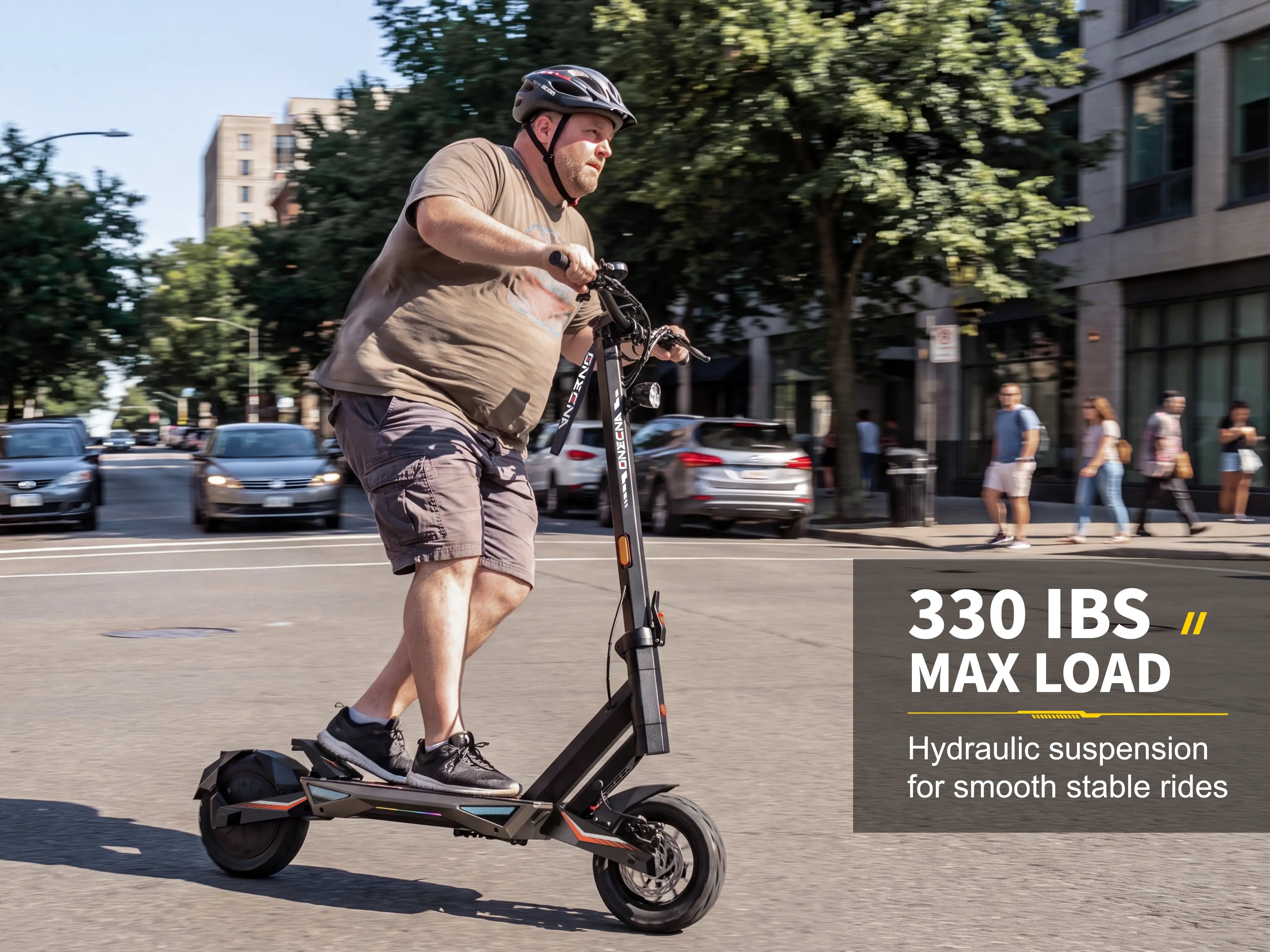
Every additional pound reduces top speed slightly. A scooter rated for 45 MPH at 165 lbs might top out at 38–40 MPH for a 220 lb rider. This is rarely disclosed in spec sheets but is consistently reported by real-world riders.
Terrain and Incline
Top speed figures are almost always measured on flat, smooth pavement. Add a 5% grade and you'll lose 5–10 MPH on most scooters. Add a 10% grade and you may lose 15–20 MPH. If your commute includes hills, factor this in heavily.
Tire Pressure and Size
Properly inflated pneumatic tires reduce rolling resistance and allow the motor to reach higher speeds more efficiently. Underinflated tires can reduce top speed by 3–5 MPH and significantly increase battery drain.
3. Speed Tiers Explained: 20 MPH vs. 35 MPH vs. 50 MPH+
Tier 1: 15–25 MPH — The Urban Commuter Range
Who it's for: Daily commuters in cities, riders who primarily use bike lanes, beginners.
Typical specs: 500W–1,000W motor, 36V–48V battery, single motor.
Pros: Legal in most jurisdictions, lighter weight, lower cost, easier to control.
Cons: Feels slow on open roads, struggles on hills with heavier riders, limited range at higher loads.
Reality check: 20 MPH feels fast in a bike lane. It feels slow on a 35 MPH road. Know your environment before deciding this tier is enough.
Tier 2: 25–40 MPH — The Performance Commuter Range
Who it's for: Experienced riders, suburban commuters, riders who share roads with cars.
Typical specs: 1,500W–4,000W motor (single or dual), 48V–60V battery.
Pros: Practical for mixed traffic, strong hill-climbing ability, meaningful range.
Cons: Heavier than entry-level, requires better safety gear, may exceed legal limits in some areas.
Reality check: This is where most serious riders land. Fast enough to keep up with traffic on most roads, manageable enough for daily use.
Tier 3: 40–55+ MPH — High Performance Territory
Who it's for: Enthusiasts, off-road riders, experienced riders who understand the risks.
Typical specs: 4,000W–12,000W+ (dual motor), 60V–84V battery.
Pros: Exhilarating performance, handles any terrain, significant power reserve for hills and headwinds.
Cons: Heavy (often 80–120 lbs), expensive, requires full safety gear, not legal on public roads in many jurisdictions.
Reality check: At 50 MPH on a scooter, a fall is a serious injury event. This tier demands respect, experience, and proper protective equipment — not just enthusiasm.
4. Motor Power vs. Battery Voltage: Which Matters More?
This is one of the most common points of confusion when comparing fast e scooters. Here's the direct answer: for top speed, voltage matters more. For acceleration and hill climbing, wattage matters more.
| Spec | Primary Impact | Secondary Impact | What to Look For |
|---|---|---|---|
| Motor Wattage (continuous) | Torque, acceleration, hill climbing | Sustained speed under load | Higher continuous W = better real-world performance |
| Battery Voltage | Top speed ceiling | Motor efficiency at speed | 60V+ for 35 MPH+; 72V+ for 45 MPH+ |
| Battery Capacity (Ah) | Range | Sustained high-speed range | Higher Ah = more miles at speed |
| Controller Rating | Power delivery ceiling | Speed governor limits | Match controller to motor rating |
A practical example: two scooters both advertised as "3,000W" — one running 48V, one running 60V. The 60V scooter will have a meaningfully higher top speed because the motor receives higher voltage. The 48V scooter may have better low-end torque if its controller is tuned differently, but it will hit its speed ceiling sooner.
When comparing fast e scooters, always look at voltage alongside wattage. A 60V 3,000W system will generally outperform a 48V 4,000W system in top speed, even though the wattage number is lower.
5. The Speed-Safety Trade-Off Nobody Talks About
Speed is exciting. It's also where most e scooter injuries happen. This section isn't meant to discourage you from buying a fast scooter — it's meant to help you make an informed decision about what "fast" actually requires from you as a rider.
Stopping Distance Scales with Speed Squared
This is physics, not opinion. Stopping distance doesn't double when you double your speed — it quadruples. A scooter traveling at 20 MPH that can stop in 20 feet needs roughly 80 feet to stop from 40 MPH, assuming the same braking force. At 50 MPH, you're looking at 125+ feet. On a shared path or urban street, that's the length of several car lengths.
Reaction Time Doesn't Scale with Speed
Human reaction time is roughly 0.2–0.3 seconds regardless of how fast you're moving. At 20 MPH, you travel about 9 feet during that reaction window. At 45 MPH, you travel about 20 feet before you even begin to brake. This is why high-speed scooters require not just better brakes, but better situational awareness and more conservative riding environments.
What This Means Practically
- At 25 MPH and below: A helmet is the minimum. Wrist guards are smart.
- At 25–40 MPH: Full-face helmet, gloves, knee pads, and ideally a jacket with CE-rated armor.
- At 40 MPH+: Motorcycle-grade protective gear is not optional — it's the difference between a bad day and a life-altering injury.
6. Suspension, Tires, and Brakes at High Speed
A scooter's top speed is only as useful as its ability to handle that speed safely. Three systems determine whether a fast scooter is actually rideable at its rated speed: suspension, tires, and brakes.
Suspension
At 20 MPH, a road crack is a minor annoyance. At 40 MPH, it's a stability event. High-speed scooters need front and rear suspension with enough travel and damping to absorb road imperfections without destabilizing the rider. Hydraulic shocks are significantly better than basic coil springs at speed — they provide more consistent damping and don't bounce unpredictably over repeated impacts.
Tires
Pneumatic (air-filled) tires are essential for high-speed riding. They provide a larger, more compliant contact patch that maintains grip through corners and over surface irregularities. Solid tires transmit every vibration directly to the rider and can cause speed wobble at higher velocities. For scooters above 35 MPH, 10" or 11" pneumatic tires are the practical minimum.
Brakes
Dual hydraulic disc brakes are the standard for any scooter intended for 35 MPH+ riding. They provide consistent, modulated stopping power that doesn't fade under repeated use. Mechanical disc brakes can work at lower speeds but require more frequent adjustment and provide less consistent feel. Drum brakes have no place on a high-speed scooter.
7. Fast E Scooter Comparison by Speed Tier (2025)
Speed Tier 2 (25–40 MPH): Best for Serious Commuters
What to look for: 48V–60V system, dual motor preferred, hydraulic brakes, front and rear suspension, 10"+ tires.
Scooters in this tier represent the best balance of performance and practicality for most riders. They're fast enough to keep pace with urban traffic, capable enough for suburban mixed terrain, and still manageable in terms of weight and portability.
The ONECNA GT7 sits comfortably in this tier — its 60V 27Ah battery and dual 5,600W peak motor system deliver real-world speeds in the 35–45 MPH range depending on rider weight and terrain. The 11" pneumatic tires and front/rear suspension make that speed feel controlled rather than chaotic. For a rider who wants genuine performance without stepping into full performance-scooter territory, it's a well-rounded option.
Speed Tier 3 (40–55+ MPH): Best for Performance Enthusiasts
What to look for: 60V–72V+ system, dual motor with high continuous rating, dual hydraulic disc brakes, adjustable suspension, 11"+ off-road tires.
This tier is where the engineering requirements escalate significantly. Frame rigidity, suspension travel, brake quality, and tire compound all matter more at these speeds. A scooter that feels stable at 35 MPH may develop speed wobble at 48 MPH if the geometry isn't right.
The ONECNA GT8 PRO is built for this tier. Its 6,000W peak motor, 60V 33Ah battery, and 40° uphill rating reflect a scooter designed for sustained high-speed performance rather than just a headline number. The dual hydraulic disc brakes and full suspension setup mean the speed is actually usable — not just achievable in ideal conditions on flat pavement.
Side-by-Side Comparison
| Feature | Tier 2 (25–40 MPH) | Tier 3 (40–55+ MPH) |
|---|---|---|
| Typical Voltage | 48V–60V | 60V–72V+ |
| Motor Setup | Single or dual, 1,500W–4,000W peak | Dual motor, 4,000W–12,000W+ peak |
| Brakes | Mechanical or hydraulic disc | Dual hydraulic disc (required) |
| Suspension | Spring or hydraulic | Hydraulic or air (adjustable preferred) |
| Tire Size | 10"–11" pneumatic | 11"–13" pneumatic off-road |
| Scooter Weight | 45–70 lbs | 70–120 lbs |
| Price Range | $1,000–$2,000 | $2,000–$4,500+ |
| Safety Gear Required | Full-face helmet, gloves, pads | Motorcycle-grade gear |
8. Buying Guide: How to Choose the Right Speed for You
Step 1: Define Your Riding Environment
Where will you actually ride? Bike lanes cap out at 20–25 MPH legally in most US cities. Suburban roads with 35 MPH limits are where Tier 2 scooters shine. Open roads or private property are where Tier 3 makes sense. Be honest about your environment — buying a 50 MPH scooter for a 15 MPH bike lane is expensive overkill.
Step 2: Check Local Regulations
E scooter speed laws vary significantly by state and city. Many jurisdictions cap street-legal e scooters at 20–25 MPH. Some states classify scooters above certain speeds as motor vehicles requiring registration and insurance. Know your local rules before you buy — a scooter that's illegal to ride on public roads is a very expensive paperweight.
Step 3: Assess Your Riding Experience
High-speed scooters are not beginner vehicles. If you've never ridden an e scooter before, starting at 40+ MPH is genuinely dangerous — not because the scooter is poorly made, but because high-speed riding requires developed instincts for balance, braking, and hazard avoidance that take time to build. Start in a lower tier, develop your skills, then upgrade.
Step 4: Factor in the Full Cost
A high-speed scooter's purchase price is just the beginning. Add safety gear ($200–$600 for quality equipment), potential registration/insurance costs, higher electricity costs for larger batteries, and more frequent maintenance on high-performance components. The total cost of ownership for a Tier 3 scooter is meaningfully higher than the sticker price suggests.
Step 5: Prioritize Brakes and Suspension Over Top Speed
When comparing two scooters with similar top speeds, choose the one with better brakes and suspension every time. A scooter that can reach 45 MPH but stop confidently from that speed is far more valuable than one that reaches 50 MPH but takes twice the distance to stop. Speed is exciting; control is what keeps you safe.
9. Use Cases: Who Actually Needs a High-Speed E Scooter?
The Suburban Commuter (25–35 MPH)
Scenario: 8–15 mile daily commute on roads with 30–40 MPH speed limits, some hills, mixed pavement quality.
What they need: Reliable 30–35 MPH top speed, 25+ mile real-world range, dual motor for hills, hydraulic brakes.
What they don't need: 50 MPH capability, off-road tires, 100 lb scooter weight.
Best fit: Tier 2 scooter with 60V system and dual motor.
The Speed Enthusiast / Weekend Rider (35–50 MPH)
Scenario: Recreational riding on open roads, private property, or designated areas. Prioritizes performance over practicality.
What they need: Genuine 40+ MPH capability, robust suspension for varied terrain, maximum braking confidence, long range for extended rides.
What they don't need: Lightweight portability, city-legal compliance.
Best fit: Tier 3 scooter with 60V+ system, dual motor, full hydraulic suspension.
The Long-Distance Commuter (30–40 MPH, Range Priority)
Scenario: 20–40 mile round trip, needs both speed and range, may encounter varied terrain.
What they need: High-capacity battery (30Ah+), sustained speed capability (not just peak), comfortable ergonomics for longer rides.
What they don't need: Maximum top speed — sustained 30–35 MPH with 40+ mile range is more valuable than 50 MPH with 25 mile range.
Best fit: High-voltage, high-capacity battery scooter in the upper Tier 2 / lower Tier 3 range.
10. Pros and Cons of High-Speed Electric Scooters
Pros
- Practical for roads where cars travel at 30–40 MPH — you're not a hazard to traffic
- Significant power reserve means hills, headwinds, and heavier loads don't dramatically reduce performance
- Faster commute times on longer routes where sustained speed matters
- Higher-spec components (brakes, suspension, tires) that come standard on fast scooters improve overall ride quality
- More engaging riding experience for enthusiasts who value performance
Cons
- Higher injury severity in crashes — speed amplifies consequences significantly
- Legal restrictions in many jurisdictions limit where you can legally ride at full speed
- Heavier scooter weight reduces portability and makes storage more challenging
- Higher purchase price and total cost of ownership including safety gear
- Larger batteries mean longer charge times (6–12 hours for high-capacity packs)
- More demanding maintenance — hydraulic brakes, air suspension, and high-output motors require periodic servicing
Final Thoughts
Choosing the right e scooter high speed setup comes down to honest self-assessment: where you ride, how experienced you are, what your local laws allow, and how much you're willing to invest in both the scooter and the safety gear that makes riding it responsible. The fastest scooter isn't always the right scooter — but for the right rider in the right environment, a high-speed e scooter transforms what's possible on two wheels.
Focus on voltage and continuous motor power over peak wattage claims. Prioritize brakes and suspension quality over headline top speed. And always buy more scooter than you think you need — a scooter operating at 70% of its capability is more reliable, more comfortable, and more durable than one running at its limit every ride.
FAQ: E Scooter High Speed
Q: What is considered high speed for an electric scooter?
A: In the consumer market, anything above 25 MPH is generally considered fast, with 35 MPH+ entering performance territory and 45 MPH+ classified as high-performance. The practical definition depends on your riding environment — 25 MPH is fast in a bike lane, slow on a 40 MPH road.
Q: How fast can electric scooters legally go on public roads?
A: This varies significantly by location. In most US cities, e scooters are legally limited to 15–20 MPH on public roads and bike lanes. Some states allow higher speeds on roads if the scooter is registered as a motor vehicle. Always check your local regulations before riding at speed on public infrastructure.
Q: Does higher wattage always mean higher top speed?
A: Not necessarily. Battery voltage has a larger impact on top speed than motor wattage. A 60V 3,000W system will typically outrun a 48V 5,000W system in top speed, even though the wattage is lower. Wattage primarily affects torque and acceleration; voltage sets the speed ceiling.
Q: How does rider weight affect e scooter top speed?
A: Meaningfully. Most top speed figures are tested at around 165 lbs. For every 20–30 lbs above that, expect to lose 2–5 MPH from the rated top speed. A scooter rated for 45 MPH might realistically top out at 38–40 MPH for a 220 lb rider on flat pavement.
Q: What safety gear do I need for a high-speed electric scooter?
A: At 25–35 MPH: full-face helmet, gloves, knee pads, and wrist guards at minimum. At 35–45 MPH: add CE-rated jacket with elbow and shoulder armor. At 45 MPH+: motorcycle-grade gear including armored jacket, pants, boots, and full-face helmet rated for motorcycle use. The gear requirement scales with speed — this is not an area to cut corners.
Q: Is a dual motor scooter faster than a single motor scooter?
A: Not always in top speed, but usually in acceleration and hill-climbing ability. Two motors of the same wattage as one motor will accelerate faster and maintain speed better on inclines. Some dual motor setups do achieve higher top speeds, but the primary advantage is torque and performance consistency rather than raw top speed.
Q: What voltage system do I need for a 40 MPH electric scooter?
A: For sustained 40 MPH performance, a 60V system is the practical minimum. Many 40 MPH+ scooters run on 60V or 72V systems. Lower voltage systems (48V) can reach 40 MPH in ideal conditions but will struggle to maintain that speed under load, on hills, or with heavier riders.
Q: How does speed affect electric scooter range?
A: Significantly. Range is typically rated at moderate speeds (15–20 MPH). Riding at 35–40 MPH can reduce range by 30–50% compared to the rated figure. A scooter rated for 60 miles might deliver 35–40 miles when ridden consistently at high speed. If range matters to you, factor this in when evaluating battery capacity.
Q: Can I unlock higher speed on my electric scooter?
A: Many scooters have speed governors that can be adjusted through display settings or app controls. Some models have a "sport" or "turbo" mode that removes software limits. However, unlocking speed beyond the manufacturer's rated maximum can void your warranty, stress components beyond their design limits, and create safety risks. Research your specific model before attempting any speed unlocking.
Share:
Best E Scooter for Big Guys: Top Picks for Power, Comfort and Stability
How to Lock an E Scooter: The Complete Anti-Theft Guide for 2026