




Table of Contents
- What Is the E Scooter Speed Limit in the U.S.?
- Why Speed Limits for E Scooters Exist
- State-by-State Speed Limit Breakdown
- How E Scooter Speed Limits Are Enforced
- When Your Scooter's Top Speed Exceeds the Legal Limit
- Public Roads vs. Private Property: Different Rules Apply
- How to Ride Fast — and Stay Legal
- FAQ
What Is the E Scooter Speed Limit in the U.S.?
The e scooter speed limit in the United States is not a single national number — it varies by state, municipality, and the type of infrastructure you're riding on. That said, the most common legal ceiling for electric scooters on public roads and bike paths is 15 mph (24 km/h), which applies in California, New York, Texas, Florida, and most other major states.
Some states set the bar at 20 mph. A handful of cities have local ordinances that drop it to 10 mph in pedestrian-heavy zones. And on private property, there is typically no legal speed restriction at all — which is why performance scooters capable of 40–55 mph are legal to sell and own, even if you can't legally ride them at full speed on public streets.
This guide answers the four questions that matter most for any e scooter rider:
- What the actual speed limits are, by state and road type
- Why those limits were set where they were
- How enforcement works in practice
- When you can legally ride faster — and where

Why Speed Limits for E Scooters Exist
E scooter speed limits weren't invented arbitrarily. They emerged from a specific set of safety, infrastructure, and liability concerns that regulators had to balance against the genuine utility of micromobility.
Shared Infrastructure Was Not Designed for Fast Scooters
Most bike lanes and shared paths in U.S. cities were designed for cyclists traveling 10–15 mph. When e scooters began appearing at 20–25 mph in these same spaces, the conflict with pedestrians and slower cyclists became a documented safety issue. Speed limits are partly a response to that infrastructure mismatch.
Stopping Distance Increases Exponentially with Speed
At 15 mph, a scooter with good disc brakes can stop in roughly 15–20 feet under normal conditions. At 25 mph, that stopping distance nearly doubles. On a shared path with pedestrians stepping out unexpectedly, that difference is the margin between a near-miss and a serious collision.
Liability and Insurance Frameworks
Most U.S. states classify e scooters as a distinct vehicle category — not a bicycle, not a moped — and the speed threshold is often what determines which regulatory framework applies. Scooters under 20 mph typically don't require registration, insurance, or a driver's license. Above that threshold, different rules kick in depending on the state.
Shared Scooter Program Requirements
Companies like Bird, Lime, and Spin operate under city permits that mandate GPS-enforced speed caps in designated zones. These geofenced limits (often 10–12 mph near schools, parks, and pedestrian plazas) are part of the permit conditions — not optional. This is why you'll notice rental scooters slowing down automatically in certain areas.
State-by-State Speed Limit Breakdown
The following reflects the most current publicly available regulations. Always verify with your local DMV or city transportation authority, as municipal ordinances can be stricter than state law.
| State | Public Road Limit | Bike Path Limit | Notes |
|---|---|---|---|
| California | 15 mph | 15 mph | No sidewalk riding; helmet required under 18 |
| Texas | 20 mph | 20 mph | Cities may set lower limits; no license required |
| Florida | 15 mph | 15 mph | Must yield to pedestrians on shared paths |
| New York | 15 mph | 15 mph | NYC has additional local rules; helmet required |
| Washington | 15 mph | 15 mph | Helmet required for all ages |
| Colorado | 20 mph | 15 mph | Different limits for road vs. path |
| Illinois | 20 mph | 15 mph | Chicago has additional permit zones |
| Oregon | 20 mph | 15 mph | Helmet required under 16 |
| Arizona | 20 mph | 20 mph | No helmet law for adults |
| Georgia | 20 mph | 20 mph | Must be 16+ to ride |
* Table reflects state-level law. Local ordinances may impose stricter limits. Always check your city's current regulations.
How E Scooter Speed Limits Are Enforced
This is where the practical reality diverges from the legal text. Enforcement of e scooter speed limits in the U.S. is inconsistent — and that inconsistency cuts both ways.
Shared Scooter Programs: Automatic Enforcement
If you're riding a rental scooter from Bird, Lime, or Spin, speed limits are enforced automatically via GPS geofencing. The scooter's motor is electronically throttled when you enter a restricted zone. You don't get a warning — the scooter simply slows down. This is the most reliable form of enforcement and applies regardless of whether a police officer is present.
Personal Scooters: Primarily Reactive Enforcement
For privately owned scooters, enforcement is almost entirely reactive — meaning a police officer has to observe a violation and choose to act on it. In practice, this means enforcement is concentrated in areas where complaints have been filed, near schools and parks, and in cities with active micromobility programs that have political pressure to regulate.
That said, "low enforcement probability" is not a legal defense. If you're stopped while exceeding the speed limit, the fine is real. In California, riding an e scooter above 15 mph on a public road can result in a fine of $250 or more. In New York City, fines for traffic violations on e scooters can reach $500 for repeat offenses.
Speed Governors and App-Based Monitoring
Some newer personal scooters include built-in speed governors that can be set via a companion app. This allows riders to configure a legal mode for public road use and an unrestricted mode for private property. This is the approach taken by several performance scooter manufacturers, and it's the cleanest solution for riders who want both legal compliance and full performance capability.

When Your Scooter's Top Speed Exceeds the Legal Limit
This is the situation most performance scooter owners find themselves in. A scooter capable of 40 or 55 mph is perfectly legal to own in every U.S. state. The restriction is on where and how fast you ride it on public infrastructure — not on the hardware itself.
The Classification Threshold
In most states, the legal classification of an e scooter depends on its maximum speed capability, not just how fast you're actually riding. A scooter with a top speed above 30 mph may be classified as a moped or low-speed motorcycle in some states, which triggers registration, insurance, and licensing requirements — even if you never ride it above 15 mph on public roads.
This is a critical distinction that many buyers miss. Before purchasing a high-performance scooter, check your state's classification thresholds. In California, for example, any motorized scooter capable of more than 30 mph requires a driver's license and registration. In Texas, the threshold is 35 mph.
Speed Modes: The Practical Solution
Most quality performance scooters offer multiple riding modes — typically labeled Eco, Standard, and Sport (or similar). In Eco or Standard mode, the scooter is electronically limited to 15–20 mph, making it compliant with most state laws for public road use. Sport mode unlocks full power for private property use.
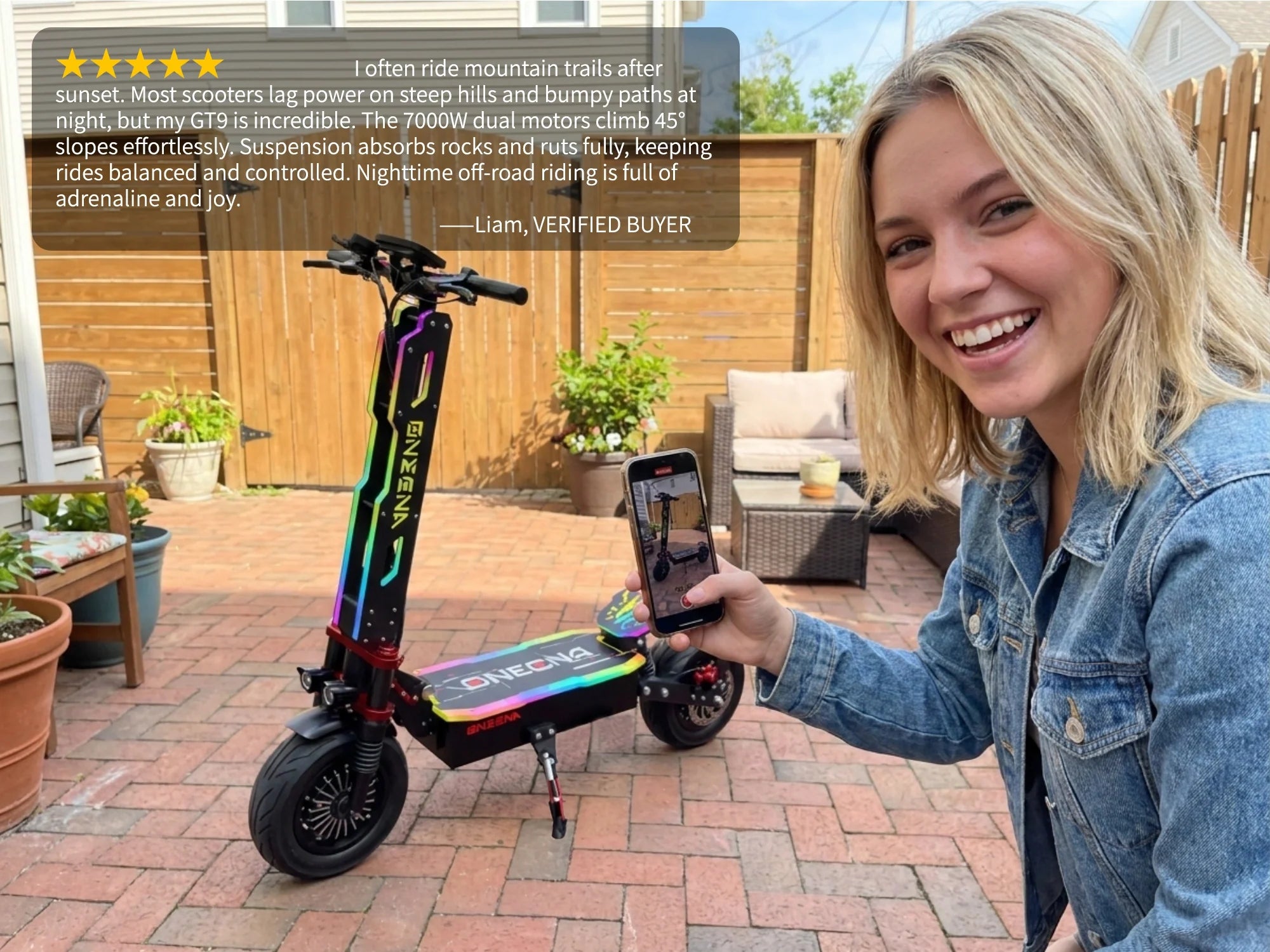
For example, the ONECNA GT9 — which has a 7,000W dual motor and a top speed of 55 mph — can be set to a 15 mph limit via its riding mode selector for compliant urban commuting, then switched to full performance mode for off-road or private track use. This dual-use capability is what makes high-performance scooters practical for everyday riders who also want performance headroom.
Public Roads vs. Private Property: Different Rules Apply
The single most important distinction in e scooter law is the public/private divide. Speed limits, helmet laws, age restrictions, and licensing requirements all apply to public roads, bike lanes, and shared paths. On private property — with the landowner's permission — most of these restrictions do not apply.
What Counts as Private Property?
- Private parking lots (with owner permission)
- Private roads on residential or commercial property
- Dedicated off-road riding areas and tracks
- Large private estates or rural land
- Some industrial or warehouse facilities
What Does Not Count as Private Property
- Public parks (even if they feel remote)
- Sidewalks and pedestrian plazas
- Shared-use paths maintained by the city
- Parking structures owned by municipalities
- School grounds during school hours
The practical implication: if you own a high-performance scooter and want to experience its full speed capability legally, you need access to private land or a dedicated riding facility. Riding at 40+ mph on a public bike path is illegal in every U.S. state, regardless of how empty it appears.
How to Ride Fast — and Stay Legal
Riding within the law doesn't mean sacrificing the experience of owning a capable scooter. It means understanding which mode to use where, and planning your riding accordingly.
Step 1: Know Your State's Classification Rules
Before you ride on public roads, confirm whether your scooter's top speed capability triggers any registration or licensing requirements in your state. This is a one-time check that takes 10 minutes and can save you significant legal headaches.
Step 2: Set Your Speed Mode Before You Leave
If your scooter has multiple speed modes, set it to the appropriate legal mode before you start riding in public. Don't rely on remembering to switch modes mid-ride — it's easy to forget, and the consequences of being stopped in Sport mode on a public road are the same as if you were actively speeding.
Step 3: Use GPS Route Planning
Apps like Komoot, Ride with GPS, and even Google Maps can help you identify bike lanes, shared paths, and road types along your route. Knowing in advance where you'll be riding helps you anticipate speed limit changes — particularly in cities where limits drop to 10 mph near schools and parks.
Step 4: Find Legal High-Speed Riding Venues
If you want to experience your scooter's full performance capability, look for:
- Private off-road riding areas and motocross facilities that allow e scooters
- Large private parking lots (with permission from the property owner)
- Rural private roads on land you own or have access to
- Dedicated e-scooter or EV riding events in your area
Step 5: Wear Appropriate Gear for Your Speed
Even where helmet laws don't apply to adults, the physics of riding at speed don't change based on legal requirements. At 15 mph, a standard bicycle helmet provides meaningful protection. At 30+ mph on private property, a full-face motorcycle helmet and protective jacket are the appropriate gear — not because the law requires it, but because the risk profile is fundamentally different.

Frequently Asked Questions
What is the legal speed limit for e scooters in the U.S.?
The most common legal speed limit for e scooters on public roads and bike paths in the U.S. is 15 mph, which applies in California, Florida, New York, and Washington, among others. Some states — including Texas, Colorado, and Arizona — allow up to 20 mph. Local ordinances can set lower limits in specific zones (schools, parks, pedestrian plazas). There is no single federal standard; always check your state and city rules.
Can I ride my e scooter faster than 15 mph legally?
On public roads and bike paths, only if your state's law permits it (some allow 20 mph). On private property with the landowner's permission, there is typically no speed restriction. The key distinction is public vs. private infrastructure — not the scooter's hardware capability.
Do I need a license if my scooter can go faster than the legal limit?
It depends on your state's classification rules. In California, a scooter capable of more than 30 mph may be classified as a motorized vehicle requiring a driver's license and registration. In Texas, the threshold is 35 mph. Check your state's DMV website for the specific classification criteria — the relevant factor is usually the scooter's maximum speed capability, not how fast you actually ride it.
How are e scooter speed limits enforced?
Shared rental scooters (Bird, Lime, Spin) enforce speed limits automatically via GPS geofencing — the motor is throttled in restricted zones. For privately owned scooters, enforcement is primarily reactive: a police officer must observe a violation. Fines vary by state and city, ranging from $50 to $500+ for repeat offenses in places like New York City.
What happens if I get caught riding above the speed limit?
Consequences vary by jurisdiction. Common outcomes include a traffic citation (typically $100–$500), points on your driving record in some states, and in rare cases, scooter confiscation for repeat or egregious violations. In states where your scooter's top speed triggers a moped classification, riding without the required registration or license can result in more serious penalties.
Can I modify my scooter to go faster legally?
Modifying a scooter to exceed its original speed rating may affect its legal classification and void any warranty. More importantly, if the modification causes the scooter to exceed the threshold for a different vehicle class in your state, you may be required to register it, obtain insurance, and hold a valid driver's license to operate it on public roads. Modifications for private property use only are generally not regulated, but always verify your state's specific rules.
Is there a federal e scooter speed limit?
No. The U.S. does not have a federal speed limit for electric scooters. Regulation is handled at the state level, with cities and counties able to impose additional local restrictions. The Consumer Product Safety Commission (CPSC) sets safety standards for e scooter hardware (including a 20 mph cap for the "low-speed electric scooter" product category), but this is a product classification standard, not a riding speed law.
Share:
E Scooter LED Light: A Complete Guide to Safer and Brighter Riding
Fastest Cheapest E Scooter: How to Find the Best Value for Your Money