




Table of Contents
- Why Night Riding on Electric Scooters Is Different
- Lighting Setup: What You Actually Need
- Reflective Gear & High-Visibility Clothing
- Speed Management After Dark
- Route Planning for Night Rides
- Situational Awareness & Defensive Riding
- When to Ride: Dusk vs. Full Dark vs. Pre-Dawn
- Pre-Ride Night Safety Checklist
- FAQ
Why Night Riding on Electric Scooters Is Different
The best practices for safe night riding on electric scooters start with understanding one fundamental truth: darkness doesn't just reduce what you can see — it dramatically reduces how visible you are to everyone else on the road. According to the NHTSA, pedestrians and cyclists are significantly more likely to be involved in fatal traffic incidents after dark, despite lower overall traffic volume. Scooter riders face the same risk profile.
Daytime riding gives you a full visual field, predictable lighting, and natural contrast between your scooter and the road. At night, all of that changes. Depth perception degrades. Peripheral vision narrows. Reaction times for both you and drivers around you compress. A pothole that's obvious at noon becomes invisible at 10 PM without proper lighting.
None of this means night riding is inherently dangerous — millions of commuters do it safely every day. But it does mean the margin for error is smaller, and preparation matters more. The sections below break down exactly what to do, why it works, and when each practice matters most.
Lighting Setup: What You Actually Need
What: The Three-Light Minimum
A safe night riding setup requires at minimum three light sources:
- Front headlight — illuminates the path ahead and signals your presence to oncoming traffic
- Rear taillight — makes you visible to vehicles approaching from behind
- Supplemental side or deck lighting — fills the blind spots that front/rear lights miss, especially at intersections
Why Lumens Matter More Than You Think
Most entry-level scooters ship with headlights in the 100–300 lumen range. That's adequate for low-speed urban riding on well-lit streets, but falls short on unlit paths or at speeds above 20 MPH. At 30+ MPH, your stopping distance at night can exceed your headlight's throw distance — meaning you may not see an obstacle until it's too late to avoid it.
A practical benchmark: aim for a front light with at least 400–600 lumens for urban commuting, and 800+ lumens for unlit roads or off-road use. Some riders on higher-speed scooters add a dedicated handlebar-mounted light (like a bike light rated at 1000+ lumens) as a supplement to the built-in headlight.
How to Check Your Scooter's Lighting
- Test headlight and taillight before every night ride — bulbs and connections can fail without warning
- Check that the headlight beam angle is adjusted correctly — too high blinds oncoming traffic, too low shortens your visible range
- Verify the taillight is visible from at least 100 feet in normal conditions
- If your scooter has a brake light function (separate from the running taillight), confirm it activates when you squeeze the brake lever
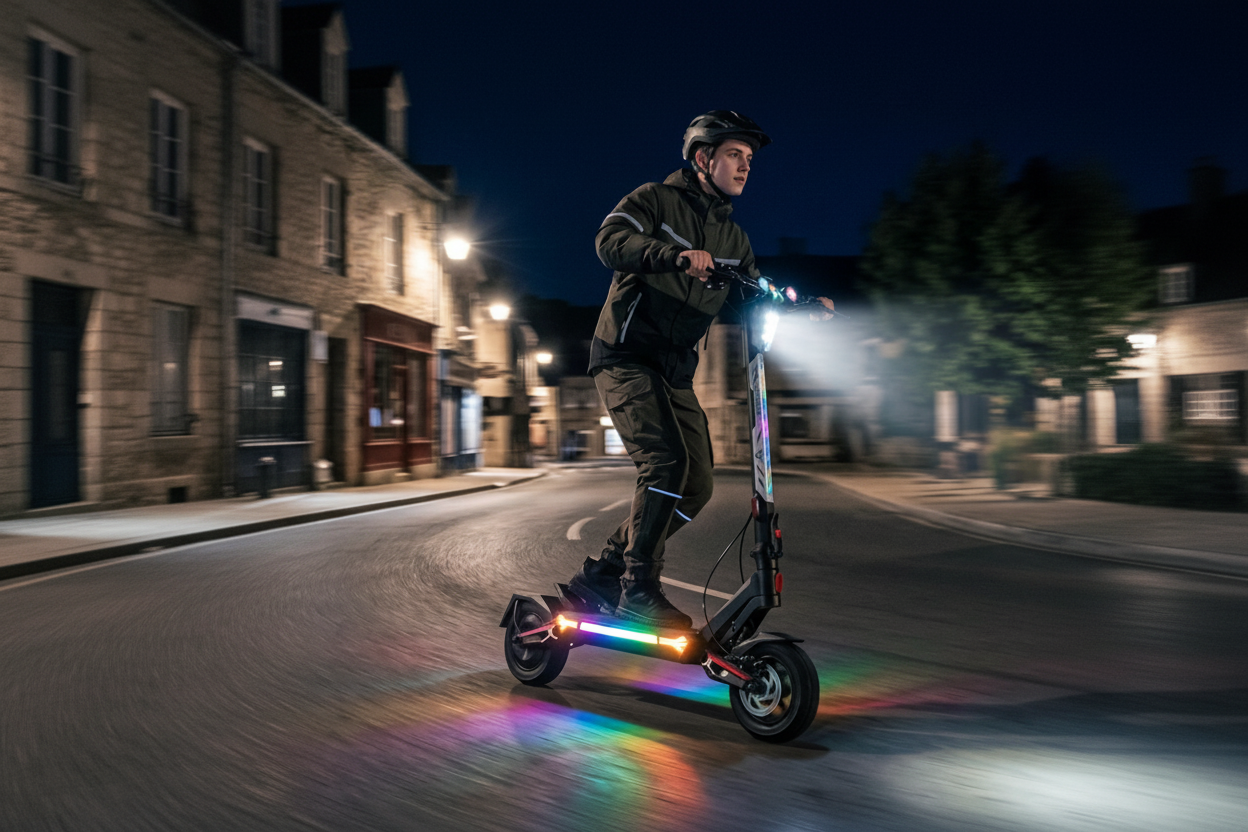
Scooters with integrated RGB or accent lighting — like some ONECNA GT-series models — add lateral visibility as a side benefit, though these are not a substitute for a proper front/rear lighting system.
Reflective Gear & High-Visibility Clothing
What Drivers Actually See
A driver's headlights illuminate a rider wearing dark clothing at roughly 50–75 feet — less than two seconds of reaction time at 30 MPH. The same driver can spot a rider in a high-visibility vest at 500+ feet. That gap is the difference between a close call and a collision.
What to Wear
- High-visibility vest or jacket — fluorescent yellow-green is the most visible color in low-light conditions, outperforming orange and red
- Reflective ankle bands — moving reflectors (on ankles and wrists) are more attention-grabbing to drivers than static ones
- Helmet with reflective strips — your head is the highest point on your profile; making it visible matters
- Reflective gloves — hand signals become visible at night with reflective material on the back of the glove
Passive vs. Active Visibility
Reflective gear is passive — it only works when a light source hits it. For routes with minimal street lighting or vehicle traffic, consider adding active visibility: a small LED clip-on light on your helmet or backpack that emits light independently of external sources. These cost under $15 and can be seen from 400+ feet.
Speed Management After Dark
Why Your Daytime Speed Is Too Fast at Night
Speed management is the most underrated element of night riding safety. The physics are straightforward: your reaction time stays roughly the same (0.7–1.5 seconds for most adults), but your ability to detect hazards decreases significantly after dark. At 25 MPH, you travel about 37 feet per second. If your headlight only illuminates 60 feet ahead, you have less than two seconds to identify and respond to anything in your path.
Practical Speed Guidelines by Condition
- Well-lit urban streets: Ride at or slightly below your normal daytime speed — visibility is comparable
- Partially lit roads: Reduce speed by 20–30% and increase following distance from vehicles ahead
- Unlit paths or bike lanes: Drop to a speed where you can stop within your headlight's throw distance — typically 15–20 MPH maximum
- Wet roads at night: Reduce speed by at least 40% — wet pavement reflects light unpredictably and extends braking distance
Using Dual Drive Mode Strategically
Riders on dual-motor scooters have the option to switch between single and dual drive modes. At night, single drive mode is often the better choice for urban commuting — it delivers smoother, more predictable acceleration and reduces the risk of wheel spin on slick surfaces. Reserve dual mode for situations where you need rapid acceleration to clear an intersection safely.
Route Planning for Night Rides
Why Route Choice Changes Everything
The same distance can carry very different risk profiles depending on the route. A 3-mile commute on a well-lit protected bike lane is categorically safer than the same distance on an unlit arterial road — even if the arterial is faster.
How to Plan a Safe Night Route
- Prioritize lit infrastructure: Use Google Maps or Komoot to identify routes with street lighting. Satellite view at night can show lit vs. unlit corridors.
- Avoid high-speed vehicle roads: Roads with speed limits above 40 MPH are significantly more dangerous for scooter riders at night, regardless of lighting.
- Identify road surface quality in advance: Potholes and debris are invisible at night. If you know a section of road has poor surface quality, either avoid it or slow to a crawl.
- Plan your intersections: Left turns across traffic are the highest-risk maneuver for scooter riders at night. Where possible, use crosswalks or right-turn-only routes.
- Have a backup route: If your primary route has unexpected construction or lighting outages, know your alternative before you leave.
When to Reconsider the Ride
Some conditions make night riding inadvisable regardless of preparation: dense fog (visibility under 100 feet), heavy rain, black ice, or routes with no shoulder and no lighting. In these cases, the safest practice is to delay the ride or use alternative transport.
Situational Awareness & Defensive Riding
The Defensive Riding Mindset
Defensive riding means operating on the assumption that other road users may not see you — because at night, they often don't. This isn't pessimism; it's the correct mental model for low-visibility conditions.
Key Defensive Practices
- Never assume a driver has seen you at an intersection, even if you have right of way. Make eye contact or wait for a clear signal before proceeding.
- Increase following distance behind vehicles — their brake lights give you less warning time at night because your reaction to the visual cue is slower in low-light conditions.
- Avoid riding in blind spots. Position yourself where you're visible in a driver's mirrors, not tucked alongside their vehicle.
- Use auditory cues. Keep one ear free if using earbuds — ambient sound (approaching vehicles, warning horns) is a critical input at night.
- Scan further ahead. Train yourself to look 10–15 seconds ahead on your route rather than just the immediate path. This gives you more time to identify and respond to hazards.
Managing Fatigue
Night riding, especially after a full workday, introduces fatigue as a compounding risk factor. Reaction times degrade measurably after 16+ hours of wakefulness. If you're riding home late after a long day, be honest with yourself about your alertness level. A 10-minute rest before a night commute can meaningfully improve your response time.
When to Ride: Dusk vs. Full Dark vs. Pre-Dawn
Dusk (Sunset to ~1 Hour After)
Dusk is statistically the most dangerous period for riders and pedestrians. Ambient light is low enough to impair visibility but not dark enough for drivers to have their headlights on — or to be mentally in "night driving" mode. Your scooter's lights are less visible against the fading sky. If you ride at dusk, activate all lights and wear high-visibility gear even if it feels unnecessary.
Full Dark (1 Hour After Sunset to Pre-Dawn)
Counterintuitively, full dark is often safer than dusk for scooter riders. Drivers are in night-driving mode, headlights are on, and your lights and reflective gear stand out clearly against the dark background. Traffic volume is also typically lower. The main risks shift to road surface hazards (potholes, debris) and fatigue.
Pre-Dawn (1–2 Hours Before Sunrise)
Pre-dawn shares characteristics with dusk — ambient light begins to return, creating the same transitional visibility challenges. Additionally, this window often coincides with peak driver fatigue (the 4–6 AM window has elevated accident rates). Treat pre-dawn with the same caution as dusk.
Pre-Ride Night Safety Checklist
Run through this before every night ride — it takes under two minutes and covers the most common failure points:
| Check | What to Verify |
|---|---|
| Headlight | On, aimed correctly, adequate brightness |
| Taillight | On, visible from 100+ feet |
| Brake light | Activates when brake lever is pressed |
| Battery level | Sufficient for the full route + 20% buffer |
| Tire pressure | Within spec — low pressure increases stopping distance |
| Brakes | Firm lever feel, no grinding or sponginess |
| Reflective gear | Vest, ankle bands, helmet strips in place |
| Phone charge | Sufficient for navigation + emergency calls |
| Route | Planned, including backup option |
| Helmet | Fastened, fit checked |
Riders on higher-speed models — such as those in the ONECNA GT series capable of 45–55 MPH — should treat this checklist as non-negotiable. At those speeds, a lighting failure or brake issue at night has significantly higher consequences than on a 20 MPH commuter scooter.
FAQ — Safe Night Riding on Electric Scooters
Is it legal to ride an electric scooter at night?
In most US states and cities, yes — but with conditions. Many jurisdictions require a functioning front white light and rear red reflector or light for night riding. Some cities additionally require a bell or horn. Check your local municipal code before riding after dark, as requirements vary significantly by location.
What is the minimum lighting required for safe night riding?
At minimum: a front headlight (400+ lumens recommended), a rear taillight, and reflective material on your person. For speeds above 25 MPH or unlit roads, supplement with a dedicated handlebar light and active LED visibility aids on your helmet or clothing.
How much does night riding reduce my scooter's range?
Running lights draw power from the battery. On most scooters, headlight and taillight consumption is modest (5–15W combined), which reduces range by roughly 3–8% depending on battery size. On a 60-mile range scooter like the GT8 PRO, that's a 2–5 mile reduction — worth accounting for on longer night rides.
Should I wear a helmet for night riding even if it's not required?
Yes, without qualification. Head injuries are the leading cause of serious e-scooter fatalities. At night, the risk of an undetected road hazard causing a fall is higher than during the day. A helmet with integrated or attached rear LED light also improves your visibility to drivers.
What speed is safe for riding an electric scooter at night?
There's no universal answer — it depends on lighting conditions, road surface, and your scooter's headlight output. A practical rule: never ride faster than the speed at which you can stop within your headlight's illuminated distance. On unlit paths, that typically means 15–20 MPH maximum. On well-lit urban streets, your normal commuting speed is generally appropriate.
Can I use my phone's flashlight as a substitute for a headlight?
No. A phone flashlight is not a substitute for a proper headlight — it's not mounted at the correct angle, it's not rated for sustained use, and it occupies a hand you need for control. If your scooter's headlight fails, stop riding and arrange alternative transport.
What's the best color for night riding visibility?
Fluorescent yellow-green is the most visible color in low-light and transitional lighting conditions, outperforming orange, red, and white for human visual detection. For active lights, white (front) and red (rear) are the standard and are legally required in most jurisdictions.
Share:
Guide to Maintaining Your Electric Scooter for Longevity
Understanding Scooter Battery Life and Extending Range