




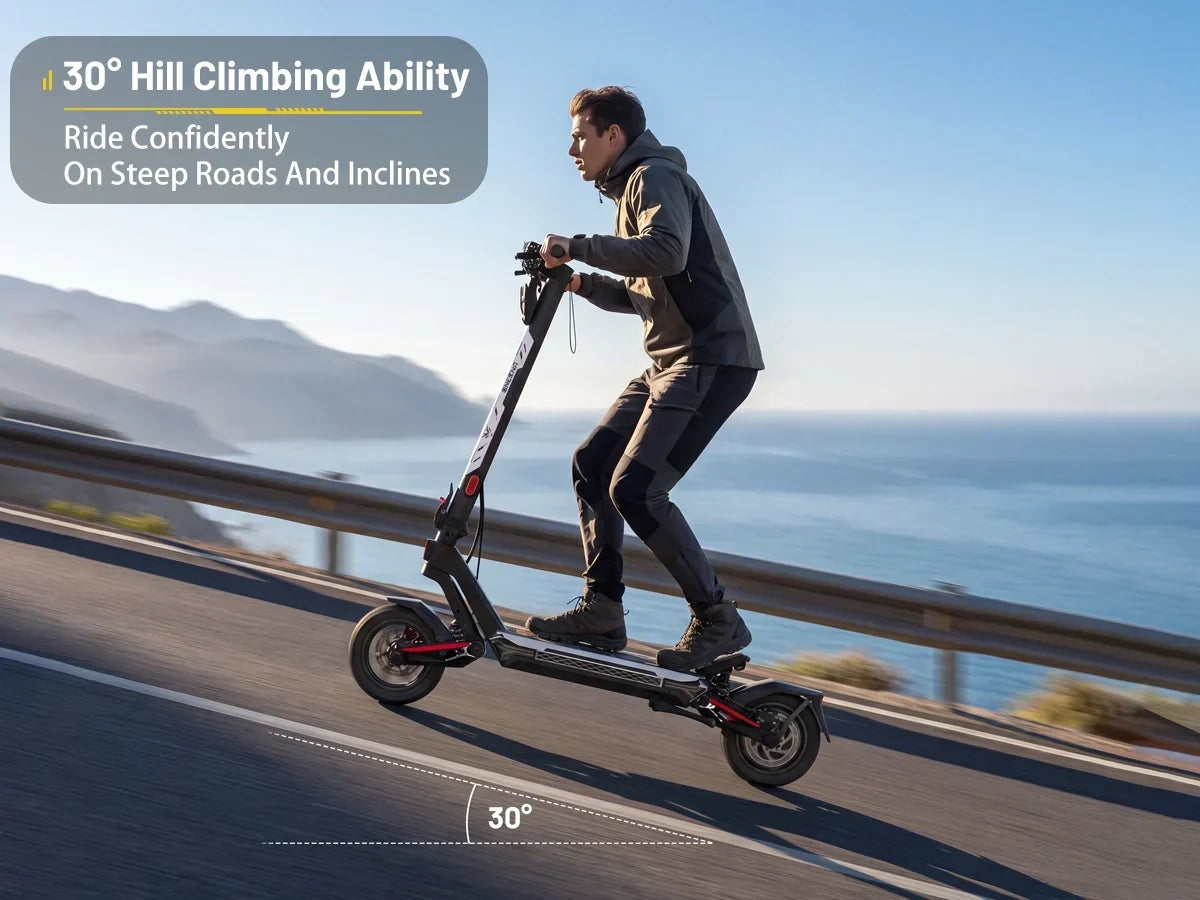
Can you drive an e scooter on the road? It's one of the most searched questions among new and prospective electric scooter riders — and the answer is more nuanced than a simple yes or no. Road access for e scooters varies by state, city, and even the scooter's own specifications. This guide covers what the law actually says, why the rules differ so much, how to determine if your scooter is street-legal, and when you can (and can't) ride on public roads.
📋 Article Outline
- What Does the Law Actually Say?
- Why E Scooter Road Rules Differ by Location
- How to Know If Your E Scooter Is Street-Legal
- Road vs. Bike Lane vs. Sidewalk: Where Can You Ride?
- US State-by-State Overview
- Safety Requirements for Road Riding
- When You Should NOT Ride on the Road
- FAQ
What Does the Law Actually Say?
In the United States, there is no single federal law governing electric scooter road use. Regulation is handled at the state level — and sometimes at the city or county level within states. This creates a patchwork of rules that can change the moment you cross a city line.
That said, most states that have addressed e scooter legislation follow a similar framework built around three key variables:
- Motor wattage — most states cap street-legal e scooters at 750W–2,000W
- Top speed — typically limited to 20–30 mph for road-legal classification
- Rider age — most states require riders to be 16 or 18+
If your scooter exceeds these thresholds, it may be classified as a moped or motorcycle — which triggers an entirely different set of requirements: registration, insurance, a valid driver's license, and in some cases a motorcycle endorsement.
The practical takeaway: most consumer-grade commuter e scooters are legal to ride on roads in most US states, provided you follow local speed limits and use designated lanes where required. High-performance off-road scooters with motors above 2,000W occupy a legal gray area in many jurisdictions.
Why E Scooter Road Rules Differ So Much by Location
The variation in e scooter laws isn't arbitrary — it reflects genuine differences in infrastructure, traffic density, political priorities, and how quickly local governments have been able to respond to a technology that arrived faster than legislation could keep up with.
Infrastructure Differences
Cities with extensive protected bike lane networks (like Portland, Minneapolis, and Washington D.C.) have been more willing to integrate e scooters into existing infrastructure. Cities without dedicated cycling infrastructure face harder questions about where scooters belong — on roads with 45 mph traffic, or on sidewalks with pedestrians.
Shared Scooter Programs vs. Personal Ownership
Many cities developed their e scooter laws specifically in response to shared scooter programs (Lime, Bird, Spin). These laws were written for low-speed, GPS-tracked rental scooters — not necessarily for privately owned performance scooters. This creates situations where a rental scooter is explicitly legal but a privately owned scooter with similar specs exists in a regulatory gap.
Speed and Power Thresholds
The 20 mph threshold appears in many state laws because it aligns with existing electric bicycle (e-bike) classifications. Scooters that stay under 20 mph are often treated similarly to e-bikes. Those that exceed it may require registration or be prohibited from bike lanes entirely.
How to Know If Your E Scooter Is Street-Legal
Before riding on any public road, work through this checklist:
Step 1: Check Your Scooter's Specs
- Motor wattage: Is it under 750W (e-bike equivalent) or under 2,000W (moped threshold in most states)?
- Top speed: Can it be limited to 20–25 mph for road use?
- Lighting: Does it have a front headlight and rear taillight/reflector?
- Brakes: Does it have at least one functional mechanical brake?
Step 2: Look Up Your State Law
Search "[your state] electric scooter law" and look for the official state DMV or legislature website. Key things to confirm:
- Is registration required?
- Is a driver's license required?
- Is a helmet required (and for what age groups)?
- Are e scooters allowed on roads, bike lanes, or both?
- Is there a speed limit specific to e scooters?
Step 3: Check Local City Ordinances
State law sets the floor, but cities can add restrictions. A scooter legal under state law may be banned from certain downtown zones, boardwalks, or school zones by local ordinance. Always check both levels.
Step 4: Confirm Insurance Requirements
Most states do not require insurance for e scooters classified below the moped threshold. However, if your scooter is classified as a moped or motorcycle due to its power output, liability insurance is typically mandatory.
Road vs. Bike Lane vs. Sidewalk: Where Can You Actually Ride?
This is where most riders get confused — and where the rules vary most dramatically. Here's a general breakdown:
| Location | Typically Allowed? | Key Conditions |
|---|---|---|
| Road (travel lane) | ✅ Often yes | Speed limit usually ≤35 mph; scooter must have lights |
| Protected bike lane | ✅ Usually yes | Speed ≤20 mph in most jurisdictions |
| Shared bike/ped path | ⚠️ Sometimes | Often limited to 15 mph; varies widely by city |
| Sidewalk | ❌ Usually no | Banned in most US cities; pedestrian safety concern |
| Highway / freeway | ❌ No | Prohibited in all US states |
The general rule of thumb: If there's a bike lane available, use it. If there isn't, ride as far right as safely possible in the travel lane. Never ride on sidewalks unless you're in a jurisdiction that explicitly permits it (rare in urban areas).
One important nuance: road speed limits matter. Most state laws that permit e scooters on roads restrict this to roads with speed limits of 25–35 mph or lower. Riding on a 45 mph arterial road is both dangerous and often illegal, even if e scooters are technically permitted on roads in your state.
US State-by-State Overview: Key E Scooter Road Rules
The following covers major states and their general stance as of 2025–2026. Always verify current local law before riding — regulations change frequently.
| State | Road Legal? | Speed Limit | Helmet Required? | License Required? |
|---|---|---|---|---|
| California | ✅ Yes | 15 mph | Under 18 only | No (must be 16+) |
| Texas | ✅ Yes | 35 mph road max | No | No |
| Florida | ✅ Yes | 25 mph | Under 16 only | No |
| New York | ✅ Yes (2020+) | 15 mph | Under 18 only | No (must be 16+) |
| Washington | ✅ Yes | 20 mph | Yes (all ages) | No |
| Colorado | ✅ Yes | 20 mph | Under 18 only | No |
| Illinois | ✅ Yes | 20 mph | Under 18 only | No |
| Georgia | ✅ Yes | 35 mph road max | No | No |
| Arizona | ✅ Yes | 20 mph | No | No |
| Oregon | ✅ Yes | 20 mph | Yes (all ages) | No |
Note: This table reflects general state-level law. City and county ordinances may be more restrictive. Always verify with your local DMV or city transportation authority.
Safety Requirements for Road Riding: What You Actually Need
Even where e scooters are legally permitted on roads, riding safely requires more than just knowing the law. Here's what experienced riders consider non-negotiable:
Lighting
A front white headlight and rear red taillight or reflector are legally required in most states for road riding after dark — and strongly recommended at all times. Many scooters come with built-in lighting, but the brightness varies significantly. If your scooter's stock lights are dim, aftermarket upgrades are worth the investment.
Helmet
Even where helmets aren't legally required for adults, wearing one is the single most effective safety measure available to a scooter rider. A standard bicycle helmet provides meaningful protection. A full-face helmet is recommended for speeds above 20 mph or road riding in traffic.
Visibility Gear
- High-visibility vest or jacket (especially for dawn/dusk riding)
- Reflective ankle bands (visible to drivers at low angles)
- Bright clothing — avoid dark colors at night
Mechanical Readiness
Before any road ride, check:
- Tire pressure — under-inflated tires reduce braking distance and handling
- Brake function — both front and rear should engage firmly without excessive lever travel
- Folding mechanism (if applicable) — must be fully locked before riding
- Battery level — don't start a road ride below 20%; range drops faster in traffic with frequent acceleration
Riding Behavior on Roads
- Signal turns using hand signals
- Ride predictably — no sudden lane changes or weaving
- Maintain at least 3 feet from parked cars (door zone)
- Make eye contact with drivers at intersections before proceeding
- Never ride with headphones in both ears
When You Should NOT Ride an E Scooter on the Road
Knowing when not to ride is as important as knowing when you can. Avoid road riding in these situations:
- Speed limits above 35 mph — the speed differential between your scooter and traffic creates serious risk
- No shoulder or bike lane on a multi-lane road — you become an obstacle in fast-moving traffic
- Heavy rain or standing water — even IP54-rated scooters can have reduced braking performance on wet surfaces; hydroplaning is a real risk on smooth tires
- Night riding without proper lighting — if your scooter's lights aren't bright enough to be seen from 300+ feet, don't ride in traffic after dark
- Mechanical issues — a brake that feels "a little soft" on a trail is a brake failure waiting to happen in traffic
- Unfamiliar roads — potholes, railroad tracks, and drainage grates that you'd navigate easily on a familiar route can cause falls on unknown roads
High-performance scooters like the ONECNA GT9 are built with dual suspension and large-diameter tires that handle road imperfections well — but no scooter engineering substitutes for situational awareness and appropriate route selection.
FAQ: Can You Drive an E Scooter on the Road?
Q: Is it legal to ride an electric scooter on the road in the US?
In most US states, yes — with conditions. The scooter typically must stay under 20–25 mph, the road must have a speed limit of 35 mph or lower, and the rider must meet minimum age requirements. Some states require helmets; most do not require a license or registration for scooters under the moped threshold.
Q: Do I need a license to ride an e scooter on the road?
In most US states, no license is required for e scooters classified below the moped threshold (typically under 750W–2,000W and under 20–30 mph). However, if your scooter is classified as a moped or motorcycle due to its power output, a valid driver's license — and sometimes a motorcycle endorsement — is required.
Q: Can I ride my e scooter in a bike lane?
In most jurisdictions, yes. Bike lanes are the preferred riding location for e scooters in areas where they exist. Speed is typically limited to 15–20 mph in bike lanes. Some cities restrict e scooters to protected bike lanes only and prohibit them from shared pedestrian paths.
Q: Do I need insurance for an e scooter?
For most consumer e scooters (under the moped threshold), insurance is not legally required in the US. However, personal liability coverage is worth considering — if you cause an accident, you could be held financially responsible for damages. Some homeowner's or renter's insurance policies extend limited coverage to e scooters; check your policy.
Q: What happens if I ride my e scooter illegally on the road?
Penalties vary by jurisdiction but typically include fines ranging from $50 to $500. In some cities, the scooter can be impounded. Repeat violations may result in higher fines. More importantly, riding illegally often means riding in conditions that are genuinely unsafe — the legal risk is secondary to the physical risk.
Q: Can I ride a high-powered e scooter (2,000W+) on the road?
In most US states, scooters above 2,000W (or capable of speeds above 30 mph) are classified as mopeds or motorcycles. This means they require registration, insurance, and a valid driver's license to operate on public roads. Some states have lower thresholds. Always check your state's specific classification rules before riding a high-power scooter on public roads.
Q: Are e scooters allowed on sidewalks?
In most US cities, no. Sidewalk riding is prohibited for e scooters in the majority of urban areas due to pedestrian safety concerns. Some suburban or rural areas may permit it, but this is the exception rather than the rule. When in doubt, assume sidewalk riding is not permitted and use the road or bike lane instead.
Q: What speed should I ride at on the road?
Match traffic speed where safely possible, up to your scooter's legal limit. On roads with a 25 mph speed limit, riding at 15–20 mph is generally safe and legal. Avoid riding significantly slower than surrounding traffic on multi-lane roads — this creates a hazard. If you can't keep up with traffic safely, the road may not be appropriate for scooter use.
Q: Do e scooters need to follow the same traffic laws as cars?
Yes, in virtually all US jurisdictions. E scooters must obey traffic signals, stop signs, lane markings, and right-of-way rules just like any other vehicle. Running red lights or stop signs on a scooter carries the same legal consequences as doing so in a car — and significantly higher physical risk.
Share:
Most Reliable E Scooter: How to Choose a Durable Electric Scooter
Best E Scooter for Big Guys: Top Picks for Power, Comfort and Stability