




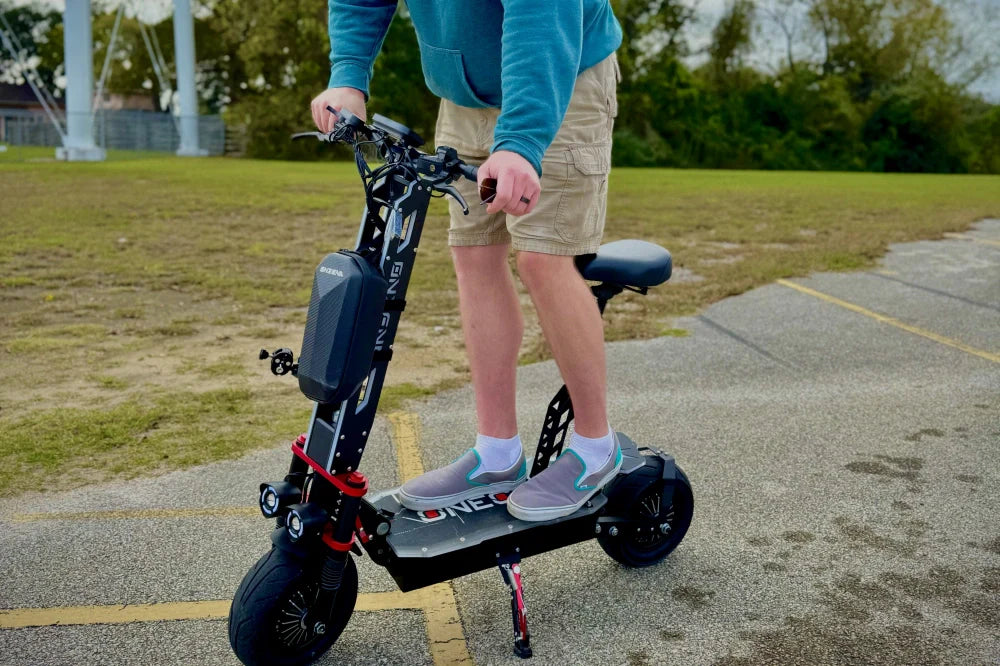
Speed gets the attention. Power sells the dream. But braking is what ultimately defines control.
For any high-performance electric scooter, choosing the right braking system is not optional — it is foundational. That is why understanding electric scooter disc brakes is essential for riders who value safety, predictability, and real-world performance.
In this guide, we break down how disc brakes work, the differences between mechanical and hydraulic systems, and why braking design plays a critical role in performance scooters like those developed by ONECNA 🔧.
Why Braking Systems Matter More Than You Think
Electric scooters are capable of rapid acceleration and increasingly higher top speeds.
As power increases, so does stopping distance — unless the braking system is designed to manage that energy effectively.
A weak braking setup can turn even moderate speeds into a safety risk, especially on downhill terrain, wet roads, or loose surfaces.
This is why disc brakes have become the standard for performance-oriented electric scooters.
What Are Disc Brakes and How Do They Work?
Disc brakes use calipers to clamp brake pads onto a metal rotor attached to the wheel hub.
When the rider pulls the brake lever, friction is generated between the pads and the rotor, converting kinetic energy into heat and slowing the wheel.
Compared to drum or electronic braking alone, disc brakes offer:
- Stronger stopping power
- More consistent performance
- Better heat dissipation
- Improved control under load
Types of Electric Scooter Disc Brakes
Mechanical Disc Brakes
Mechanical disc brakes use a steel cable to actuate the brake caliper.
They are widely used due to their simplicity, durability, and ease of maintenance.
Mechanical systems provide reliable braking for everyday riding and moderate speeds, making them suitable for urban and commuter scooters.
Hydraulic Disc Brakes
Hydraulic disc brakes rely on fluid pressure rather than cables.
When the brake lever is pulled, hydraulic fluid transfers force evenly to the caliper pistons, producing smoother and stronger braking.
Hydraulic systems offer superior modulation and are better suited for high-speed, off-road, and heavy-duty electric scooters.
Mechanical vs Hydraulic: Key Differences Explained
The difference between mechanical and hydraulic disc brakes lies in how force is transferred.
| Feature | Mechanical | Hydraulic |
|---|---|---|
| Force Transmission | Steel cable | Hydraulic fluid |
| Braking Power | Moderate | High |
| Modulation | Basic | Precise |
| Maintenance | Simple | More technical |
For riders pushing higher speeds or heavier loads, hydraulic disc brakes provide a clear advantage.
Braking Performance at Different Speeds
At low speeds, most braking systems feel adequate.
However, as speed increases, braking demands rise exponentially.
High-speed scooters require braking systems that can deliver consistent stopping force without fading or loss of control.
Performance models categorized as electric scooter disc brakes are engineered with larger rotors and reinforced calipers to handle repeated high-energy stops.
Maintenance, Reliability, and Longevity
Mechanical disc brakes are easier to adjust and repair, making them appealing for riders who prefer low-maintenance systems.
Hydraulic brakes, while requiring more specialized servicing, offer longer pad life and more consistent performance under stress.
In both cases, rotor quality and caliper alignment play a crucial role in braking reliability.
Which Riders Need Disc Brakes the Most?
Disc brakes are essential for riders who:
- Ride at higher speeds regularly
- Operate on hills or uneven terrain
- Use dual-motor or high-torque scooters
- Carry heavier rider loads
For these users, disc brakes are not an upgrade — they are a requirement.
Disc Brakes for Off-Road and High-Power Scooters
Off-road riding introduces unpredictable traction, loose surfaces, and sudden obstacles.
Disc brakes excel in these conditions due to their exposure and cooling efficiency.
High-power models such as the electric scooter disc brakes are designed to deliver controlled stopping power even when traction varies.
How ONECNA Integrates Braking into Performance Design
ONECNA approaches braking as part of the overall riding system, not a standalone component.
Frame geometry, weight distribution, tire grip, and suspension tuning are all optimized to support braking performance.
This integrated design philosophy ensures that each electric scooter disc brakes setup delivers predictable, repeatable stopping under real-world conditions 🚀.
Final Thoughts: Control Is the Real Performance Metric
Electric scooters continue to get faster and more powerful.
But true performance is defined by control — not just speed.
Choosing the right disc braking system ensures confidence, safety, and long-term riding enjoyment, no matter where the road leads.
Share:
Not All Bumps Are Equal: Choosing the Right Scooter with Shock Absorber
Lock It Smart: How to Keep an Electric Scooter from Being Stolen