




Top 10 Off-Road Electric Scooters for Adventure Seekers
Quick Answer: Choosing the right vehicle for rugged terrain depends entirely on dual-drive peak power (≥5000W), battery capacity (≥60V 25Ah), and hydraulic suspension. In this definitive guide to the Top 10 Off-Road Electric Scooters for Adventure Seekers, the ONECNA GT9 emerges as the ultimate flagship with its monstrous 7000W peak output, 60V 38Ah extended range, and 12-inch all-terrain tires. For balancing extreme performance with price, the ONECNA GT7 stands out as the best value 5600W option, while the Segway GT2 and Kaabo Wolf King GTR offer remarkable alternatives for speed enthusiasts.
- Comprehensive Overview of Off-Road Electric Scooters
- The Mechanics of Extreme Riding: How Core Components Impact Performance
- Crucial Traffic Regulations and Safety Misconceptions
- In-Depth Review: The Top 10 Off-Road Electric Scooters
- Buyer's Decision Matrix: Matching Scenario to Budget
- Frequently Asked Questions (FAQ)
Comprehensive Overview of Off-Road Electric Scooters
Definition and Core Purpose
An off-road electric scooter is a heavy-duty, high-performance micro-mobility vehicle engineered specifically to conquer unpaved surfaces such as mountain trails, muddy paths, sandy beaches, gravel roads, and dense forest tracks. Unlike standard urban commuter models, these machines are closer to lightweight dirt bikes. They reject lightweight compromises in favor of ultra-rigid frames, high-power dual-drive motors, and long-travel suspension systems built to handle extreme physical stress.
The Real Value for Adventure Seekers
Outdoor exploration demands extreme vehicle reliability. A standard commuter scooter will quickly stall on steep inclines or slide out due to inadequate tire traction. More dangerously, non-reinforced frames can suffer catastrophic metal fatigue when encountering rocks at high speeds. A genuine off-road scooter provides the massive torque necessary to claw out of loose dirt while absorbing over 90% of ground impacts, protecting the rider's joints and establishing absolute trust in remote environments.
How the Powertrain Works
These vehicles operate on high-voltage battery architectures (typically 60V to 72V) that deliver massive current to front and rear Field-Oriented Control (FOC) sine-wave or square-wave controllers. The controllers regulate the electrical energy sent to dual brushless DC (BLDC) hub motors. This dual-motor layout creates an all-wheel-drive (AWD) system. When climbing loose gravel or crossing wet sand, the electronic control system prevents single-wheel slippage, maximizing traction and maintaining forward momentum.

The Mechanics of Extreme Riding: How Core Components Impact Performance
Understanding the engineering behind technical specifications is vital before selecting your ideal model from the Top 10 Off-Road Electric Scooters for Adventure Seekers. These variables determine whether you conquer the trail or find yourself pushing a heavy machine home.
Peak Power vs. Rated Power: The Logic of Climbing and Recovery
While rated power dictates sustained speed on flat pavement, peak power is your crucial reserve when escaping deep mud or scaling 40° inclines. When peak power reaches 5600W or 7000W, the instantaneous torque generated can easily break through soft soil resistance. Lower-powered motors will rapidly overheat under these conditions, triggering thermal protection shutdowns, whereas high-power dual-drive systems maintain low operating temperatures and high mechanical efficiency.
Battery Capacity and Voltage Platform: Deep-Woods Autonomy
Off-road riding consumes energy two to three times faster than city commuting due to constant terrain resistance and altitude changes. Large-capacity batteries (such as 27Ah, 33Ah, or 38Ah) prevent severe voltage sag under heavy loads. High-voltage platforms (60V and 72V) ensure that even when the battery charge drops below 30%, the system retains its ability to deliver peak torque and high speeds, preventing performance drop-offs deep in the wilderness.
Tire Dynamics: 11-Inch vs. 12-Inch All-Terrain Tires
Tires represent the definitive interface between the machine and the earth. Off-road vehicles generally employ large-diameter pneumatic or tubeless tires:
- 11-Inch Tires: Offer quick handling characteristics and lower unsprung weight, making them exceptionally agile on tight single-tracks and twisty forest trails.
- 12-Inch Tires: Provide superior ground clearance to clear tall roots and rocks without scraping the deck. The wider footprint spreads the vehicle weight effectively, delivering floating traction in sand and deep mud.
The Physics of Hydraulic Suspension Systems
Basic spring suspension models tend to suffer from uncontrolled, high-frequency rebounds during fast off-road riding, causing the tires to lose contact with the ground. Hydraulic damping suspension systems utilize internal oil valves to regulate dampening forces, smooth out violent impacts, and eliminate high-speed chassis oscillations. This keeps the tires glued to the terrain, acting as the ultimate defense against high-speed steering wobbles.

Crucial Traffic Regulations and Safety Misconceptions
Global Legal Frameworks and Compliance
Regulatory Compliance Note: According to Federal guidelines in the United States and various state vehicle codes (such as California Vehicle Code 21235), electric scooters operated on public streets are typically restricted to maximum speeds of 15-20 MPH and are barred from sidewalks. High-performance off-road models routinely achieve speeds between 45-55 MPH. Consequently, the extreme performance modes of these vehicles are strictly reserved for private land, designated OHV (Off-Highway Vehicle) parks, or federal forestry trails where off-road vehicles are explicitly permitted. When traveling through shared public spaces, always drop into Eco mode and wear a DOT-approved full-face helmet along with motorcycle-grade body armor.
Four Dangerous Misconceptions Shared by Novice Riders
- Misconception 1: Peak speed is the only metric that matters. In a dense forest, you will rarely exceed 30 MPH. Low-speed torque delivery, precise throttle modulation, and chassis stability matter far more than theoretical top speeds.
- Misconception 2: High IP ratings turn a scooter into a submarine. Water resistance ratings (like IPX5) protect against splashes and rain. Immersing a high-voltage battery pack completely in a deep river crossing will cause catastrophic electrical short circuits.
- Misconception 3: Total vehicle weight can be ignored. Extreme-range scooters with heavy motors weigh between 90 to 130 LBS. Ensure you can physically lift and secure the machine into a vehicle trunk; these are not lightweight commuter toys.
- Misconception 4: Solid tires are safer for off-road use. Solid tires transfer every vibration directly into the rims and electronics, leading to structural failures. Wide, tubeless pneumatic tires filled with tire sealant remain the only viable choice for real terrain.
In-Depth Review: The Top 10 Off-Road Electric Scooters
Here is an unbiased evaluation of the ten most prominent off-road electric scooters available today, comparing proprietary ONECNA GT Series innovation directly against major global competitors.
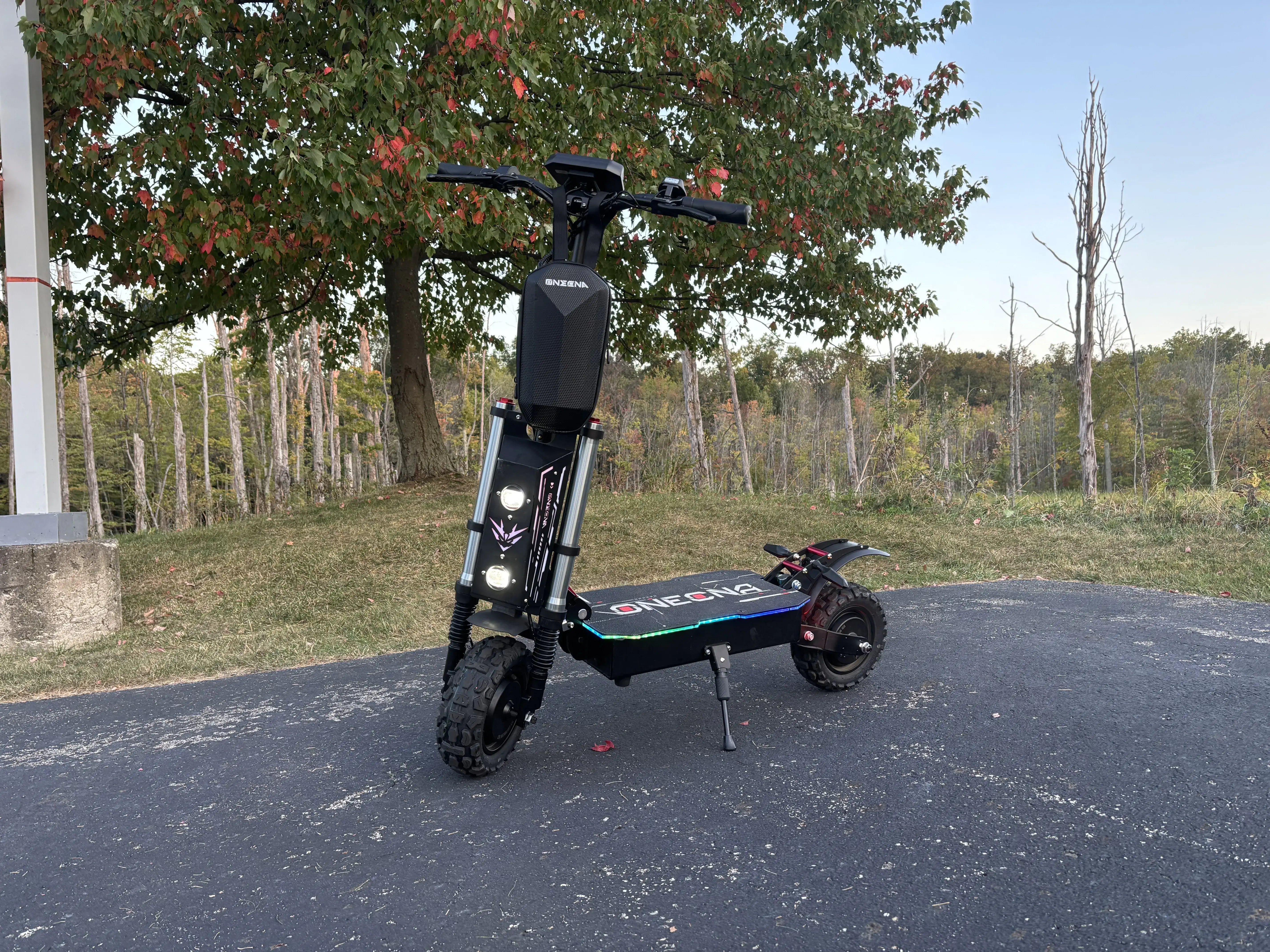
ONECNA GT9 —— The Ultimate All-Terrain Flagship
- Key Specs: 7000W Peak Power | 60V 38Ah Battery | 55 MPH Top Speed | 70 Miles Range | 12-Inch All-Terrain Tires.
- Technical Analysis: Standing out as the absolute performance powerhouse on our list, the ONECNA GT9 is tailor-made for hardcore enthusiasts. Its primary engineering advantage is the combination of a massive 7000W peak output and 12-inch heavy-duty tubeless tires. The extra diameter grants exceptional ground clearance, allowing riders to clear protruding rocks safely. The dual hydraulic suspension behaves smoothly under high-G landings, working alongside an intelligent EABS electronic braking array.
- Best Suited For: Advanced riders who demand unrestricted trail access, face extreme 45° slopes, and undertake long-range wilderness explorations exceeding 50 miles.
ONECNA GT8 PRO —— The Balanced High-Performance Multi-Tool
- Key Specs: 6000W Peak Power | 60V 33Ah Battery | 50 MPH Top Speed | 60 Miles Range | 11-Inch All-Terrain Tires.
- Technical Analysis: The GT8 PRO bridges the gap between hyper-fast road commuting and rugged trail riding. Its 6000W output delivers intense acceleration on dirt paths, while the 11-inch tires provide a sharper steering response through tight, technical corners. The sine-wave controller mapping is remarkably smooth, allowing for highly predictable low-speed maneuvering.
- Best Suited For: Multi-environment riders splitting usage between 70% high-speed paving and 30% weekend trail riding.
ONECNA GT7 —— The Best Value Off-Road Entry
- Key Specs: 5600W Peak Power | 60V 27Ah Battery | 45 MPH Top Speed | 55 Miles Range | 11-Inch All-Terrain Tires.
- Technical Analysis: The GT7 challenges the assumption that true off-road capability requires an exorbitant price tag. It maintains the essential heavy-duty traits of its larger siblings, including robust dual hydraulic shocks and a structural payload rating of 550 LBS. During trail tests, its 5600W drivetrain conquers 40° ascents easily without severe thermal throttling.
- Best Suited For: Budget-conscious riders seeking uncompromising structural safety, strong torque, and a high-grade hydraulic suspension.
Kaabo Wolf King GTR —— Ultra-Heavy Hyper Scooter
- Key Specs: ~13440W Peak Power | 72V 35Ah LG Battery | ~65 MPH Top Speed | 11-Inch Tires.
- Technical Analysis: Kaabo’s dual-stem motorcycle-style chassis offers exceptional stability at extreme road speeds. The GTR variant introduces a removable battery pack and a high-voltage 72V electrical architecture. However, at roughly 137 LBS, portability is non-existent, and the aggressive initial throttle curves demand expert-level reflexes on loose dirt.
Segway SuperScooter GT2 —— Futuristic Technological Marvel
- Key Specs: 6000W Peak Power | 1512Wh Battery | 43.5 MPH Top Speed | 11-Inch Self-Healing Tires.
- Technical Analysis: Segway’s crowning achievement features an automotive-inspired double-wishbone front suspension and dynamic traction control (STDC). Build quality is immaculate, complemented by a transparent PMOLED display. However, its 1512Wh (roughly 52V 30Ah) battery array drains quickly under sustained off-road climbing, resulting in less range relative to its premium price.
Dualtron Thunder 3 —— Premium High-Speed Luxury
- Key Specs: 11000W Peak Power | 72V 40Ah Battery | 62 MPH Top Speed | 11-Inch Tubeless Tires.
- Technical Analysis: A legendary name in hyper-scooter history, the Thunder 3 features an impressive 72V 40Ah power reserve. Its 9-step adjustable cartridge rubber suspension is highly optimized for high-speed street carving, though it can feel overly rigid when navigating large tree roots and jagged rocks compared to true hydraulic dampers.
Nami Burn-E 2 Max —— The Ultimate Adjustable Plush Ride
- Key Specs: 8400W Peak Power | 72V 32Ah Battery | 60 MPH Top Speed | 11-Inch Tires.
- Technical Analysis: Built around a hand-welded tubular exoskeleton, the Burn-E 2 Max is famous for its highly adjustable dual hydraulic coil shocks. It glides over gravel beautifully. However, the open cage frame design easily traps mud, fallen leaves, and sticks, requiring meticulous post-ride teardowns and cleaning.
Apollo Pro —— Smart Ecosystem Integration
- Key Specs: 7000W Peak Power | 60V 30Ah Battery | 42.8 MPH Top Speed | 11-Inch Tires.
- Technical Analysis: Apollo focuses heavily on advanced software integration, utilizing IoT connectivity and high-resolution braking regeneration. It delivers a refined, premium road performance. However, when pushed into raw dirt environments, its sleek exterior elements and standard suspension travel feel less protected against severe impacts.
GoTrax GX3 —— Accessible All-Terrain Performer
- Key Specs: 2000W Rated Dual-Drive | 50.4V 25Ah Battery | 38 MPH Top Speed | 11-Inch Tires.
- Technical Analysis: A widely popular choice in North America, the GX3 employs a reliable quad-link suspension layout suited for light trail exploration. While highly accessible, its lower 50.4V voltage platform experiences more pronounced voltage sag on extended 30°+ inclines compared to more robust 60V platforms.
Solar Hyperion RST —— Specialized High-Output Machine
- Key Specs: 10000W Peak Power | 72V 40Ah Battery | 65 MPH Top Speed | Four-Piston Hydraulic Brakes.
- Technical Analysis: Hailing from a premium boutique lineup, the Hyperion is armed with race-grade four-piston hydraulic calipers that offer unmatched stopping power. Its extreme power delivery makes it an absolute weapon on open tracks, though its niche market presence means component sourcing and warranty logistics require patience.
Buyer's Decision Matrix: Matching Scenario to Budget
Financial Tier Distribution
| Budget Bracket (USD) | Recommended Model | Primary Selection Rationale |
|---|---|---|
| $1,200 - $1,800 | ONECNA GT7 | Delivers true 5600W flagship-grade torque and hydraulic shock absorbers at an accessible mid-tier price point. |
| $1,800 - $2,500 | ONECNA GT8 PRO | Steps up to a 60V 33Ah capacity and a 50 MPH threshold, optimizing versatility across pavement and deep dirt. |
| $2,500+ | ONECNA GT9 | Unlocks the 7000W peak envelope alongside 12-inch tires for absolute dominance over major wilderness obstacles. |
Targeted Outdoor Riding Scenarios
-
Scenario A: Steep Mountain Ascents & Jagged Boulder Trails
Top Recommendation: ONECNA GT9
Engineering Reason: Scaling a 45° grade requires raw power, but clearing rocks demands chassis height. The 12-inch tubeless tires lift the entire deck clear of obstacles, eliminating deck high-centering risks. -
Scenario B: Tight Forest Singletracks & Muddy Overgrown Paths
Top Recommendation: ONECNA GT7
Engineering Reason: Dense foliage requires a compact, agile setup; 11-inch wheels steer rapidly through technical lines. Additionally, its 550 LBS load rating means you can carry heavy camp gear without overloading the structural elements. -
Scenario C: The Daily Dual-Use Rider (Mon-Fri City Commute, Sat-Sun Off-Road Exploration)
Top Recommendation: ONECNA GT8 PRO
Engineering Reason: A 50 MPH top speed integrates smoothly into fast suburban traffic lanes, while the fine-tuned FOC controllers avoid jerky throttle inputs during low-speed urban lane filtering.
Frequently Asked Questions (FAQ)
Q1: Are off-road electric scooters prone to flat tires? How should I handle a puncture in the wild?
Off-road terrain is littered with sharp rocks and thorns. Traditional inner-tube tires suffer frequent pinch flats. This is why advanced platforms like the ONECNA GT9 utilize 12-inch thick tubeless tires. The tubeless design, combined with pre-installed tire sealant, automatically seals punctures up to 5mm instantly. For long-distance journeys, always carry a compact electric inflator and a tubeless tire plug kit (commonly known as bacon strips).
Q2: What is the mechanical difference between hydraulic damping and basic spring suspension on a trail?
Standard spring suspensions act like trampolines; after hitting a deep hole, the chassis bounces up and down multiple times, which can cause your feet to slip off the deck at high speeds. A high-grade hydraulic suspension uses oil flow resistance to absorb the energy, stabilizing the vehicle almost instantly. This keeps your tires planted firmly against the dirt, providing crucial control.
Q3: What practical advantage does a 60V or 72V electrical platform offer over standard 48V models?
Based on electrical engineering mathematics, power output is calculated via the formula: $$P = V \times I$$ Where $P$ is power, $V$ is voltage, and $I$ is current. Generating 6000W on a low 48V system requires drawing a massive amount of current, creating heavy thermal strain that can damage wires and melt essential subcomponents. Stepping up to a 60V or 72V architecture delivers immense peak torque efficiently while mitigating voltage sag, ensuring your vehicle maintains continuous climbing power even when battery reserves fall below 30%.
Q4: Does an ultra-high weight capacity (like 550 LBS) matter if I am a lightweight rider?
Absolutely. A 550 LBS rating is not just about rider weight; it reflects the structural integrity of the frame, folding joints, and welds. When a 180 LB rider drops off a half-meter ledge, gravity multiplies the impact forces exponentially. A frame engineered for a 550 LBS static load ensures that structural components will not suffer stress fractures under repetitive high-G off-road forces.
Q5: What is the correct post-ride maintenance routine for a heavy-duty off-road scooter?
Following intense trail riding, adhere to a simple three-step process:
- Clean: Use a damp microfiber cloth to clean dirt away. Never use high-pressure power washers, as they can bypass seals and damage wheel bearings or internal electronics.
- Inspect: Check critical stress hardware, specifically the folding mechanism and brake caliper bolts, for any signs of loosening due to vibration. Apply blue thread locker (Loctite 242) where necessary.
- Battery Care: Avoid storing the machine in sub-zero environments or inside hot cars. Allow the battery cells to cool down for 30 minutes post-ride before connecting the charger to extend overall cycle life.
Summary: Unforgiving terrain has no mercy for poorly engineered equipment. When filtering through the choices for the Top 10 Off-Road Electric Scooters for Adventure Seekers, choose a model that aligns precisely with your environment. For raw torque, ground clearance, and reliable build quality, the ONECNA GT9 and GT8 PRO offer compelling answers that match global industry standards. Gear up, respect the limits of the trail, and begin your next adventure!
Share:
Best Affordable High Performance Adult Electric Scooter in 2026
Best Electric Scooter for Traveling to World Cup Matches in 2026