




Can You Ride an E-Scooter at Night? Laws in Texas, New York, Washington & Illinois
Can you ride an e-scooter at night in Texas, New York, Washington, or Illinois? The short answer is yes — but each state has specific lighting requirements, visibility rules, and safety conditions that apply after dark. Riding without the proper setup isn’t just dangerous; in most of these states, it’s a citable offense. This guide breaks down exactly what the law requires, why it matters, and how to ride at night confidently and legally.
We’ll cover the rules in each state, the reasoning behind night-riding regulations, what gear you actually need, and the scenarios where the rules apply in ways most riders don’t expect.
📋 Table of Contents
- Why Night Riding Has Its Own Rules
- Texas: Night Riding Laws for E-Scooters
- New York: Lighting and Visibility Requirements
- Washington State: One of the Most Specific Frameworks
- Illinois: State Law and Chicago Enforcement
- State-by-State Night Riding Comparison
- Beyond Legal Compliance: Real Night Riding Safety
- How to Set Up Your Scooter for Legal Night Riding
- When Do Night Riding Rules Apply?
- FAQ
1. Why Night Riding Has Its Own Rules
Darkness fundamentally changes the risk profile of riding any vehicle — and e-scooters are no exception. Visibility drops sharply after sunset, and the core problems that night-riding regulations try to solve are straightforward:
- Drivers can’t see you. An unlit scooter at night is effectively invisible to a car driver until it’s too late. Most nighttime e-scooter accidents involve a rider who was not visible to the motorist involved.
- You can’t see hazards. Potholes, curb drops, road debris, and pedestrians that are easy to spot in daylight become genuine dangers in low-light conditions.
- Reaction time for everyone decreases. Even with lights, night riding means shorter reaction windows for both riders and the people sharing the road.
State legislators recognized these realities when building e-scooter frameworks. Rather than banning night riding outright, most states chose to mandate minimum lighting standards — essentially importing the same logic used for bicycles and mopeds into the e-scooter category.

2. Texas: Night Riding Laws for E-Scooters
Is Night Riding Legal?
Yes. Texas does not restrict e-scooter use to daytime hours. Riders are permitted to operate on public roads, bike lanes, and sidewalks (where allowed) at any time — provided they meet lighting requirements.
Required Lighting
Under the Texas Transportation Code, e-scooters operated at night must have:
- A white front light visible from at least 500 feet
- A red rear reflector or rear light visible from at least 300 feet
The front light must be a lamp — not a reflector. A reflective sticker on the front does not satisfy this requirement. The rear can be either a red reflector or an active red light.
Helmet Rules at Night
Texas’s helmet requirement (under 18 must wear a helmet) applies equally day and night. There is no additional night-specific helmet mandate for adult riders.
Practical Considerations in Texas Cities
Austin and Houston have denser traffic and more pedestrian activity in some entertainment districts late at night. City police in both markets have cited unlit riders during late-night enforcement sweeps — particularly around bar districts and busy streets where scooter activity is high after dark.
Key Texas Night Rules
- Night riding: ✅ Legal
- Front light: ✅ Required (white, 500 ft visible)
- Rear reflector or light: ✅ Required (red, 300 ft visible)
- Additional night helmet requirement: ❌ None beyond standard under-18 rule
3. New York: Lighting and Visibility Requirements
Is Night Riding Legal?
Yes. New York State’s 2020 micromobility legislation legalized e-scooters and does not restrict riding to daytime hours. Night riding is permitted under the same conditions as daytime riding, with the addition of lighting requirements.
Required Lighting
- A white front light visible from at least 500 feet
- A red rear light or red reflector visible from at least 300 feet
- Side reflectors or equivalent visibility devices are strongly recommended by NYC DOT
NYC-Specific Enforcement
New York City’s NYPD has run targeted enforcement campaigns focused on unlit e-bikes and e-scooters, particularly after a series of high-profile nighttime accidents. Riding without lights in NYC after dark is not just a technical violation — it’s an enforcement priority in certain precincts and during specific campaigns.
Sidewalk Prohibition Still Applies at Night
NYC’s ban on e-scooter sidewalk riding applies equally at night. Dark streets are not a reason to shift to the sidewalk — riding on unlit sidewalks at night poses its own hazards to pedestrians who won’t see you coming.
Key New York Night Rules
- Night riding: ✅ Legal
- Front light: ✅ Required (white, 500 ft visible)
- Rear light or reflector: ✅ Required (red, 300 ft visible)
- NYC sidewalk rule at night: ❌ Still prohibited
- Active enforcement: ⚠️ Yes, especially in NYC

4. Washington State: One of the Most Specific Frameworks
Is Night Riding Legal?
Yes. Washington permits e-scooter riding at any hour, subject to lighting requirements. The state’s framework for “motorized foot scooters” explicitly addresses night operation.
Required Lighting
Washington Revised Code (RCW 46.61.780) requires:
- A white front lamp visible from at least 500 feet
- A red rear reflector visible from at least 600 feet when directly in front of lawful lower-beam headlights of a motor vehicle
- Alternatively, a red rear lamp visible from at least 500 feet
- Side reflectors are recommended for additional visibility
Washington’s rear visibility standard is higher than Texas or New York — 600 feet for the reflector standard. This reflects Washington’s mix of well-lit urban environments and darker suburban and rural roads.
Seattle Specifics
Seattle’s active shared e-scooter fleet has geofenced speed reductions in certain zones at night, though this doesn’t apply to personal scooters. Personal riders are governed by state standards. Seattle’s bike lane infrastructure is generally well-lit in the city core, making compliance more straightforward for urban commuters.
Key Washington Night Rules
- Night riding: ✅ Legal
- Front lamp: ✅ Required (white, 500 ft visible)
- Rear reflector: ✅ Required (600 ft when illuminated by car headlights)
- Rear lamp alternative: ✅ Red, 500 ft visible
- Side reflectors: ⚠️ Recommended
5. Illinois: State Law and Chicago Enforcement
Is Night Riding Legal?
Yes. Illinois’s 2019 e-scooter legislation does not restrict riding to daytime hours. Night riding is legal under the same general framework as daytime operation, with lighting requirements layered on top.
Required Lighting
- A white front light visible from at least 500 feet
- A red rear reflector visible from at least 600 feet, or a red rear lamp visible from at least 500 feet
Chicago Night Riding Culture
Chicago’s shared scooter operators are required to ensure fleet scooters have functional lights — personal scooter owners carry that responsibility themselves. Chicago’s dense nightlife areas (River North, Wicker Park, Wrigleyville) see significant late-night scooter activity, and poorly lit riders in these zones are a known enforcement target.
Chicago Sidewalk Rule at Night
Chicago’s ban on sidewalk riding applies at all hours, including at night. Dark streets are not an exception. Stick to bike lanes and roads with speed limits of 30 mph or under, regardless of the hour.
Key Illinois Night Rules
- Night riding: ✅ Legal
- Front light: ✅ Required (white, 500 ft visible)
- Rear reflector or lamp: ✅ Required (600 ft reflector / 500 ft lamp)
- Chicago sidewalk rule: ❌ Still prohibited at night
- School zones at night: Speed limits still apply if posted
6. State-by-State Night Riding Comparison
| State | Night Riding Legal? | Front Light Required | Rear Light / Reflector | Notable Night Rules |
|---|---|---|---|---|
| Texas | ✅ Yes | White, 500 ft | Red, 300 ft | Active enforcement in bar districts (Austin, Houston) |
| New York | ✅ Yes | White, 500 ft | Red, 300 ft | Active NYPD enforcement; no sidewalk riding at night |
| Washington | ✅ Yes | White, 500 ft | Red reflector (600 ft) or lamp (500 ft) | Higher rear visibility standard; side reflectors recommended |
| Illinois | ✅ Yes | White, 500 ft | Red reflector (600 ft) or lamp (500 ft) | Chicago sidewalk ban applies at night; nightlife zones enforced |
Note: Lighting standards are drawn from state transportation codes and may be updated. Verify current requirements with your state DMV or city transportation authority.
7. Beyond Legal Compliance: Real Night Riding Safety
Meeting the legal minimum gets you out of a ticket. It doesn’t guarantee you’ll be seen — or that you’ll see what matters. Here’s what actually makes night riding safer:
Visibility That Goes Beyond the Minimum
The 500-foot front light standard was written for roads. In dense urban environments — between parked cars, at intersections, around buses — that sightline rarely exists. A brighter light combined with flashing mode improves your real-world visibility significantly beyond the legal minimum. Adding an active rear light (rather than just a reflector) dramatically increases how early a following driver spots you.
Wear High-Visibility Gear
A lit scooter on a rider in dark clothing is still difficult to see from the side. Reflective vests, ankle bands, or a light-colored jacket add meaningful side visibility that your scooter’s lighting can’t provide.
Slow Down
Your stopping distance doesn’t change at night, but the distance at which you can identify a hazard does. A pothole that’s obvious in daylight is invisible until your headlight is almost on top of it. Riding at 80% of your usual speed at night is a reasonable adjustment — especially on routes you don’t know well.
Know Your Route
Unfamiliar roads at night compound every risk. Stick to well-lit routes, especially on the first few times you ride a new path after dark.

8. How to Set Up Your Scooter for Legal Night Riding
Step 1: Check Your Front Light
Turn your headlight on in a dark environment and walk 500 feet away (roughly 1.5 city blocks). Can you clearly see the light? Is it white? If yes, you’re likely compliant. If it’s dim, orange-tinted, or barely visible, you need an upgrade.
Step 2: Check Your Rear
Most scooters have a rear reflector built in. To meet the lamp standard in Washington and Illinois, you’ll want an active red rear light — not just a reflector. A clip-on USB-rechargeable bike light ($10–$20) added to your seatpost or deck is the simplest solution.
Step 3: Consider Side Visibility
Spoke lights, reflective tape on your deck or fenders, or reflective ankle bands all add side visibility that state law doesn’t mandate but that meaningfully reduces risk at intersections where cross-traffic can’t see your front or rear lights.
Step 4: Test Before You Ride
Lights that drain USB batteries or lose charge with vibration are common scooter issues. Before each night ride, confirm your lights are on and bright. Carry a spare clip-on light if you ride at night regularly.
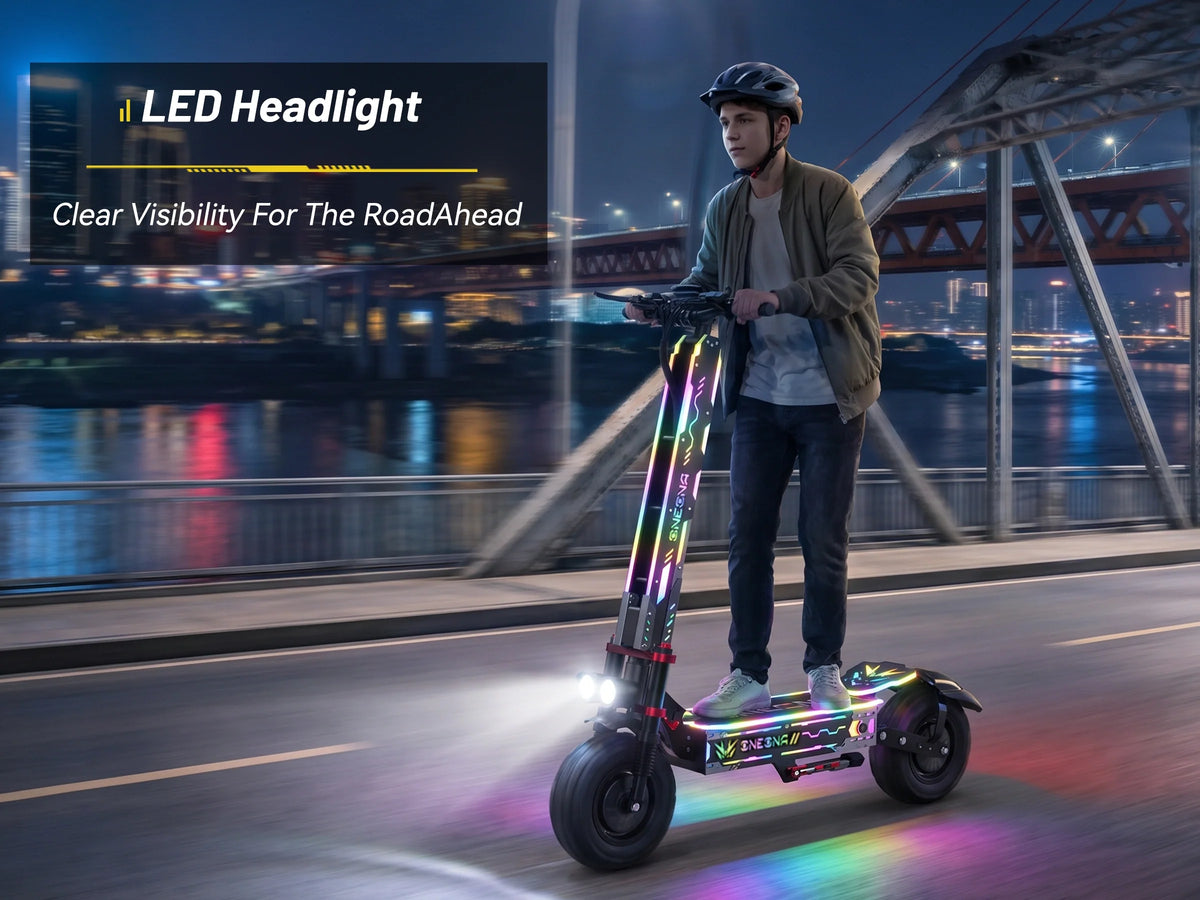
Higher-spec scooters like the ONECNA GT9 come with dedicated headlight and taillight systems built into the frame — which simplifies this significantly. But even with a purpose-built lighting system, the 500-foot check above is worth doing once so you know what you’re actually working with.
9. When Do Night Riding Rules Apply?
Night riding lighting requirements apply from sunset to sunrise in all four states. Once the sun is down, your lights need to be on — regardless of season or clock time.
Edge Cases Worth Knowing
- Low-visibility daytime conditions: Fog, heavy rain, and tunnels can trigger lighting requirements even during daylight hours. Washington’s framework explicitly covers “low visibility” conditions beyond just nighttime. If visibility drops significantly due to weather, turn your lights on.
- Underground parking and tunnels: If your commute takes you through a parking garage or tunnel at any hour, your lights should be on. These spaces are effectively nighttime conditions regardless of the clock.
- Dawn and dusk: The period around sunrise and sunset is statistically one of the most dangerous for visibility. Turn your lights on at dusk, not just after dark.
- Shared-use trails at night: Some parks close shared trails to all users at certain hours. Check your local parks department before planning a night ride on a trail route.
- Event venues and temporary closures: Large events sometimes involve blocked streetlights or construction zones that change the safety calculus for a normally familiar route. Stay aware when riding through event areas at night.
📌 Structured Summary
What
Night riding is legal in Texas, New York, Washington, and Illinois — but requires a white front light (visible 500 feet) and a red rear light or reflector in all four states. Washington and Illinois have a slightly higher rear reflector standard (600 feet). No state bans night riding outright, but lighting violations are actively enforced in dense urban areas.
Why
Lighting requirements exist because an unlit scooter at night is effectively invisible to motor vehicle drivers. The standards are borrowed from bicycle law and reflect the minimum visibility needed to give drivers enough reaction time to avoid a collision. Real-world safety goes further — a legal light setup is a floor, not a ceiling.
How
Audit your front light against the 500-foot standard, add an active rear light if your scooter only has a reflector, consider reflective gear for side visibility, and slow down to account for reduced hazard detection distances at night. Test your lights before every night ride.
When
Night riding rules apply from sunset to sunrise in all four states. Low-visibility weather conditions, tunnels, and dawn/dusk windows are practical extensions of the same logic — turn your lights on whenever visibility drops. Shared trails may have separate closing-hour rules that restrict access at night entirely.
❓ Frequently Asked Questions
Q: Is it legal to ride an e-scooter at night in Texas?
Yes. Texas does not restrict e-scooter riding to daytime hours. You must have a white front light visible from 500 feet and a red rear reflector or light visible from 300 feet to ride legally after dark.
Q: What lights do I need to legally ride an e-scooter at night in New York?
A white front light (500 feet visible) and a red rear light or reflector (300 feet visible). NYC actively enforces these requirements — riding without lights in the city after dark can result in a citation.
Q: Does Washington State require a front light AND a rear light for night riding?
Yes. Washington requires a white front lamp (500 feet) and either a red rear reflector (visible from 600 feet when lit by car headlights) or a red rear lamp (500 feet visible). The rear visibility standard in Washington is slightly higher than in Texas and New York.
Q: Can I ride my e-scooter on Chicago sidewalks at night?
No. Chicago’s sidewalk ban applies at all hours, including at night. Use bike lanes or roads with speed limits of 30 mph or under, regardless of the time.
Q: Is a rear reflector enough, or do I need an active rear light?
In Texas and New York, a rear reflector meets the legal minimum. In Washington and Illinois, a reflector must be visible from 600 feet when illuminated by car headlights. An active rear light provides significantly better real-world visibility from all angles and is strongly recommended regardless of what state you’re in.
Q: My e-scooter has a built-in headlight. Does that meet state requirements?
It depends on the brightness and color. The light must be white and visible from 500 feet. Test it: go somewhere dark, turn the light on, and walk 500 feet away. If you can clearly see it, you’re likely compliant. If it’s dim, you need an upgrade or a supplemental front light.
Q: Do night riding rules apply on private property?
State transportation codes apply to public property. On private property, the owner’s rules govern. That said, using lights on private property is still good practice — visibility is a safety issue independent of legal compliance.
Q: What happens if I get cited for riding without lights at night?
Fines vary by state and city. In most jurisdictions, a first-time lighting violation results in a modest fine. More significantly, riding without lights in an accident scenario can affect liability — it’s evidence that you weren’t operating safely.
Q: Do e-scooter night riding rules apply during dusk and dawn?
Legally, night-riding rules kick in at sunset. Practically, dusk and dawn are among the most dangerous visibility windows. Turn your lights on at dusk, not just after it’s fully dark.
Q: Are there curfews for e-scooter riding in any of these states?
No state-level curfew exists for personal e-scooter riders in Texas, New York, Washington, or Illinois. Some shared fleet operators impose operational hours on their fleets — but those don’t affect personal scooter owners. Park closures may restrict riding on specific trails after certain hours, which is worth checking for your route.
Disclaimer: This article is for informational purposes only and does not constitute legal advice. Lighting requirements and e-scooter laws change frequently. Always verify current rules with your state DMV or local transportation authority before riding at night.
Share:
E-Scooter Age Restrictions by State: Texas, New York, Washington & Illinois
Shared vs. Private E-Scooter Laws: Texas, New York, Washington & Illinois