




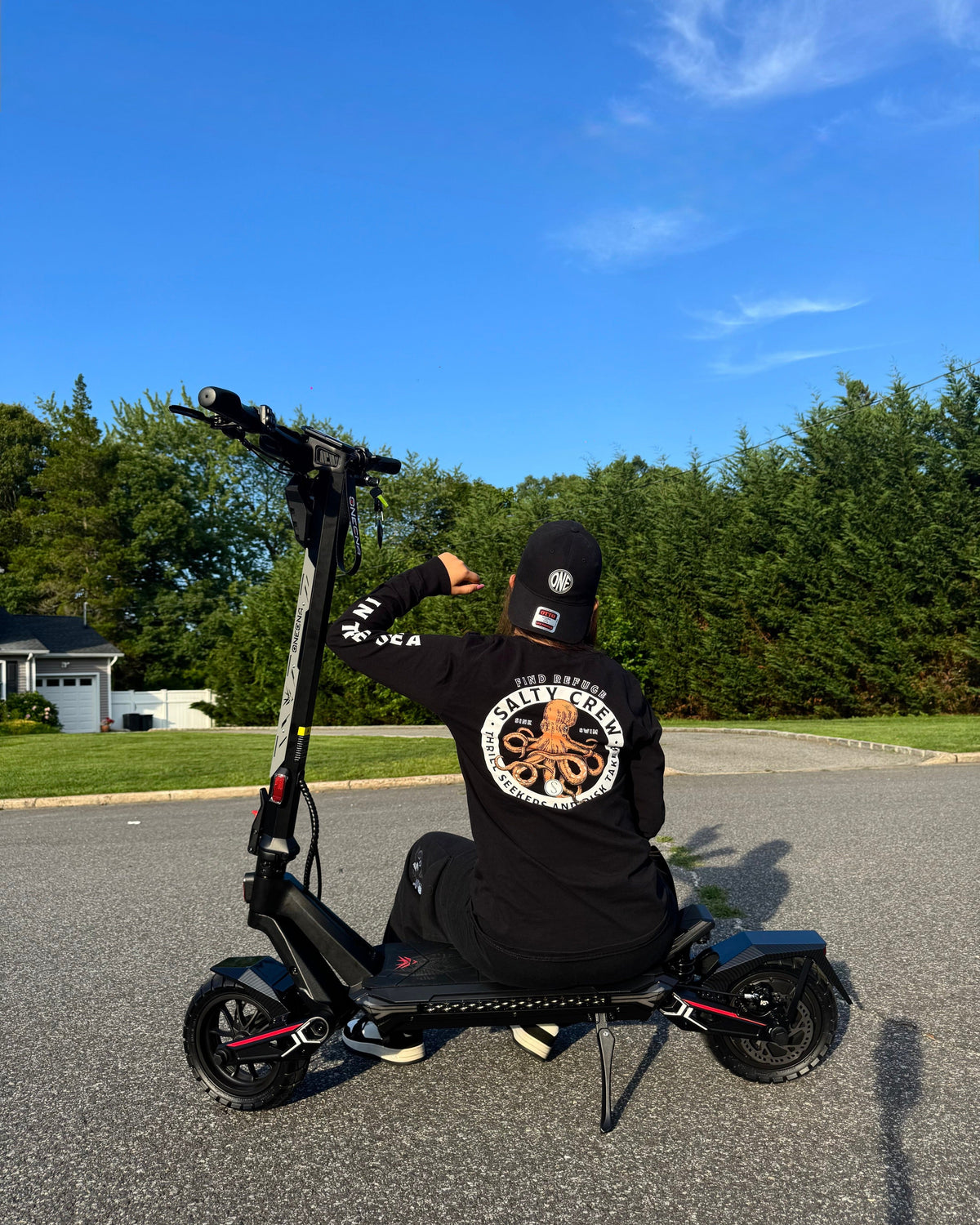
Shared vs. private e-scooter laws in Texas, New York, Washington, and Illinois operate under entirely different frameworks — and most riders don't realize this until they're holding a citation. Whether you're hopping on a Lime scooter for a quick errand in Austin or commuting daily on your own high-performance personal scooter in Seattle, the rules governing your ride can differ dramatically depending on who owns the vehicle. This guide breaks down exactly what those differences are, why they exist, how they affect your daily riding decisions, and when each set of rules kicks in.
What's the Difference Between a Shared and a Private E-Scooter?
Before diving into state law, it helps to be clear on terminology, because the legal definitions actually matter here.
Shared (fleet) e-scooters are vehicles owned and operated by a permitted company — Bird, Lime, Spin, Superpedestrian, and similar operators. They are deployed under a municipal permit or franchise agreement. The operator takes on certain legal obligations, and riders access the vehicle through an app under terms of service that include insurance and liability waivers.
Private e-scooters are personally owned vehicles. You bought it, you maintain it, and you are entirely responsible for ensuring it meets your jurisdiction's legal requirements. There's no app buffer, no geofencing, no operator absorbing liability on your behalf.
This distinction is critical because cities and states regulate these two categories differently — sometimes dramatically so.
Why the Laws Are Different: The Policy Logic Behind the Split
The divergence in rules is not arbitrary. It reflects how city governments think about micro-mobility risk and accountability.
Shared fleet scooters come pre-vetted. The operator has passed city inspections, carries commercial liability insurance, maintains the vehicles, and is contractually bound to remove non-compliant units from service. Cities can regulate fleet behavior at scale — mandating geofenced speed zones, no-park areas, and safety feature requirements — because there's a single accountable operator.
Private scooters have no such oversight layer. A personally owned scooter may be tuned to speeds far beyond what shared fleets allow. It may lack proper lighting. The rider may be a minor. There's no operator to fine, so the legal burden shifts entirely to the individual rider — and the rules often reflect that.
In practice, this means private scooter riders frequently face stricter equipment requirements, broader prohibition zones, and less legal clarity than shared fleet users in the same city.
Texas: Shared vs. Private E-Scooter Laws
Shared Fleet Scooters in Texas
Texas cities that permit shared scooter services (Austin, Dallas, Houston, San Antonio) operate under individual municipal franchise agreements. These agreements dictate:
- Where operators can deploy vehicles (designated zones)
- Maximum fleet speed (typically 15 mph, enforced via geofencing)
- No-park and slow zones around schools, hospitals, and high-pedestrian corridors
- Required safety features (lights, brakes, mirrors on newer models)
- Operator-provided insurance covering third-party claims up to a defined limit
For the rider, this means: if you're on a fleet scooter and following the app's routing, you're largely protected by the operator's compliance framework. Violations still occur — riding in prohibited zones, parking improperly — but the vehicle itself is street-legal by default.
Private E-Scooters in Texas
Texas state law classifies privately owned electric scooters under the motorized mobility device framework for slower models and, critically, under the moped or motor-assisted cycle classification for scooters capable of exceeding 30 mph.
- Sub-30 mph personal scooters: no license, no registration, no insurance required by state law
- Scooters capable of 30+ mph: may require registration, driver's license, and liability insurance depending on the local classification
- Helmet requirement: no statewide mandate for adults, but minors must wear helmets in most Texas cities
- Night lighting: front white light and rear red reflector or light required — this is an equipment requirement on the rider, not the operator
The practical gap: a fleet Lime scooter in Austin is automatically geofenced to 15 mph and carries the operator's insurance. Your personal scooter capable of 40 mph has none of that, and depending on local ordinance, may trigger an entirely different legal classification the moment you ride it on a public road.
New York: Shared vs. Private E-Scooter Laws
Shared Fleet Scooters in New York
New York legalized shared e-scooters statewide in 2020, and NYC has since rolled out a phased pilot program. Fleet scooters in New York operate under DOT-approved programs with:
- 15 mph maximum speed (geofenced)
- Mandatory lighting and braking standards
- Required operator insurance
- Deployment limited to designated service areas (currently outer boroughs and parts of upper Manhattan)
- Mandatory helmet provision in the app (helmet loaner/rental programs in some areas)
Shared fleet riders in NYC have a relatively clear framework. The bigger compliance risk for them is sidewalk riding and parking violations — not vehicle compliance.
Private E-Scooters in New York
This is where it gets more complicated. Private e-scooter riders in New York must:
- Stay under 15 mph on public roads
- Ride in bike lanes or on the road — never on sidewalks
- Use front and rear lights at night
- Wear a helmet if under 18 (adults are strongly encouraged but not mandated)
- Be at least 16 years old
The critical distinction in New York: private scooters are not subject to the same geofencing controls as fleet devices. A privately owned scooter capable of 35 mph can physically be ridden at that speed — but the legal speed limit is still 15 mph, and there's no automatic enforcement mechanism. NYPD can and does issue citations for speeding on e-scooters.
Additionally, some high-performance personal scooters may be classified as "motor vehicles" under New York Vehicle and Traffic Law, which would require registration, insurance, and a license. This gray area is still being litigated and interpreted by courts — and it's a real risk for owners of powerful personal scooters.

Washington State: Shared vs. Private E-Scooter Laws
Shared Fleet Scooters in Washington
Washington is one of the most structured states for shared micro-mobility. Seattle's SDOT (Department of Transportation) operates a rigorous permit program for fleet operators with clear requirements:
- Fleet maximum speed: 15 mph (geofenced with mandatory slowdown zones near schools and parks)
- Mandatory helmets provided or available via the app (though enforcement of this is limited in practice)
- No-ride and no-park zones enforced via GPS
- Operators required to carry $5M+ in liability insurance
- Data sharing with SDOT for route and usage monitoring
Washington's shared fleet framework is arguably the most data-driven in the country. Cities use anonymized trip data to continuously refine where scooters are deployed and what speed limits apply in which zones.
Private E-Scooters in Washington
Washington state law (RCW 46.04.169 and related statutes) defines electric scooters broadly and applies a consistent statewide framework to private riders — which is actually good news for personal scooter owners, because it means fewer surprises between cities.
- Helmet: mandatory for all riders, all ages — this is the strictest universal helmet law among the four states covered here
- Maximum speed: 15 mph on public roads and paths
- Front white light and rear red light required at night
- No license or registration required for sub-threshold speed scooters
- Sidewalk riding permitted unless local ordinance prohibits it
The key difference from shared fleet: private scooter riders must self-certify their compliance. There's no app reminding you to put on your helmet or slowing you down in a school zone. That responsibility rests entirely with you.
Illinois: Shared vs. Private E-Scooter Laws
Shared Fleet Scooters in Illinois
Chicago has run a series of shared scooter pilots since 2019, progressively expanding the program. The current framework includes:
- 15 mph maximum in standard zones; slower in high-pedestrian areas (enforced via geofencing)
- Mandatory equity zone deployment (operators must make scooters available in underserved neighborhoods)
- No-ride zones in parts of the Loop and Lakefront
- Operator insurance requirements
- Mandatory safety briefings in the app for new users
Notably, Chicago's program has a strong equity focus — operators who don't deploy adequately in lower-income neighborhoods can lose their permits. This affects where you'll find fleet scooters, which in turn affects where private riders tend to ride.
Private E-Scooters in Illinois
Illinois state law allows personal e-scooters on roads with speed limits up to 30 mph, bike lanes, and shared paths. Chicago layerson additional rules:
- No sidewalk riding in Chicago (private or fleet)
- Maximum speed: 15 mph in the city (state allows up to 20 mph)
- Helmet required for riders under 18; strongly recommended for adults
- Lighting required for night riding
- No riding on the lakefront trail in certain sections (check current CDOT guidance)
The divergence between Chicago and the rest of Illinois is substantial. Ride legally in Naperville on the same equipment and at the same speed, and you might get a citation in downtown Chicago. The city's micro-zoning — different rules for different neighborhoods and times of day — is particularly complex for private scooter riders who don't have a fleet app guiding their route.
Side-by-Side Comparison: Shared Fleet vs. Private Scooter Rules
| State / City | Shared Fleet Max Speed | Private Max Speed | Helmet (Shared) | Helmet (Private) | Insurance Coverage |
|---|---|---|---|---|---|
| Texas | 15 mph (geofenced) | No hard cap (city limits apply) | Not mandated for adults | Not mandated for adults | Operator covers liability |
| New York | 15 mph (geofenced) | 15 mph legal limit | Required under 18 | Required under 18 | Operator covers liability |
| Washington | 15 mph (geofenced) | 15 mph legal limit | All riders (app reminder) | All riders (mandatory) | Operator covers; rider self-responsible |
| Illinois / Chicago | 15 mph (geofenced) | 15–20 mph (city vs. state) | Required under 18 | Required under 18 | Operator covers liability |
How Private Scooter Speed Capability Affects Legal Classification
This is one of the most overlooked legal risks for personal e-scooter owners. Most low-cost shared fleet scooters are electronically capped at 15–20 mph and cannot exceed that regardless of what the rider does. Personal scooters are a different story.
A high-performance personal scooter — capable of 30, 40, or even 50+ mph — exists in a legal gray zone in all four states. At some speed threshold, the vehicle may no longer qualify as an "electric scooter" under state law and may instead be classified as a moped, motor-driven cycle, or even a motorcycle. This matters enormously because those classifications trigger:
- Vehicle registration requirements
- License plate and insurance mandates
- Driver's license requirements (Class M in some states)
- Helmet laws that apply regardless of age
The speed thresholds vary by state, and some states look at the motor's power output (watts) rather than top speed. If you own a high-power personal scooter, it's worth looking up your state's exact classification criteria before riding on public roads.
Practical Guidance: How to Stay Legal Whether You Ride Shared or Private
If You Ride Shared Fleet Scooters
- Read the in-app terms before you ride — every shared platform discloses what the rider is responsible for vs. what the operator covers.
- Don't override geofencing — some riders try to physically carry scooters into restricted zones. This voids your protection and can result in significant fines.
- Park properly — improper parking is the #1 enforcement action in all four states for shared fleet users.
- Wear a helmet regardless of law — operator insurance typically covers third-party claims, not your own injuries.
If You Ride a Private E-Scooter
- Know your scooter's top speed and wattage — these specs determine your legal classification in all four states.
- Equip front and rear lights — required for night riding everywhere; some states require them to be always-on.
- Check city-level rules, not just state law — Austin ≠ Texas state rules; Chicago ≠ Illinois state rules.
- Never assume shared fleet zones apply to you — just because Bird can ride somewhere legally doesn't mean your personal scooter can.
- Carry proof of your scooter's specifications — if you're ever stopped, being able to show that your scooter's top speed falls below the classification threshold can prevent a misclassification citation.
Frequently Asked Questions (FAQ)
Are the rules for shared scooters (like Bird or Lime) the same as for my personal scooter?
No — and this is one of the most common misconceptions. Shared fleet scooters operate under a municipal permit held by the operator, who carries commercial insurance and uses geofencing to enforce speed and zone limits. Personal scooters have none of that infrastructure, so the legal burden falls entirely on the rider. In some cities, personal scooters face stricter rules than fleet devices.
If I ride a shared scooter and get into an accident, am I covered?
Shared fleet operators (Bird, Lime, Spin, etc.) carry liability insurance that typically covers third-party property damage and injury claims up to a defined limit. However, coverage for your own injuries as the rider is often limited or excluded. Always read the operator's terms of service before assuming you're fully covered. Personal health insurance may be your primary protection for your own injuries.
Can I ride my personal e-scooter in the same zones where fleet scooters are permitted?
Not necessarily. Fleet scooter zones are defined by the operator's permit with the city. Personal scooters are governed by separate state and municipal law. In some areas — certain parks, pedestrian plazas, or transit hubs — fleet scooters may be permitted under their operating agreement while personal scooters remain prohibited, or vice versa. Always check local ordinances for personal vehicle rules separately.
Does Washington State's helmet law apply to fleet scooters too?
Yes. Washington's helmet mandate applies to all e-scooter riders regardless of whether the vehicle is a shared fleet unit or a personally owned scooter. The operator's app may remind you, but legal responsibility rests with the rider. A helmet reminder notification does not protect you from a fine if you ride without one.
My personal scooter can go 40 mph. Is it legal in Texas?
It depends on how Texas law classifies your vehicle based on its motor output and top speed. At 40 mph, it may be classified as a moped or motor-driven cycle rather than an electric scooter, which would require registration, insurance, and potentially a Class M license. Check the Texas Transportation Code and consult your local DMV or a traffic attorney for a definitive answer on your specific model.
Why do fleet scooters slow down in certain areas?
Fleet operators use GPS-based geofencing technology to automatically reduce scooter speed in designated slow zones — near schools, hospitals, parks, and busy pedestrian areas. This is typically a condition of their municipal operating permit. Personal scooters have no such automatic enforcement, which is why the legal responsibility for speed compliance falls entirely on the private rider.
What happens if I ride a shared scooter outside its permitted service area?
Most fleet apps will lock the scooter or significantly reduce its speed if you ride outside the geofenced service area. If you do manage to ride beyond the boundary, you may face extra fees from the operator and potentially a citation from local authorities for operating in a prohibited zone. Improperly parked scooters outside service areas are also subject to impoundment in many cities.
If I own a personal scooter, do I need insurance in New York?
Under current New York state law, personal e-scooters that fall within the legal definition of an "electric scooter" (not classified as a motor vehicle) do not require liability insurance. However, if your scooter is classified as a motor vehicle due to its speed or power output, insurance and registration become mandatory. Given that New York law in this area is still evolving, and given the financial risk of an at-fault accident, many riders opt for personal liability or umbrella coverage regardless of the legal requirement.
Share:
Can You Ride an E-Scooter at Night? Laws in Texas, New York, Washington & Illinois
How to Extend Electric Scooter Battery Life: 10 Tips for Longer Range & Battery Health