




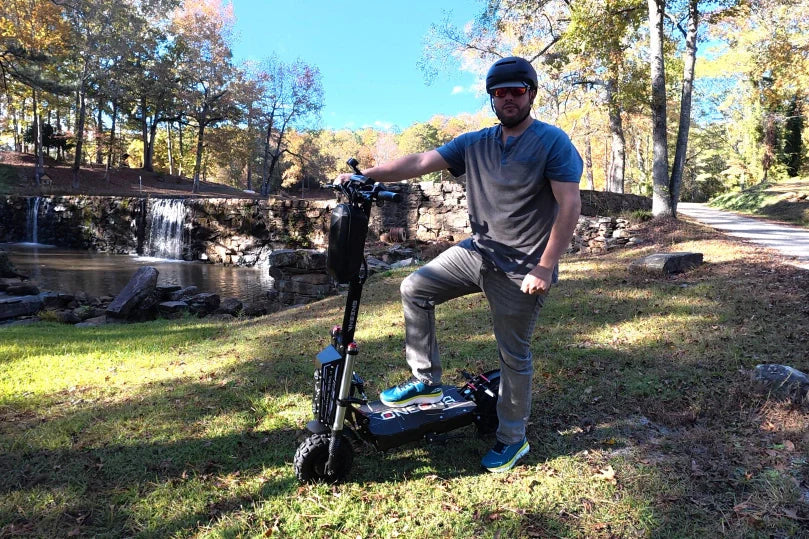
Two motors sound impressive. Twice the power, twice the fun, right? Not always. And that misunderstanding is exactly why many riders end up with the wrong scooter. 🛴
A Quick Reality Check Before We Talk About Dual Motor
The phrase dual motor has become one of the most persuasive labels in the electric scooter world. It appears in product titles, comparison charts, and buying guides as if it were a guaranteed upgrade.
But here is the uncomfortable truth:
Not every rider benefits from a dual motor electric scooter.
Some riders gain real performance advantages. Others gain weight, complexity, and cost — without noticing meaningful improvements in daily riding.
This guide exists to separate those two groups.
Myth #1: Dual Motor Always Means Faster Top Speed
This is the most common assumption, and also the easiest one to dismantle.
Top speed is influenced by motor power, controller limits, battery voltage, rider weight, and gearing. Adding a second motor does not automatically raise top speed.
In many designs, a dual motor electric scooter uses both motors primarily to improve torque and load handling, not maximum velocity.
If you ride mostly on flat bike lanes at steady speeds, a well-tuned single motor scooter can feel just as fast.
Dual motor strength shows up elsewhere.
Myth #2: Two Motors Are Only for Extreme Riders
This misconception comes from how dual motor scooters are marketed — aggressive visuals, off-road imagery, dramatic language.
In practice, dual drive systems are not only about adrenaline.
They are about control under load.
- Steep urban hills
- Heavier adult riders
- Carrying gear or backpacks
- Riding on uneven pavement
A two motor electric scooter distributes torque across both wheels, reducing strain on each motor and improving traction consistency.
This matters just as much in a city commute as it does on dirt.
What Dual Motor Actually Changes When You Ride
Instead of talking specs, let’s talk about sensations — the things riders notice after weeks, not minutes.
1. Launch Feel
Acceleration feels smoother rather than sharper. There is less wheel slip and less delay between throttle input and movement.
2. Hill Behavior
Speed loss on inclines is more gradual. The scooter doesn’t “fight” gravity — it manages it.
3. Stability Under Throttle
Power delivery feels planted, especially at mid-range speeds where single motors often feel strained.
These differences don’t always show up on spec sheets, but they shape daily confidence.
Myth #3: Dual Motor Scooters Are Inefficient
Efficiency is not about how many motors you have. It is about how hard each motor is working.
Under the same riding conditions, a dual motor scooter often operates each motor at a lower stress level than a single motor system pushed to its limit.
That can translate into:
- Lower thermal buildup
- More consistent performance
- Reduced long-term wear
When tuned properly, a dual drive scooter can feel calmer, not hungrier.
When Dual Motor Makes Little Sense
Honest guides need boundaries.
Dual motor is probably unnecessary if:
- Your routes are flat and predictable
- You prioritize ultra-light portability
- You ride short distances at moderate speeds
In these cases, extra hardware adds complexity without solving a real problem.
Where Dual Motor Quietly Excels
Dual motor scooters shine in situations riders rarely mention upfront:
- Inconsistent road surfaces
- Sudden elevation changes
- Variable rider loads
This is why experienced riders often prefer a best dual motor electric scooter even when they do not ride aggressively.
The value is not spectacle. It is margin.
Dual Motor vs Single Motor: A Practical Way to Decide
Instead of asking “Which is better?”, ask:
- Where do I lose speed today?
- When does my scooter feel stressed?
- What situations reduce my confidence?
If the answer is “almost never”, single motor is fine.
If the answer involves hills, load, or inconsistency, dual motor stops being a luxury and starts being a solution.
How ONECNA Approaches Dual Motor Design
ONECNA does not treat dual motor as a marketing checkbox.
The focus is on:
- Balanced front-rear torque
- Controller tuning over peak numbers
- Thermal stability during long rides
This philosophy is consistent across models that prioritize real-world riding rather than headline specs.
Final Thought: Dual Motor Is a Tool, Not a Trophy
The best scooters are not defined by how many motors they carry.
They are defined by how honestly those motors solve real riding problems.
When chosen for the right reasons, a dual motor setup feels less like an upgrade — and more like things finally working the way they should 🙂
Share:
Electric Scooter Weight Explained: Why Heavier Is Not Always Worse
How Long Will Your Scooter Battery Last? Here's the Answer