




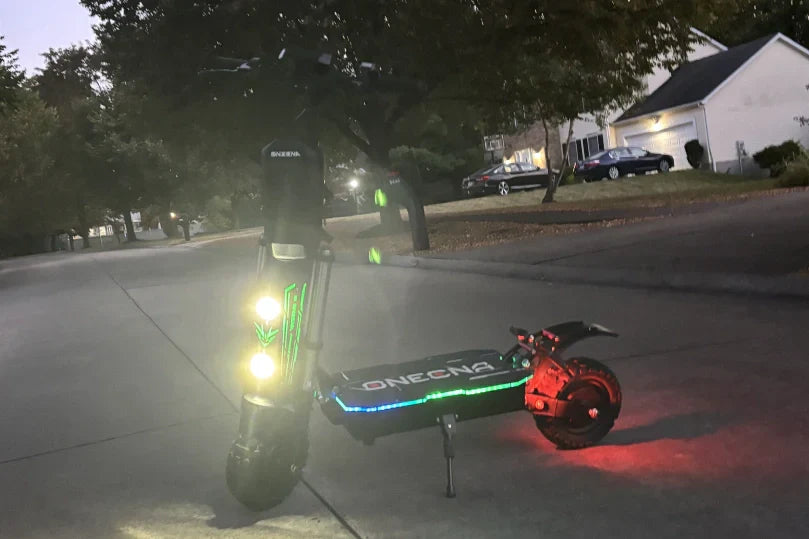
There’s a quiet moment that happens when a scooter dies mid-ride. Not the drama of a breakdown — just the sudden realization that your route, your plan, and your confidence were all tied to one small component.
That component is the scooter battery.
And if you’ve ever asked, “how long does a scooter battery last?” or “how long do electric scooter batteries last?” you’re not alone. The question isn’t just about numbers. It’s about whether your scooter fits your life.
1. Why Battery Life Matters More Than Top Speed
Most people buy an electric scooter because it feels fast. But they keep it because it’s reliable.
A scooter that goes 40 mph but dies after 5 miles is not a “fast scooter.” It’s a short-range toy with a big motor.
When you start measuring a scooter by how often you need to charge it, you’re measuring its real value. That’s why electric scooter battery life is the real performance metric.
2. Battery Life Isn’t Just “Distance” — It’s a Whole System
Battery life is often described as a single number. But it is actually a set of behaviors.
- How far you can go on a charge
- How long the battery stays healthy over months and years
- How quickly it recharges
All three affect your daily experience.
3. What Really Determines Scooter Battery Life
Here’s the part most buyers don’t know: the biggest factors aren’t always the ones the specs emphasize.
Weight and Load
A heavier rider, or a rider carrying a bag, increases energy demand. That means the battery depletes faster, and the scooter feels weaker uphill.
Speed and Riding Style
Riding at top speed is expensive. Not in money, but in battery power.
High speeds require exponentially more energy because wind resistance increases dramatically. So if you always ride fast, your range will be shorter.
Terrain and Hills
Hills are a battery’s worst enemy.
On a flat road, a scooter uses steady energy. On an incline, the battery has to fight gravity. That can reduce range significantly.
Temperature
Battery chemistry is temperature-sensitive.
Cold weather slows down chemical reactions, so the battery delivers less power and depletes faster. Hot weather increases degradation over time.
Tyre Pressure
Low tyre pressure increases rolling resistance.
That means more energy is spent just moving the scooter forward. So, yes — tyre pressure matters more than many riders expect.
4. Why “Rated Range” Is Often Misleading
Manufacturers provide a range number because it’s useful for comparison.
But those numbers are measured under controlled conditions: a certain rider weight, flat terrain, moderate speed, and ideal temperature.
In real life, none of those conditions stay consistent.
So the “rated range” is a starting point, not a promise.
5. A Better Way to Estimate Your Real Range
Instead of trusting a single number, estimate your range based on your real usage.
Here’s a simple method:
- Choose a route you ride often.
- Track your battery percentage before and after.
- Calculate how much battery you used per mile.
- Multiply by 100 to estimate the full range.
This method gives you a practical expectation, not a theoretical one.
6. Battery Life vs Battery Longevity (They’re Not the Same)
Two questions get mixed up:
- How far can I ride today? (range)
- How long will the battery stay good? (lifespan)
A battery can offer great range at first and still die after a year if it’s poorly managed.
So you need to care about both.
7. How to Keep a Scooter Battery Healthy (Without Becoming Obsessive)
Battery care doesn’t require rituals. It requires common sense and consistency.
1. Avoid letting it sit at 0%
Running a battery flat frequently stresses it.
2. Don’t always charge to 100%
Charging to full is fine sometimes, but constantly topping it off can accelerate degradation.
3. Keep it in moderate temperatures
Store your scooter indoors when it’s very cold or very hot.
4. Avoid fast charging as a daily habit
Fast charging is convenient, but heat from rapid charging increases wear over time.
8. Charging Habits That Actually Matter
Many riders ask: “Is it bad to charge overnight?”
Overnight charging isn’t inherently bad. What matters is the charger’s protection system and the battery management system.
A modern battery pack will stop charging once full, but it still benefits from being unplugged once it’s done.
9. When Should You Replace the Battery?
Here are real signs your battery is aging:
- Range drops significantly even at moderate speed
- Battery percentage drops quickly under normal use
- Charging takes longer than usual
- Unexpected power loss on hills
Battery replacement is not a “failure.” It’s a maintenance decision — like changing tires.
10. ONECNA’s Practical Approach to Battery Management
ONECNA’s scooters are designed around the idea that battery performance is a system, not a spec.
The focus is on:
- Stable power delivery under load
- Thermal stability during long rides
- Efficient energy use in real conditions
That’s why riders who need reliable range often choose a scooter that balances power and battery efficiency.
For example, a electric scooter battery life can feel different in real life compared to what a spec sheet claims, because the design aims for consistent performance across conditions.
11. Final Thought: Battery Is a Rhythm, Not a Feature
Most riders don’t think about battery until it stops working the way they expect.
But a scooter battery is not a hidden component — it defines your riding rhythm.
If you understand how range works, and how to protect battery health, you stop chasing numbers and start riding with confidence.
That’s when the scooter stops being a gadget and becomes a tool.
😊
Share:
Dual Motor Electric Scooters: What Actually Matters (And What Doesn‘t)
10000W and 100 MPH: The Brutal Truth Behind Scooter Specs in 2026