




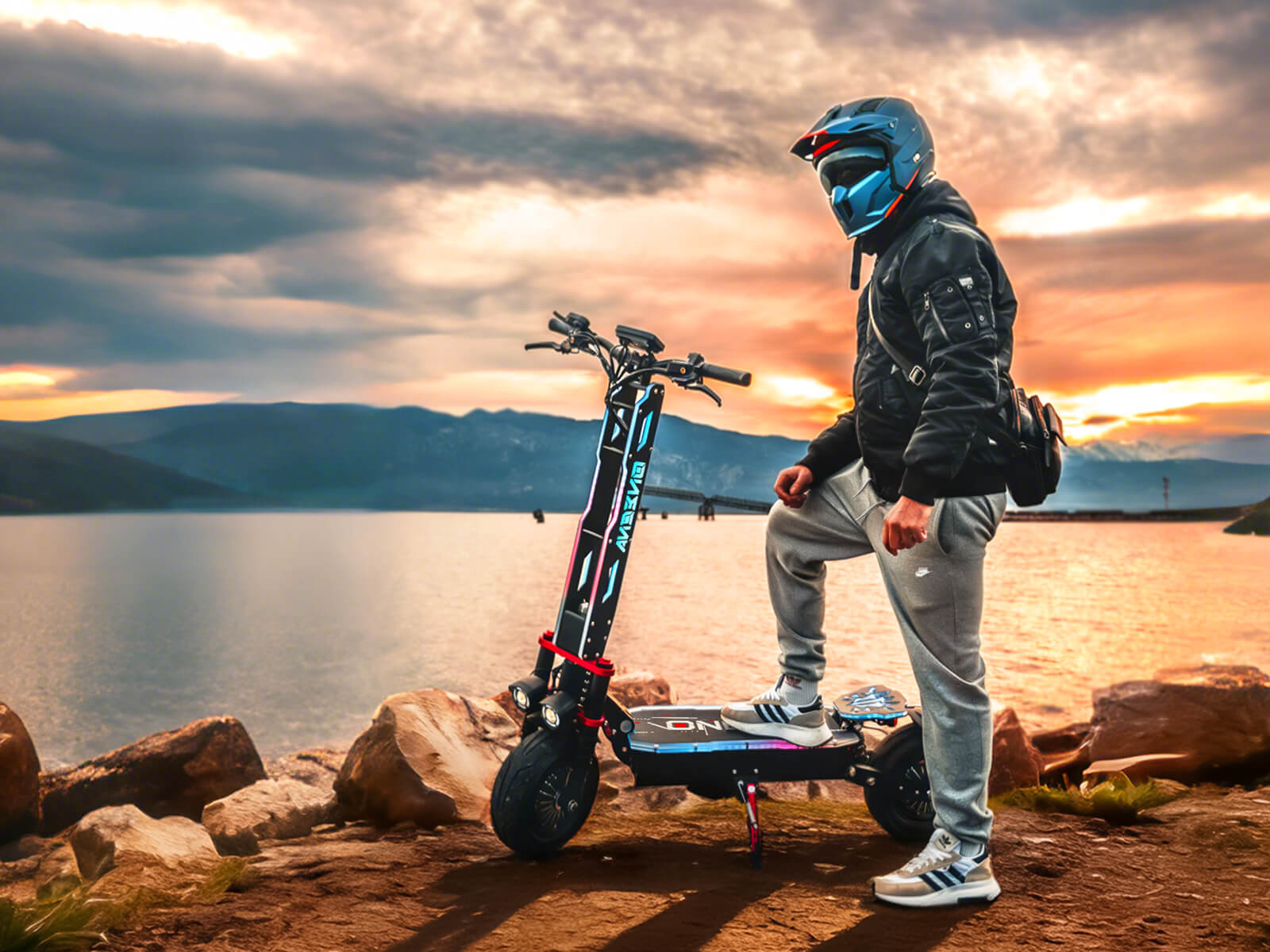
E Scooter Top Speed Guide: What Affects Speed and Which Model Is Right for You?
Understanding e scooter top speed is more nuanced than reading a spec sheet. The number a manufacturer lists is almost always a best-case figure — measured under controlled conditions that rarely match real-world riding. This guide breaks down every factor that affects how fast an electric scooter actually goes, why those factors matter, and how to use that knowledge to choose the right model for your specific needs.
Table of Contents
- What Does "Top Speed" Actually Mean on an E Scooter?
- What Affects E Scooter Top Speed?
- Motor Power: The Primary Driver
- Rider Weight and Its Real Impact
- Terrain and Road Conditions
- Battery State and Voltage Sag
- Tire Size, Type, and Pressure
- Speed Modes and Controller Settings
- E Scooter Speed by Category
- Which Speed Class Is Right for You?
- Speed and Safety: What Changes at Higher Speeds
- Legal Speed Limits for E Scooters
- FAQ
1. What Does "Top Speed" Actually Mean on an E Scooter?
When a brand lists a top speed — say, 35 MPH or 40 MPH — that figure is typically measured under the following conditions:
- Flat, smooth pavement with no incline
- A rider weighing approximately 150–165 lbs
- Full battery charge (100%)
- No wind resistance or headwind
- Scooter in its highest speed mode
Change any one of those variables and the real-world top speed drops. Change several at once — heavier rider, slight incline, 60% battery — and you might see 20–30% less than the advertised figure.
This isn't necessarily deceptive marketing. It's a standardized measurement. But understanding what it means in practice is the difference between buying a scooter that meets your needs and one that disappoints on day one.

2. What Affects E Scooter Top Speed?
Six primary variables determine how fast an e scooter actually moves in real-world conditions. Understanding each one helps you read spec sheets critically and set realistic expectations before you buy.
- Motor power — the most direct determinant of top speed and acceleration
- Rider weight — heavier loads reduce both speed and range
- Terrain and gradient — inclines and surface type create significant drag
- Battery charge level — voltage sag at lower charge reduces motor output
- Tire size and pressure — affects rolling resistance and grip
- Controller and speed mode settings — software limits that cap output
Each of these is explored in detail below.
3. Motor Power: The Primary Driver
Motor wattage is the single most influential spec for top speed. But the relationship isn't linear — and the way wattage is reported varies significantly between manufacturers.
Peak vs. Continuous Wattage
Most manufacturers list peak wattage — the maximum output the motor can sustain for a few seconds during hard acceleration. Continuous wattage is what the motor can maintain indefinitely without overheating. These two numbers can differ by 50–100%.
A scooter listed as "3000W" may only sustain 1,200–1,500W continuously. For hill climbing, sustained high-speed cruising, or heavier riders, continuous wattage is the number that actually matters.
Single Motor vs. Dual Motor
| Configuration | Typical Top Speed | Best For | Trade-Off |
|---|---|---|---|
| Single Motor (500–1500W) | 15–25 MPH | Light commuting, flat terrain | Limited hill performance |
| Single Motor (2000–3000W) | 25–35 MPH | Urban commuting, moderate hills | Less torque than dual |
| Dual Motor (4000–6000W) | 35–45 MPH | Mixed terrain, heavy riders | Higher energy consumption |
| Dual Motor (6000–8000W+) | 45–60+ MPH | Off-road, performance riding | Weight, cost, range trade-off |
Dual motor configurations distribute power across both wheels, which improves traction and acceleration — particularly on loose surfaces or inclines. The torque reserve also means the motors aren't running at their ceiling during normal riding, which extends motor life and reduces heat buildup over time.
4. Rider Weight and Its Real Impact

Rider weight is one of the most underestimated variables in e scooter performance. Here's how it plays out in practice:
- A scooter rated for 35 MPH with a 165 lb rider may top out at 28–30 MPH with a 220 lb rider
- Range can decrease by 15–25% at higher body weights due to increased motor load
- Hill-climbing performance degrades more sharply than flat-road speed as weight increases
There's also an important distinction between the structural weight limit (what the frame can hold without breaking) and the performance weight threshold (the weight at which the scooter delivers its rated speed and range). These are rarely the same number.
If you're a heavier rider — 200 lbs or above — look specifically for scooters with dual motor configurations, explicit heavy-rider ratings, and reinforced frame construction. The weight limit on the spec sheet is a starting point, not a guarantee of performance.
Weight vs. Speed: A Practical Reference
| Rider Weight | Expected Speed vs. Rated | Range Impact |
|---|---|---|
| Under 150 lbs | At or above rated speed | Minimal |
| 150–180 lbs | ~95–100% of rated speed | Minimal |
| 180–220 lbs | ~85–95% of rated speed | 10–15% reduction |
| 220–265 lbs | ~75–85% of rated speed | 15–25% reduction |
| 265–330 lbs | ~65–80% of rated speed | 20–30% reduction |
5. Terrain and Road Conditions
Surface type and gradient have a dramatic effect on achievable top speed. Here's what to expect across common riding environments:
Flat Pavement
The baseline condition for all manufacturer speed claims. Smooth asphalt or concrete with no incline is where rated top speed is achievable. Even here, road texture matters — rough chip-seal pavement creates more rolling resistance than polished concrete.
Inclines
Gradient is one of the most speed-limiting factors. A 10° incline can reduce top speed by 30–40% on a single-motor scooter. A 15° incline may reduce it by 50% or more. Dual-motor configurations handle inclines significantly better due to combined torque output.
As a rough guide:
- 0–5° incline: Minimal speed reduction (5–10%)
- 5–10° incline: Moderate reduction (15–30%)
- 10–15° incline: Significant reduction (30–50%)
- 15°+ incline: May require walking assist on underpowered models
Off-Road Surfaces
Gravel, dirt, grass, and packed trails all increase rolling resistance and reduce effective top speed. Off-road riding also demands more from suspension and tires — which is why purpose-built off-road scooters use larger pneumatic tires and full suspension systems rather than simply adding more motor power.

6. Battery State and Voltage Sag
Battery charge level affects top speed more than most riders expect. Here's why: as a lithium battery discharges, its output voltage drops — a phenomenon called voltage sag. Lower voltage means less power delivered to the motor, which translates directly to reduced speed and torque.
In practical terms:
- 100–70% charge: Full rated speed available
- 70–40% charge: Speed may drop 5–10% depending on motor load
- 40–20% charge: Noticeable speed reduction, especially on hills
- Below 20% charge: Many controllers enter a protection mode that further limits output
This is why real-world range at high speed is often significantly less than the manufacturer's claimed range — which is typically measured at moderate speed with a full battery. If you're planning a 20-mile commute at sustained high speed, a 1000+ Wh battery pack gives you meaningful headroom. A 500 Wh pack will struggle.
Battery Size vs. Speed Range
| Battery Capacity | Real Range @ 20 MPH | Real Range @ 35 MPH |
|---|---|---|
| 360 Wh | 15–20 miles | 8–12 miles |
| 720 Wh | 28–38 miles | 15–22 miles |
| 1040 Wh | 40–55 miles | 22–30 miles |
| 1500+ Wh | 55–75 miles | 30–45 miles |
7. Tire Size, Type, and Pressure
Tires affect speed in two ways: rolling resistance and grip. Both matter more at higher speeds.
Pneumatic vs. Solid Tires
- Pneumatic (air-filled) tires have lower rolling resistance, better shock absorption, and superior grip — all of which support higher speeds safely. They require pressure maintenance but perform significantly better at speed.
- Solid (foam or rubber) tires are maintenance-free but have higher rolling resistance and transmit more vibration. At speeds above 20 MPH, the handling difference becomes noticeable.
Tire Size
Larger diameter tires cover more ground per rotation, which contributes to higher top speed at the same motor RPM. They also provide better stability at speed:
- 8.5" tires: Common on commuter scooters, adequate up to ~20 MPH
- 10" tires: Better stability, suitable for 20–30 MPH
- 11"–12" tires: Recommended for 30+ MPH, especially on mixed terrain
Tire Pressure
Under-inflated tires increase rolling resistance and reduce top speed. Over-inflated tires reduce grip and make the ride harsher. Check manufacturer recommendations — typically 40–65 PSI for most pneumatic scooter tires — and check pressure every 2–4 weeks.
8. Speed Modes and Controller Settings
Most e scooters ship with multiple speed modes — often labeled Eco, Standard, and Sport (or 1, 2, 3). These are software-level limits applied by the motor controller that cap maximum output regardless of what the motor is physically capable of.
Why this matters:
- A scooter in Eco mode may be limited to 10–15 MPH even if the motor can do 35 MPH
- Some scooters ship with a default speed cap that requires unlocking via the app or display settings
- Certain markets have region-locked firmware that limits top speed to comply with local regulations
If your scooter isn't reaching its advertised top speed, check the speed mode setting before assuming a hardware issue. Many riders discover their scooter was simply in a restricted mode.

9. E Scooter Speed by Category
The e scooter market broadly segments into four speed tiers. Here's what each tier looks like in practice:
Tier 1: Entry-Level Commuter (10–20 MPH)
- Motor: 250–500W single motor
- Battery: 180–360 Wh
- Weight limit: 220 lbs typical
- Best for: Short urban commutes, bike paths, first-time riders
- Limitations: No hill capability, limited range, not suitable for mixed terrain
Tier 2: Mid-Range Commuter (20–28 MPH)
- Motor: 500–1500W single motor
- Battery: 360–720 Wh
- Weight limit: 220–265 lbs
- Best for: Daily commuting on paved roads, moderate hills
- Limitations: May struggle with sustained high-speed riding or heavier riders
Tier 3: Performance Commuter (28–40 MPH)
- Motor: 1500–4000W single or dual motor
- Battery: 720–1040 Wh
- Weight limit: 265–330 lbs
- Best for: Longer commutes, mixed terrain, heavier riders, traffic-speed riding
- Limitations: Heavier, higher cost, longer charge time
Tier 4: High-Performance / Off-Road (40+ MPH)
- Motor: 4000–8000W+ dual motor
- Battery: 1000–2000+ Wh
- Weight limit: 265–330+ lbs
- Best for: Off-road trails, performance riding, heavy riders who need full-speed performance
- Limitations: Significant weight (75–100+ lbs), high cost, not portable
10. Which Speed Class Is Right for You?

The right speed class depends on four factors: your commute distance, terrain, rider weight, and local regulations. Here's a practical decision framework:
Choose Tier 1–2 (10–28 MPH) if:
- Your commute is under 8 miles on flat, paved surfaces
- You ride on dedicated bike paths where speed limits apply
- You're a first-time rider building confidence at speed
- Portability matters — you need to carry the scooter regularly
Choose Tier 3 (28–40 MPH) if:
- You commute 8–20 miles daily on roads with mixed traffic
- Your route includes hills or occasional unpaved sections
- You weigh 180–265 lbs and need consistent performance
- You want a scooter that won't feel maxed-out at cruise speed
Choose Tier 4 (40+ MPH) if:
- You ride off-road trails or mixed terrain regularly
- You weigh 220+ lbs and need full-rated performance
- You have a long daily commute (20+ miles) at sustained speed
- You've ridden high-speed scooters before and understand the handling demands
As a practical reference: the ONECNA GT9 sits in the upper Tier 3 / Tier 4 range with its dual-motor system and 12" pneumatic tires — a configuration suited to riders who need consistent performance across both pavement and off-road terrain, particularly at higher body weights.
11. Speed and Safety: What Changes at Higher Speeds
Speed changes the physics of riding in ways that aren't always intuitive. Here's what actually shifts as you move up the speed tiers:
Braking Distance
Stopping distance increases with the square of speed — not linearly. At 15 MPH with good brakes, you might stop in 10 feet. At 30 MPH, that becomes 35–40 feet. At 40 MPH, 60+ feet. This is why brake quality matters so much at higher speeds — hydraulic disc brakes are the standard for anything above 25 MPH.
Stability
At higher speeds, small imperfections in road surface — cracks, pebbles, expansion joints — have a larger destabilizing effect. Longer wheelbase, lower deck height, and larger tires all improve stability at speed. This is why high-speed scooters are physically larger and heavier than commuter models.
Reaction Time
At 35 MPH, you're covering roughly 51 feet per second. A 1-second reaction time — which is fast — means you've already traveled 51 feet before braking begins. Situational awareness, riding posture, and protective gear all become more critical as speed increases.
Protective Gear by Speed Tier
| Speed Range | Minimum Recommended Gear |
|---|---|
| Under 15 MPH | Helmet (open-face), wrist guards |
| 15–25 MPH | Certified helmet, wrist guards, knee pads |
| 25–35 MPH | Full-face helmet (DOT/ECE), knee pads, gloves |
| 35+ MPH | Full-face helmet, CE-rated jacket, gloves, knee/shin guards |
12. Legal Speed Limits for E Scooters
This is one of the most important — and most overlooked — aspects of e scooter top speed. The speed a scooter is capable of and the speed it's legal to ride at are often very different numbers.
United States
E scooter regulations vary by state and municipality. Most states that have legalized e scooters cap street-legal operation at 15–20 MPH on public roads. Some states allow higher speeds on roads with posted speed limits above 25 MPH. A few states have no specific e scooter laws, defaulting to bicycle regulations.
Key point: owning a 40 MPH scooter doesn't mean you can legally ride it at 40 MPH on public roads in most US cities. Check your state's vehicle code and your city's municipal ordinances before riding at high speed on public infrastructure.
Private Property and Off-Road
Speed restrictions typically don't apply on private property or designated off-road areas. This is where high-performance scooters are most commonly used at their full rated speed.
Europe
Most EU countries cap e scooters at 25 km/h (15.5 MPH) for street-legal operation. Some countries require registration, insurance, and a minimum age for higher-speed models. Regulations are evolving rapidly — check the specific rules for your country and region.
FAQ: E Scooter Top Speed Guide
Q: Why is my e scooter not reaching its advertised top speed?
Several factors could be responsible: the scooter may be in a restricted speed mode (check your display or app settings), the battery may be below 70% charge, you may be heavier than the test rider weight used for the spec, or you may be riding on an incline or rough surface. Check speed mode first — it's the most common cause and the easiest to fix.
Q: Does riding at top speed damage the motor?
Not inherently, if the scooter is properly designed for that speed. However, sustained top-speed riding on a scooter that's already at its performance ceiling — particularly with a heavy rider or on inclines — generates more heat and accelerates motor wear. Scooters with meaningful torque headroom (dual motors, high continuous wattage) handle sustained high-speed riding better than those running at their limits.
Q: How much does rider weight actually affect top speed?
More than most people expect. A rider 50–70 lbs above the test weight used for the spec can see 15–25% reduction in top speed and 20–30% reduction in range. If you're a heavier rider, look for scooters with explicit heavy-rider ratings and dual motor configurations rather than relying on the advertised top speed figure.
Q: What's the fastest legal e scooter I can ride on public roads in the US?
This depends entirely on your state and city. Most US jurisdictions cap street-legal e scooter operation at 15–20 MPH. Some allow up to 25–30 MPH on certain road types. There is no single federal standard. Always check your local regulations — riding above the legal limit can result in fines and may affect your liability in an accident.
Q: Is a higher top speed always better?
No. Higher top speed comes with trade-offs: more weight, higher cost, shorter range at speed, and greater safety demands. For most urban commuters riding under 10 miles on flat pavement, a 20–25 MPH scooter is more practical than a 40 MPH model. The right speed is the one that matches your actual riding conditions — not the highest number on the spec sheet.
Q: How do I know if a scooter's top speed claim is realistic?
Look for independent reviews from riders close to your weight, riding on terrain similar to yours. Check whether the manufacturer publishes continuous wattage (not just peak), and look for real-world range data at high speed rather than just the claimed maximum range. Community forums and video reviews are often more reliable than spec sheets for real-world speed data.
Q: Can I increase my e scooter's top speed after purchase?
Sometimes. Some scooters have software-unlockable speed limits that can be raised via the app or display settings. Others have hardware limits (motor size, controller capacity) that can't be changed without component replacement. Modifying a scooter beyond its designed parameters can void the warranty and create safety risks — particularly if the braking system isn't rated for the higher speed. Research your specific model before attempting any modifications.
Share:
35 MPH E Scooter Buying Guide: How to Choose the Right High-Speed Scooter
How Much Is an E Scooter? Average Prices by Type and Features