




How Much Is an E Scooter? Average Prices by Type and Features

How much is an e scooter? It's one of the first questions anyone asks before making the switch to electric. The honest answer: average e scooter prices range from $300 to over $3,000, depending on the type, motor power, battery size, and build quality. Whether you're looking for a lightweight city commuter or a heavy-duty off-road machine, understanding what drives the price helps you avoid overpaying — or buying something that won't last.
Why E Scooter Prices Vary So Much
The electric scooter market has exploded over the past five years. You'll find models priced anywhere from $299 to $4,000+ on the same search results page — and that range isn't random. Price is almost always a direct reflection of three core variables: motor output, battery capacity, and frame engineering.
A $350 scooter and a $1,800 scooter are fundamentally different products. The budget model might use a 250W single motor, a 7.5Ah battery, and a folding aluminum frame rated for 220 lbs. The premium model might run dual 1,500W motors, a 52V 20Ah battery, hydraulic brakes, and a reinforced stem — built to handle 30+ mph on rough terrain. Same category, completely different engineering.
Understanding why the price gap exists is the first step to making a smart purchase.
Average E Scooter Prices by Type
Here's a practical breakdown of what you can expect to pay across the main categories:
1. Entry-Level / Budget Commuter — $300 to $600
These are designed for short, flat urban trips — typically under 15 miles per charge. Motor output usually sits between 250W and 500W, top speed around 15–18 mph, and weight capacity around 220 lbs. They're fine for occasional use on smooth pavement, but they're not built for daily heavy commuting or hills.
Best for: Students, casual riders, last-mile transit connections.
2. Mid-Range Commuter — $600 to $1,200
This is where build quality starts to matter. You'll find 500W–800W single motors, 15–25 mile range, pneumatic tires, and basic suspension. Brands in this range often include front suspension forks and better braking systems (drum or disc). These handle moderate hills and daily commutes reliably.
Best for: Daily urban commuters, riders covering 10–20 miles per day.

3. Performance / Dual-Motor — $1,200 to $2,500
Dual-motor scooters in this range deliver serious power — typically 1,500W to 3,000W combined output, 25–45 mph top speed, and 30–50 mile range. They feature full suspension (front fork + rear spring or hydraulic), hydraulic disc brakes, and reinforced decks. These are built for riders who want speed, range, and the ability to handle hills without slowing down.
For example, the ONECNA GT8 PRO sits in this tier — dual 3,000W motors, 11-inch pneumatic tires, and a 60V battery system designed for both urban and mixed-terrain riding.
Best for: Enthusiasts, longer commutes, riders who want performance without going full off-road.

4. Off-Road / High-Performance — $2,500 to $4,000+
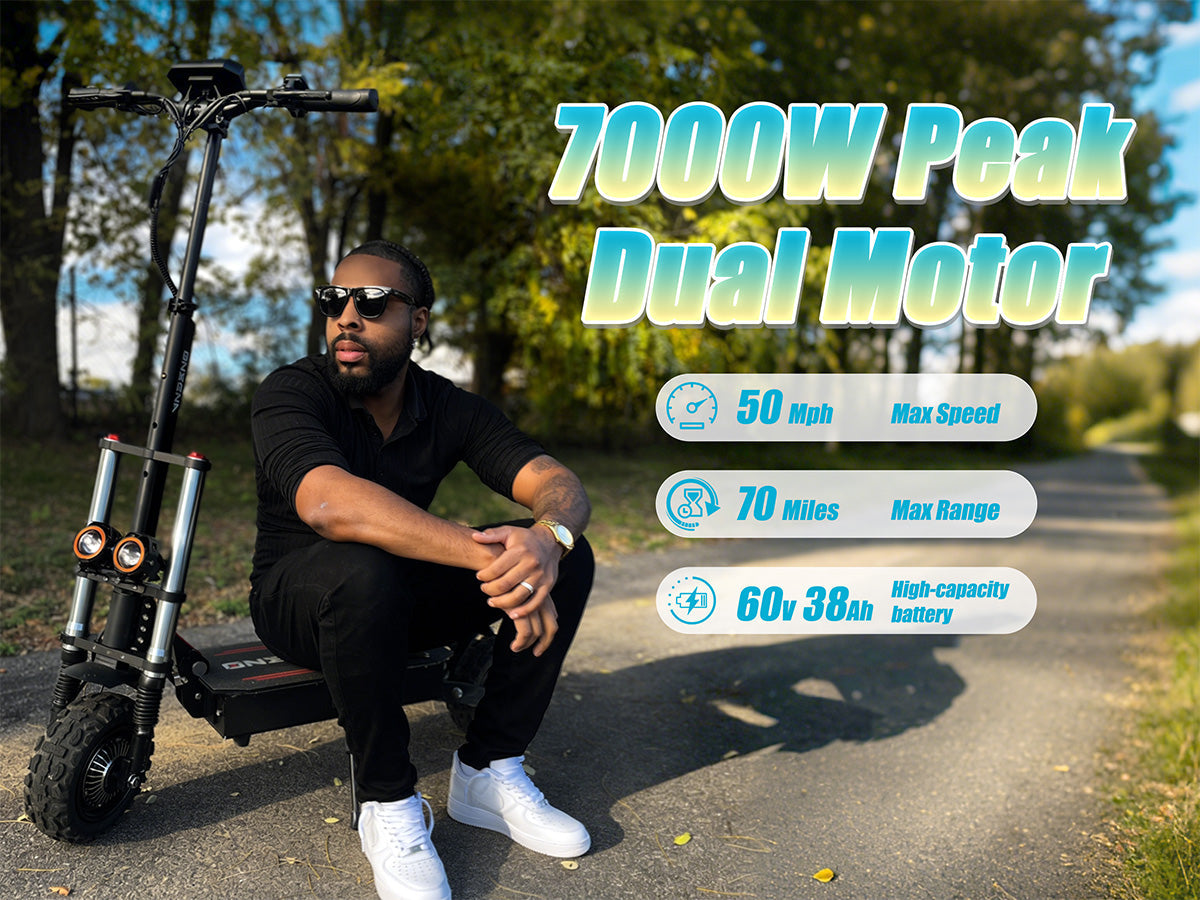
At this price point, you're getting engineering that rivals small motorcycles. Dual motors with 4,000W–6,000W+ combined output, 12-inch knobby tires, full hydraulic suspension, NFC locking, color displays, and battery systems that can push 50+ miles of range. These machines are built for trails, gravel, and aggressive terrain — not just city streets.
The ONECNA GT9 is a good reference point here — 12-inch off-road tires, dual motor system, and a chassis engineered for riders who take their scooter beyond the pavement.
Best for: Off-road riders, adventure commuters, power users who need maximum range and durability.

What Features Actually Affect the Price
Not every spec on a product page justifies a higher price. Here are the ones that genuinely do:
Motor Wattage & Configuration
Single vs. dual motor is the biggest price driver after battery. A dual-motor setup doesn't just double the power — it changes how the scooter handles hills, wet surfaces, and acceleration. Expect to pay $400–$800 more for a comparable dual-motor model vs. single-motor.
Battery Capacity (Wh)
Battery is often 30–40% of the total manufacturing cost. A 48V 15Ah battery (720Wh) will cost significantly more to produce than a 36V 7.5Ah (270Wh) unit. Range claims on spec sheets are usually measured under ideal conditions — real-world range is typically 70–80% of the advertised figure.
Suspension System
No suspension → spring suspension → hydraulic suspension. Each step up adds $150–$400 to the retail price but dramatically changes ride comfort on anything other than smooth pavement. If you're riding on city streets with cracks, curbs, or gravel, suspension is not optional.
Braking System
Drum brakes → mechanical disc → hydraulic disc. Hydraulic disc brakes offer the shortest stopping distance and the most consistent performance in wet conditions. They're standard on scooters above $1,500 for good reason.
Tire Size & Type
10-inch pneumatic tires are the sweet spot for urban commuting. 11–12-inch tires add stability and off-road capability. Solid (airless) tires are cheaper to produce but transmit more vibration and offer less grip. Pneumatic tires cost more but ride better — and they're worth it.

Frame & Weight Capacity
Aerospace-grade aluminum alloy frames cost more to machine and weld than standard aluminum. A scooter rated for 330 lbs requires a fundamentally different frame design than one rated for 220 lbs. Weight capacity is a proxy for overall build quality.
How to Choose the Right Price Range for You
The most common mistake buyers make is choosing a scooter based on the lowest price that meets their stated range requirement. Range is just one variable. Here's a more useful framework:
Step 1 — Define Your Terrain
Flat city streets with smooth pavement? A $600–$900 single-motor scooter is likely sufficient. Mixed terrain with hills, gravel, or uneven surfaces? You need suspension and more torque — budget $1,200+. Trails and off-road? Start at $2,000 and look for 12-inch tires and dual motors.
Step 2 — Calculate Your Real Daily Distance
Take your one-way commute distance, double it, and add 20% buffer. That's your minimum required range. Don't buy a scooter whose advertised range barely covers your commute — real-world range is always lower than spec-sheet range.
Step 3 — Factor in Rider Weight
Heavier riders (200 lbs+) will see significantly reduced range and performance on budget scooters. A scooter rated for 265 lbs with a 500W motor will struggle on hills with a 200 lb rider. Look for models with higher weight ratings and more motor headroom.
Step 4 — Think About Longevity
A $400 scooter used daily will likely need significant maintenance or replacement within 12–18 months. A $1,500 scooter with quality components can last 3–5 years with basic maintenance. The cost-per-mile calculation often favors spending more upfront.
When Does It Make Sense to Spend More?
Spending more on an e scooter makes sense in these specific situations:
- Daily commuting over 10 miles round-trip — battery degradation on budget models becomes a real problem within 6–12 months of daily use.
- Riding in hilly areas — underpowered motors overheat on sustained climbs, reducing both performance and lifespan.
- Riding in wet or variable weather — higher-end models have better IP ratings (water resistance) and hydraulic brakes that perform consistently in rain.
- Riders over 180 lbs — budget scooters near their weight limit perform poorly and wear out faster.
- You want to avoid the replacement cycle — buying a $1,800 scooter once is often cheaper than buying a $500 scooter three times over five years.

Hidden Costs Most Buyers Overlook
The sticker price is just the beginning. Here are the costs that don't show up in the product listing but will show up in your wallet:
Replacement Tires
Pneumatic tires on high-use scooters typically need replacement every 1,000–2,000 miles. Budget $30–$80 per tire depending on size. Off-road tires cost more.
Brake Maintenance
Mechanical disc brake pads wear out. Hydraulic systems need occasional bleeding. Budget $20–$60/year for brake maintenance if you're riding regularly.
Battery Replacement
Lithium batteries degrade over charge cycles. Most quality batteries retain 80% capacity after 500 cycles. Budget models with cheaper cells may degrade faster. A replacement battery for a mid-range scooter typically costs $200–$500.
Accessories
Helmet (required in most jurisdictions), lock, lights if not included, phone mount, carrying bag — these add $100–$300 to your total cost of ownership.
Local Regulations
Some cities require registration, insurance, or restrict scooters above certain speeds on public roads. Check your local laws before buying a high-speed model — a scooter you can't legally ride on your commute route is a poor investment regardless of price.
Frequently Asked Questions
How much does a good e scooter cost?
A "good" e scooter depends on your use case. For casual urban commuting, $600–$900 gets you a reliable, well-built scooter. For daily heavy use or mixed terrain, budget $1,200–$2,000. For off-road or high-performance riding, expect to spend $2,000–$3,500+.
Why are some e scooters so cheap?
Budget scooters cut costs on battery quality, motor efficiency, frame materials, and braking systems. They're not necessarily unsafe for light use, but they degrade faster, perform worse under load, and typically have limited warranty support. The $299 price tag often reflects $299 worth of engineering.
Is a $1,000 electric scooter worth it?
For most daily commuters, yes. At $1,000, you're entering the range where build quality, battery longevity, and component reliability improve significantly. A well-maintained $1,000 scooter will typically outlast two or three $400 budget models.
How much does an off-road e scooter cost?
Purpose-built off-road electric scooters typically start around $1,800 and go up to $4,000+. The price reflects larger tires, full suspension systems, higher-capacity batteries, and dual-motor configurations needed to handle rough terrain safely.
What is the average price of an electric scooter in 2024–2025?
Across all categories, the average retail price of an adult electric scooter is approximately $800–$1,200. The median for performance-oriented models (dual motor, 30+ mph) sits closer to $1,500–$2,500.
Do more expensive e scooters have better range?
Generally, yes — but it's not a perfect correlation. Range is primarily determined by battery capacity (Wh). A $2,000 scooter with a 1,000Wh battery will have more range than a $1,500 scooter with a 600Wh battery. However, heavier dual-motor scooters also consume more power, so range gains aren't always proportional to price.
Are dual-motor e scooters worth the extra cost?
If you ride hills regularly, carry significant weight, or want faster acceleration, dual-motor scooters are worth the premium. The performance difference on inclines is substantial — a dual-motor scooter maintains speed on a 15% grade where a single-motor model would slow to a crawl. For flat urban commuting, a single motor is usually sufficient.
What should I look for when comparing e scooter prices?
Focus on: motor wattage (single vs. dual), battery capacity in Wh (not just voltage), suspension type, brake system (hydraulic disc is best), tire size and type, weight capacity, and IP rating. Don't compare prices without comparing these specs — a $900 scooter with hydraulic brakes and full suspension is a better value than a $700 scooter with drum brakes and no suspension.
Share:
E Scooter Top Speed Guide: What Affects Speed and Which Model Is Right for You?
High Speed E Scooter Buying Guide: How to Choose the Right Model