




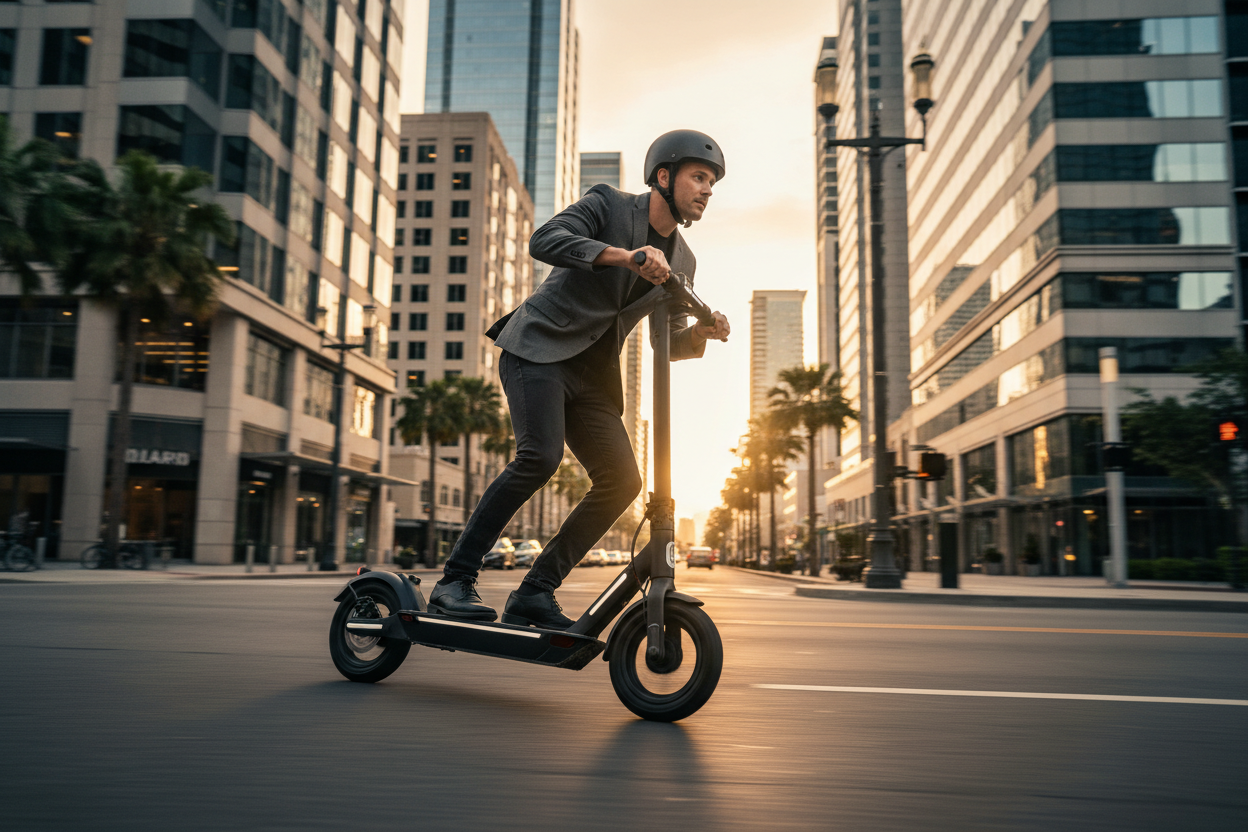
E Scooter vs E Bike: Complete Comparison of Speed, Range, Cost and Features
Choosing between an e scooter vs e bike is one of the most common questions for anyone stepping into electric micromobility. Both solve the same core problem — getting from A to B without a car — but they do it in fundamentally different ways. This guide breaks down speed, range, cost, portability, and real-world use cases so you can make a confident, informed decision.
No fluff. No sales pitch. Just a straight comparison built around how real people actually ride.
Table of Contents
- What Are E Scooters and E Bikes?
- Speed Comparison
- Range Comparison
- Cost Comparison
- Portability & Storage
- Features & Tech
- Pros and Cons
- Use Cases: Who Should Choose What?
- Buying Guide
- FAQ
What Are E Scooters and E Bikes?
Before diving into specs, it helps to understand what each vehicle actually is — because the category names can be misleading.
An electric scooter (e scooter) is a stand-up, two-wheeled vehicle powered by an electric motor and battery. You stand on a deck, steer with handlebars, and control speed via a thumb throttle. Most fold for easy transport. They range from lightweight city commuters to high-powered off-road machines.
An electric bike (e bike) looks and rides like a traditional bicycle, but has an integrated motor and battery that provides pedal assist (pedelec) or, in some models, a full throttle. You sit in a saddle, pedal (or not), and the motor amplifies your effort.
Both are legal in most US states for road and bike-lane use, though regulations vary by motor wattage and top speed. Always check your local laws before riding.
Speed Comparison: E Scooter vs E Bike
How Fast Do They Go?
Speed is often the first question people ask — and the answer is more nuanced than a single number.
| Category | E Scooter | E Bike |
|---|---|---|
| Entry-level top speed | 15–20 mph | 20 mph (Class 1/2) |
| Mid-range top speed | 25–35 mph | 28 mph (Class 3) |
| High-performance top speed | 40–60+ mph | 28–35 mph (modified/off-road) |
| Legal street limit (US) | 15–25 mph (varies by state) | 20–28 mph (Class 1–3) |
Key insight: High-performance e scooters can significantly outpace e bikes in raw top speed. A dual-motor scooter like the ONECNA T4 (3,500W) reaches speeds that most e bikes simply cannot match. However, for everyday urban commuting, both vehicles operate comfortably in the 20–28 mph range where legal limits apply.
Why it matters: If you're commuting on city streets with traffic lights and bike lanes, the speed difference between a mid-range scooter and a Class 3 e bike is minimal in practice. Where scooters pull ahead is on open paths or when you need to keep pace with light traffic.

The ONECNA T4 3500W — a high-performance electric scooter designed for riders who need serious power and speed.
Range Comparison: E Scooter vs E Bike
How Far Can You Go on a Single Charge?
Range is where the two vehicles diverge most dramatically — and where marketing numbers can be the most misleading.
| Category | E Scooter | E Bike |
|---|---|---|
| Entry-level range | 10–20 miles | 20–40 miles |
| Mid-range range | 25–45 miles | 40–70 miles |
| High-performance range | 50–80 miles | 60–100+ miles (with pedaling) |
| Real-world vs. advertised | 60–75% of claimed range | 70–85% of claimed range (with assist) |
Why e bikes tend to win on range: E bikes benefit from human pedaling input. Even light pedaling on a pedelec system can extend range by 30–50% compared to pure motor use. E scooters rely entirely on battery power — no pedaling option means the battery does all the work.
Factors that reduce range on both:
- Rider weight (heavier riders drain batteries faster)
- Terrain (hills are the biggest range killer)
- Speed (riding at max speed vs. cruising speed can halve your range)
- Temperature (cold weather reduces lithium battery efficiency by 15–30%)
- Tire pressure and road surface
Practical takeaway: For commutes under 15 miles round-trip, most mid-range e scooters handle the job comfortably. For longer daily commutes of 30–50 miles, an e bike with pedal assist is generally the more reliable choice — unless you're investing in a high-capacity scooter with a large battery pack.
Cost Comparison: E Scooter vs E Bike
What's the Real Total Cost of Ownership?
Purchase price is just the starting point. The smarter question is: what does each vehicle cost to own over 2–3 years?
Purchase Price
| Tier | E Scooter | E Bike |
|---|---|---|
| Budget | $300–$600 | $800–$1,500 |
| Mid-range | $700–$1,500 | $1,500–$3,000 |
| Premium | $1,500–$3,500+ | $3,000–$8,000+ |
E scooters generally have a lower entry price for comparable performance. A $1,200 e scooter often delivers specs that would cost $2,500+ in an e bike.
Ongoing Costs
- Electricity: Both are cheap to charge — typically $0.05–$0.15 per full charge depending on battery size and local rates.
- Tires: E scooters with pneumatic tires need replacement every 1,000–3,000 miles. E bike tires last longer but cost more per tire.
- Brakes: E bikes have more complex brake systems (disc or hydraulic) that require periodic bleeding and pad replacement. E scooter brakes are simpler but still need attention.
- Battery replacement: The biggest long-term cost for both. Expect $200–$600 for a replacement battery after 500–1,000 charge cycles (roughly 3–5 years of regular use).
- Insurance & registration: Most e scooters and Class 1–2 e bikes don't require registration in the US. High-speed models may.
- Theft: E bikes are a higher-value theft target. Budget $50–$150/year for a quality lock, or factor in insurance.
Bottom line on cost: Over a 3-year ownership period, a mid-range e scooter typically costs 30–40% less than a comparable e bike when you factor in purchase price, maintenance, and accessories.
Portability & Storage: A Clear Winner
This is where e scooters have an undeniable structural advantage.
| Factor | E Scooter | E Bike |
|---|---|---|
| Folded dimensions | Compact — fits in a car trunk or under a desk | Does not fold (most models) |
| Weight | 22–55 lbs (varies by model) | 40–80 lbs |
| Carry on public transit | Yes (most systems allow folded scooters) | Rarely permitted |
| Apartment storage | Easy — leans against a wall or fits in a closet | Requires dedicated space or wall mount |
| Last-mile use | Excellent — fold and carry into office | Limited — must lock outside |
For urban commuters who combine electric riding with subway, bus, or train travel, the foldability of an e scooter is a genuine game-changer. You can ride to the station, fold up, board the train, and ride out the other end — no locking, no theft risk, no weather exposure.

The ONECNA T2 1200W — a compact, foldable commuter scooter built for city riders who need portability without sacrificing performance.
Features & Technology Comparison
What Do You Actually Get?
Both vehicle types have evolved rapidly. Here's how they compare on key features that affect daily riding experience:
Suspension
Mid-to-high-end e scooters now come with front and rear suspension systems that handle rough urban pavement well. E bikes, especially mountain-style e bikes, often have more sophisticated suspension travel — better for truly rough terrain. For city riding, both are adequate at the mid-range price point.
Braking Systems
E bikes typically use hydraulic disc brakes — the gold standard for stopping power and modulation. E scooters use a mix of mechanical disc brakes, drum brakes, and regenerative electronic braking. High-end scooters have closed the gap significantly, but e bikes still edge ahead on braking feel and consistency.
Display & Connectivity
Modern e scooters often include color LCD displays showing speed, battery level, riding mode, and odometer. Some connect via Bluetooth to a companion app for ride tracking, firmware updates, and anti-theft features. E bikes offer similar connectivity, with some premium models integrating GPS and turn-by-turn navigation.
Lighting
Both vehicle types include front and rear lights at the mid-range tier. E scooters tend to have more integrated lighting (deck lights, ambient LEDs) while e bikes often have brighter, more focused headlights suited for road riding at night.
Cargo Capacity
E bikes win here. Rear racks, front baskets, and panniers make e bikes practical for grocery runs, commuting with a laptop bag, or carrying gear. E scooters have limited cargo options — you're essentially limited to a backpack or handlebar bag.
Pros and Cons: Honest Assessment
E Scooter — Pros
- ✅ More affordable at equivalent performance tiers
- ✅ Folds for transit, storage, and last-mile use
- ✅ Lower maintenance complexity
- ✅ High-performance ceiling (dual motors, 40+ mph possible)
- ✅ Lighter and easier to carry up stairs
- ✅ Smaller footprint — easier to park and lock
E Scooter — Cons
- ❌ Standing position is tiring on longer rides (30+ minutes)
- ❌ Less range than e bikes at equivalent price points
- ❌ Smaller wheels = more affected by potholes and debris
- ❌ No pedaling option — 100% battery dependent
- ❌ Less cargo capacity
- ❌ Wet weather riding requires more caution
E Bike — Pros
- ✅ Seated riding position — comfortable for long distances
- ✅ Pedal assist extends range significantly
- ✅ Better cargo capacity with racks and panniers
- ✅ More intuitive for people who already ride bikes
- ✅ Better wet-weather stability (larger wheels, wider tires)
- ✅ Can be used as a regular bike if battery dies
E Bike — Cons
- ❌ Higher purchase price for comparable specs
- ❌ Bulky — difficult to store in small apartments
- ❌ Cannot fold (most models) — must lock outside
- ❌ Higher theft risk and insurance cost
- ❌ More complex drivetrain maintenance
- ❌ Heavier — harder to carry up stairs or onto transit
Use Cases: Who Should Choose What?
The best vehicle is the one that fits your actual life — not the one with the best spec sheet. Here's a practical breakdown by rider profile:
Choose an E Scooter If You…
- Commute 5–20 miles round-trip in an urban environment
- Use public transit as part of your commute (subway + scooter)
- Live in an apartment with limited storage space
- Want to bring your vehicle inside at work
- Prioritize lower upfront cost
- Want higher top speed for open paths or mixed traffic
- Are a solo rider without regular cargo needs
Choose an E Bike If You…
- Commute 20–50 miles round-trip
- Ride for fitness as well as transportation
- Regularly carry groceries, gear, or a child
- Ride in hilly terrain where pedal assist makes a real difference
- Prefer a seated, bicycle-like riding experience
- Have secure outdoor storage (garage, bike room)
- Want a vehicle that works even if the battery dies
The Hybrid Commuter
Many urban commuters end up owning both — a lightweight e scooter for short daily hops and transit connections, and an e bike for weekend rides or longer commutes. If budget allows only one, the decision usually comes down to commute distance and storage situation.
Buying Guide: What to Look For
When Buying an E Scooter
- Motor wattage: 250–500W for flat city riding; 1,000W+ for hills or heavier riders; 2,000W+ for performance riding. The ONECNA T2 (1,200W) sits in the sweet spot for urban commuters who want real power without going overboard.
- Battery capacity (Wh): Aim for at least 360Wh for 20+ mile range. Larger batteries (500–800Wh) give you more buffer.
- Tire type: Pneumatic (air-filled) tires absorb bumps better than solid tires. Worth the extra maintenance.
- Braking: Look for dual disc brakes. Avoid models with only a rear fender brake.
- IP rating: IPX4 or higher means splash-resistant. Important for riding in light rain.
- Weight limit: Check the manufacturer's rated capacity — most are 220–330 lbs.
- Warranty & support: A US-based support team and accessible spare parts matter more than you'd think after 6 months of riding.
When Buying an E Bike
- Motor type: Mid-drive motors (Bosch, Shimano, Bafang) offer better hill climbing and efficiency. Hub motors are cheaper but less refined.
- Class: Class 1 (pedal assist to 20 mph) is the most universally legal. Class 3 (28 mph) is restricted in some areas.
- Frame geometry: Step-through frames are easier to mount/dismount. Diamond frames are stiffer and more efficient.
- Battery removability: A removable battery lets you charge indoors without bringing the whole bike inside.
- Drivetrain: More gears = more versatility on varied terrain. 7–9 speed is standard; 11–12 speed is premium.
- Test ride if possible: Fit and feel matter enormously on a vehicle you'll ride daily.
Quick Comparison Summary
| Factor | E Scooter | E Bike | Winner |
|---|---|---|---|
| Top Speed | Up to 60+ mph | Up to 28–35 mph | E Scooter |
| Range | 10–80 miles | 20–100+ miles | E Bike |
| Cost | Lower | Higher | E Scooter |
| Portability | Foldable, lightweight | Bulky, heavy | E Scooter |
| Cargo | Limited | Racks & panniers | E Bike |
| Comfort (long rides) | Standing — tiring | Seated — comfortable | E Bike |
| Maintenance | Simpler | More complex | E Scooter |
| Fitness benefit | Minimal | Moderate (pedaling) | E Bike |
| Urban last-mile | Excellent | Limited | E Scooter |
| Wet weather | Adequate | Better | E Bike |
Frequently Asked Questions
Is an e scooter or e bike better for commuting?
It depends on your commute distance and storage situation. For commutes under 15 miles with access to public transit, an e scooter's portability and lower cost make it the stronger choice. For longer commutes or routes with significant hills, an e bike's range and seated comfort give it the edge.
Which is faster — an e scooter or an e bike?
High-performance e scooters can reach 40–60+ mph, significantly faster than most e bikes which are legally capped at 28 mph (Class 3) in the US. For everyday street riding, both operate in a similar practical speed range of 15–25 mph.
Are e scooters cheaper than e bikes?
Generally yes. A mid-range e scooter ($700–$1,500) typically delivers comparable or better performance specs than an e bike in the $1,500–$3,000 range. Over a 3-year ownership period, e scooters also tend to have lower maintenance costs.
Can I ride an e scooter in the rain?
Most mid-range and premium e scooters carry an IPX4 or higher water resistance rating, meaning they can handle light rain and splashes. Riding in heavy rain or through standing water is not recommended for either vehicle type, as it can damage electrical components and reduce braking effectiveness.
Do I need a license to ride an e scooter or e bike?
In most US states, no license is required for e scooters under 30 mph or Class 1–2 e bikes. Requirements vary by state and municipality. Always check your local regulations, especially for higher-powered models.
Which has better resale value — e scooters or e bikes?
E bikes from established brands (Specialized, Trek, Rad Power) tend to hold resale value well due to brand recognition. E scooters from quality manufacturers also retain value, particularly performance models. Budget models from either category depreciate quickly.
What's the lifespan of an e scooter vs an e bike?
With proper maintenance, both can last 3–7 years. The battery is typically the first major component to degrade, usually after 500–1,000 charge cycles. E bikes with quality drivetrains (Bosch, Shimano) can last longer mechanically, but battery replacement costs are similar across both vehicle types.
Is an e scooter good for exercise?
E scooters provide minimal cardiovascular exercise — you're standing but not actively pedaling. E bikes offer a genuine workout option through pedal assist modes, making them the better choice if fitness is part of your motivation for switching from a car.
Share:
California E Scooter Laws 2026: Rules, Speed Limits and Safety Requirements
Florida E Scooter Laws 2026: Speed Limits, License Requirements and Safety Rules