




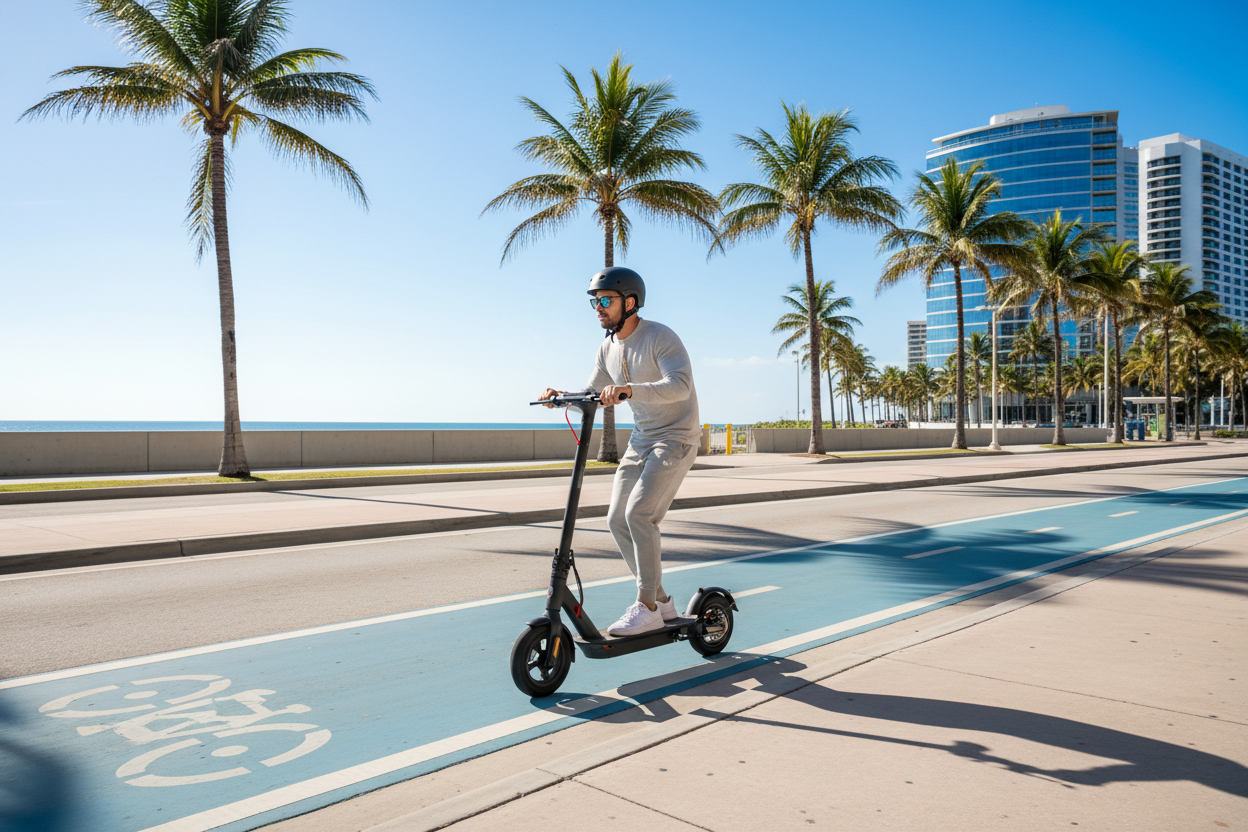
Florida E Scooter Laws 2026: Speed Limits, License Requirements and Safety Rules
Florida e scooter laws 2026 have clarified exactly where, how fast, and under what conditions riders can legally operate electric scooters across the state. Whether you're commuting in Miami, cruising the Tampa Riverwalk, or exploring Orlando's bike lanes, understanding these rules isn't optional — it's what keeps you legal, safe, and out of trouble. This guide covers every key regulation in plain language.
Table of Contents
- What Counts as an E Scooter Under Florida Law?
- Speed Limits for E Scooters in Florida
- License Requirements: Do You Need One?
- Helmet Rules and Age Requirements
- Where You Can (and Cannot) Ride
- City-by-City Rules: Miami, Orlando, Tampa
- Registration and Insurance
- Fines and Penalties for Violations
- Safety Rules Every Rider Should Follow
- What Changed in 2026
- FAQ
What Counts as an E Scooter Under Florida Law?
Florida Statute §316.003 defines a motorized scooter as any vehicle not having a seat or saddle for the use of the rider, designed to travel on not more than three wheels, and not capable of propulsion by human power alone.
In practical terms, this covers the stand-up electric scooters most people are familiar with — the kind you ride standing on a deck platform, steering with handlebars, powered by an electric motor and rechargeable battery.
Key distinction: Florida law separates motorized scooters from mopeds (which have seats and require registration) and from electric bicycles (which have pedals). If your scooter has a seat and exceeds certain power thresholds, it may be classified differently and subject to different rules.
For the purposes of this guide, we're focusing on stand-up electric scooters — the most common type used for urban commuting and recreation in Florida.
Speed Limits for E Scooters in Florida
What Is the Legal Speed Limit?
Under Florida law, electric scooters operated on public roads, bike lanes, or shared-use paths are generally subject to a maximum speed of 15 mph in most jurisdictions. However, this varies depending on where you're riding:
| Location | Typical Speed Limit | Notes |
|---|---|---|
| Bike lanes (road) | 15 mph | Must yield to cyclists |
| Shared-use paths / sidewalks | 15 mph or less | Pedestrians have right of way |
| Roadway (where permitted) | Must not impede traffic | Only where speed limit ≤ 25 mph |
| Private property | No state limit | Property rules apply |
| Municipal zones (varies) | 10–15 mph | Check local ordinances |
Why this matters: Many personal electric scooters — including performance models — are capable of speeds well above 15 mph. Florida law does not prohibit owning a faster scooter, but it does restrict how fast you can legally ride it on public infrastructure. Riding at 30+ mph on a bike path isn't just illegal — it's genuinely dangerous to pedestrians and other cyclists.
If you own a higher-powered scooter and want to use its full performance capability, that's best reserved for private property or closed courses where no public speed restrictions apply.

A commuter-class electric scooter like the ONECNA T2 1200W is well-suited for Florida's urban bike lanes and shared paths, operating comfortably within legal speed limits.
License Requirements: Do You Need One?
The Short Answer: No — With Conditions
Florida does not require a driver's license to operate a motorized scooter on public roads, provided the scooter meets the legal definition and is operated within the permitted speed and location rules.
However, there are important age-related conditions:
- Under 16: Riders under 16 are prohibited from operating motorized scooters on public roads in Florida.
- 16 and older: No license required, but riders must follow all applicable traffic laws.
- Moped classification: If your scooter is classified as a moped (typically due to a seat and higher power output), a valid driver's license IS required.
Why Florida took this approach: The state legislature recognized that low-speed electric scooters function more like bicycles than motor vehicles in urban environments. Requiring a license would create a barrier to adoption for a vehicle that reduces car traffic and emissions — two things Florida cities are actively trying to address.
Practical note: Even without a license requirement, you are still subject to Florida traffic laws while riding. Running red lights, riding under the influence, or causing an accident can result in citations and liability regardless of whether a license is required.
Helmet Rules and Age Requirements
Is a Helmet Required in Florida?
Florida's helmet law for electric scooters is age-dependent:
| Age Group | Helmet Requirement |
|---|---|
| Under 16 | Helmet required (but riders under 16 cannot legally ride on public roads) |
| 16 and older | No state law requiring a helmet for scooter riders |
| All ages (municipal zones) | Some cities may require helmets — check local rules |
The honest safety perspective: The absence of a legal requirement doesn't mean helmets are optional from a safety standpoint. Head injuries are the leading cause of serious injury and death in scooter accidents. At 15 mph, a fall onto pavement without a helmet can cause traumatic brain injury. Wearing a properly fitted helmet is one of the highest-impact safety decisions a rider can make — regardless of what the law says.
Additional protective gear worth considering:
- Wrist guards (wrists are the most common fracture point in falls)
- Knee and elbow pads for new riders
- Reflective vest or jacket for night riding
- Closed-toe shoes — never sandals or flip-flops
Where You Can (and Cannot) Ride in Florida
Permitted Riding Locations
- ✅ Bike lanes — the primary legal riding surface for e scooters in Florida
- ✅ Shared-use paths — multi-use trails where cyclists and pedestrians coexist
- ✅ Roadways with speed limits of 25 mph or less — where no bike lane exists
- ✅ Private property — with owner permission, no public speed restrictions apply
Where You Cannot Ride
- ❌ Sidewalks — prohibited in most Florida municipalities (pedestrian right-of-way)
- ❌ Highways and expressways — absolutely prohibited
- ❌ Roads with speed limits above 25 mph — unless a bike lane is present
- ❌ State parks and nature preserves — unless specifically designated trails exist
- ❌ Airport property and federal facilities — separate jurisdiction rules apply
The sidewalk question: This is the most common point of confusion. Florida state law does not explicitly ban scooters from sidewalks statewide, but most major municipalities have local ordinances that do. In Miami, Tampa, and Orlando, riding an e scooter on a sidewalk is prohibited and can result in a fine. When in doubt, use the bike lane.
City-by-City Rules: Miami, Orlando, Tampa
Florida gives municipalities significant authority to regulate e scooters beyond state minimums. Here's what riders need to know in the three largest cities:
Miami
- E scooters permitted in bike lanes and on roads with speed limits ≤ 25 mph
- Sidewalk riding prohibited in most areas
- Shared scooter programs (Bird, Lime) operate under city permits with geofenced speed limits
- South Beach and Brickell have designated scooter parking zones
- Night riding requires front white light and rear red reflector
Orlando
- E scooters allowed in bike lanes and on multi-use trails
- Downtown Orlando has specific scooter zones and no-ride zones near tourist areas
- Speed limit in shared paths: 10 mph when pedestrians are present
- Parking on sidewalks must not block pedestrian access (5-foot clearance required)
Tampa
- E scooters permitted in bike lanes; sidewalk riding prohibited downtown
- The Tampa Riverwalk has specific rules — scooters must yield to pedestrians and ride at walking pace in crowded sections
- Ybor City historic district has restricted scooter zones on weekend evenings
- Hillsborough County trails: 15 mph maximum, yield to pedestrians
Always verify current local rules before riding in a new city. Municipal ordinances can change faster than state law, and what's permitted in one neighborhood may be restricted in another.
Registration and Insurance
Do You Need to Register Your E Scooter in Florida?
No. Stand-up electric scooters that meet Florida's motorized scooter definition do not require state registration or a license plate. This is one of the practical advantages of e scooters over mopeds and motorcycles.
Is Insurance Required?
Florida does not require liability insurance for motorized scooters. However, this doesn't mean you're protected if something goes wrong:
- If you cause an accident and injure someone, you are personally liable for damages
- Your homeowner's or renter's insurance may cover some liability — check your policy
- Some insurers offer standalone micromobility policies for e scooters
- If your scooter is stolen, standard auto insurance won't cover it — a separate policy or rider is needed
For riders using their scooter regularly for commuting, a basic liability policy is worth considering. The cost is typically $100–$300/year and provides meaningful protection in the event of an at-fault accident.
Fines and Penalties for Violations
Florida treats e scooter violations as civil infractions in most cases, similar to bicycle violations. Common fines include:
| Violation | Typical Fine Range |
|---|---|
| Riding on prohibited roadway | $60–$150 |
| Sidewalk riding (where prohibited) | $50–$100 |
| No lights during nighttime riding | $60–$100 |
| Riding under the influence (DUI) | $500–$1,000+ / criminal charge |
| Reckless operation | $100–$500 / possible criminal charge |
| Under-age riding (under 16) | Fine issued to parent/guardian |
DUI on an e scooter: This surprises many riders, but Florida's DUI laws apply to motorized scooters. Operating an e scooter while impaired by alcohol or drugs is a criminal offense, not just a traffic infraction. The legal BAC limit of 0.08% applies.
Safety Rules Every Florida E Scooter Rider Should Follow
Beyond legal compliance, these practices meaningfully reduce your risk of injury:
Before Every Ride
- Check tire pressure — underinflated tires reduce stability and braking distance
- Test both brakes before moving
- Verify lights are working if riding near dusk or dawn
- Charge your battery — running out of power mid-ride on a busy road is a safety hazard
While Riding
- Ride predictably — signal turns with hand signals, don't weave between lanes
- Maintain a safe following distance from vehicles and cyclists
- Slow down significantly at intersections — most accidents happen at crossings
- Never ride with headphones in both ears — you need to hear traffic
- Avoid wet metal surfaces (grates, painted lines, manhole covers) — they become extremely slippery when wet
- Watch for car doors opening in parked car zones
Florida-Specific Hazards
- Afternoon thunderstorms: Florida's summer storm pattern means conditions can change in minutes. If you see lightning, get off the road immediately.
- Sand and debris on bike paths: Common near beaches and after storms. Sand on pavement dramatically reduces traction.
- Tourist foot traffic: In areas like South Beach, Clearwater, and International Drive, pedestrian density is high and unpredictable. Slow down significantly.
- Heat and hydration: Riding in Florida summer heat causes fatigue faster than you'd expect. Carry water and take breaks.
What Changed in Florida E Scooter Law in 2026
Florida's approach to electric scooter regulation has continued to evolve. Key developments heading into 2026 include:
- Expanded municipal authority: Cities now have clearer authority to establish designated scooter zones, no-ride zones, and parking requirements without needing state-level approval for each change.
- Shared scooter operator requirements: Companies operating shared scooter fleets (Bird, Lime, Spin) face stricter permit requirements, including mandatory geofencing for speed reduction in pedestrian-heavy zones.
- Increased enforcement in tourist corridors: Several municipalities have increased enforcement presence in high-traffic tourist areas following a rise in pedestrian-scooter incidents.
- Parking regulations tightened: Improperly parked scooters (blocking sidewalks, ADA ramps, or building entrances) now face higher fines in Miami-Dade and Orange County.
- Insurance discussion ongoing: The Florida legislature has continued debating whether to require basic liability insurance for e scooter riders, though no statewide mandate has passed as of mid-2026.
Bottom line: The regulatory trend in Florida is toward more structure, not less. Riders who stay informed and ride responsibly are unlikely to have issues. Those who treat e scooters as unregulated toys in public spaces are increasingly likely to face enforcement.
Quick Reference: Florida E Scooter Rules at a Glance
| Rule | Florida Requirement |
|---|---|
| Minimum age | 16 years old |
| Driver's license | Not required |
| Helmet (16+) | Not required by state law |
| Registration | Not required |
| Insurance | Not required (but recommended) |
| Max speed (public paths) | 15 mph |
| Sidewalk riding | Prohibited in most cities |
| Night lighting | Required (front white, rear red) |
| DUI laws apply | Yes |
| Highway riding | Prohibited |
Frequently Asked Questions
Do I need a license to ride an electric scooter in Florida?
No. Florida does not require a driver's license to operate a stand-up electric scooter on public roads. However, riders must be at least 16 years old and must follow all applicable traffic laws.
What is the speed limit for e scooters in Florida?
The general limit is 15 mph on bike lanes and shared-use paths. On roadways where scooters are permitted (speed limit ≤ 25 mph), riders must not impede traffic flow. Some municipalities set lower limits in pedestrian-heavy zones.
Can I ride my electric scooter on the sidewalk in Florida?
State law does not explicitly ban sidewalk riding statewide, but most major Florida cities — including Miami, Orlando, and Tampa — prohibit it by local ordinance. In practice, assume sidewalk riding is not permitted in any urban area unless you've confirmed otherwise.
Do I need to register my electric scooter in Florida?
No. Stand-up electric scooters that meet Florida's motorized scooter definition do not require registration or a license plate. If your scooter is classified as a moped (due to a seat and higher power output), different rules apply.
Is a helmet required for e scooter riders in Florida?
Florida state law does not require helmets for riders 16 and older. However, wearing a helmet is strongly recommended — head injuries are the leading cause of serious injury in scooter accidents, and a helmet is the single most effective protective measure available.
Can I get a DUI on an electric scooter in Florida?
Yes. Florida's DUI laws apply to motorized scooters. Operating an e scooter while impaired by alcohol or drugs is a criminal offense with the same legal BAC threshold (0.08%) as driving a car.
Are electric scooters allowed on Florida beaches?
This varies by municipality. Some beach communities allow e scooters on designated paths near the beach; others prohibit them on the beach itself and in certain beachfront zones. Check with the specific city or county before riding near beach areas.
What lights do I need for night riding in Florida?
Florida law requires a white front light visible from at least 500 feet and a red rear reflector or light visible from at least 600 feet for nighttime riding. Most mid-range and premium e scooters include integrated lighting that meets these requirements.
Can I ride an electric scooter on Florida bike trails like the Pinellas Trail?
Many Florida multi-use trails permit electric scooters, but rules vary by trail and managing authority. The Pinellas Trail, for example, allows e scooters with a 15 mph speed limit and a requirement to yield to pedestrians. Always check the specific trail's rules before riding.
What happens if I get caught riding illegally in Florida?
Most violations are civil infractions with fines ranging from $50 to $500 depending on the offense. Serious violations — DUI, reckless operation, or causing injury — can result in criminal charges. Repeat violations may result in higher fines and increased scrutiny from law enforcement.
Share:
E Scooter vs E Bike: Complete Comparison of Speed, Range, Cost and Features
How to Charge an E Scooter: A Complete Guide for Safe and Efficient Charging