




Table of Contents
- What "High-Performance" and "Commuter" Actually Mean
- Why Getting This Wrong Is an Expensive Mistake
- The Real Differences: A Spec-by-Spec Breakdown
- The Commuter E-Scooter: What It Does Well
- The High-Performance E-Scooter: What It Does Well
- How to Choose: A Practical Decision Framework
- When a Commuter Scooter Is the Right Answer
- When a High-Performance Scooter Is the Right Answer
- The Middle Ground: Mid-Range Scooters Worth Considering
- FAQ
What "High-Performance" and "Commuter" Actually Mean
Choosing between high-performance and commuter e-scooters is one of the most common decisions new electric scooter buyers face — and one of the most frequently made incorrectly. The two categories represent genuinely different engineering philosophies, not just different price points. Understanding what each category is actually optimized for is the starting point for making a decision you won’t regret six months later.
The terms themselves are used loosely in the market. “High-performance” gets applied to anything with a large motor, regardless of whether the rest of the scooter is built to match. “Commuter” sometimes means genuinely portable and practical, and sometimes just means underpowered. This guide cuts through the marketing language and focuses on what actually separates these two categories in real-world use.
What “Commuter” Means in Practice
A commuter e-scooter is designed around a specific use case: getting a person from point A to point B in an urban environment, reliably, repeatedly, with minimal friction. The engineering priorities are portability (light enough to carry), range adequacy (enough for a typical commute without anxiety), ease of use (intuitive controls, predictable handling), and low maintenance. Speed and raw power are secondary considerations — useful up to a point, but not the primary design goal.
Commuter scooters typically weigh 20–40 lbs, have top speeds of 15–28 mph, and offer 15–25 miles of real-world range. They fold compactly, fit in car trunks and transit spaces, and can be carried up stairs by most adults. They’re designed to be used every day without requiring significant mechanical knowledge or physical effort to manage.
What “High-Performance” Means in Practice
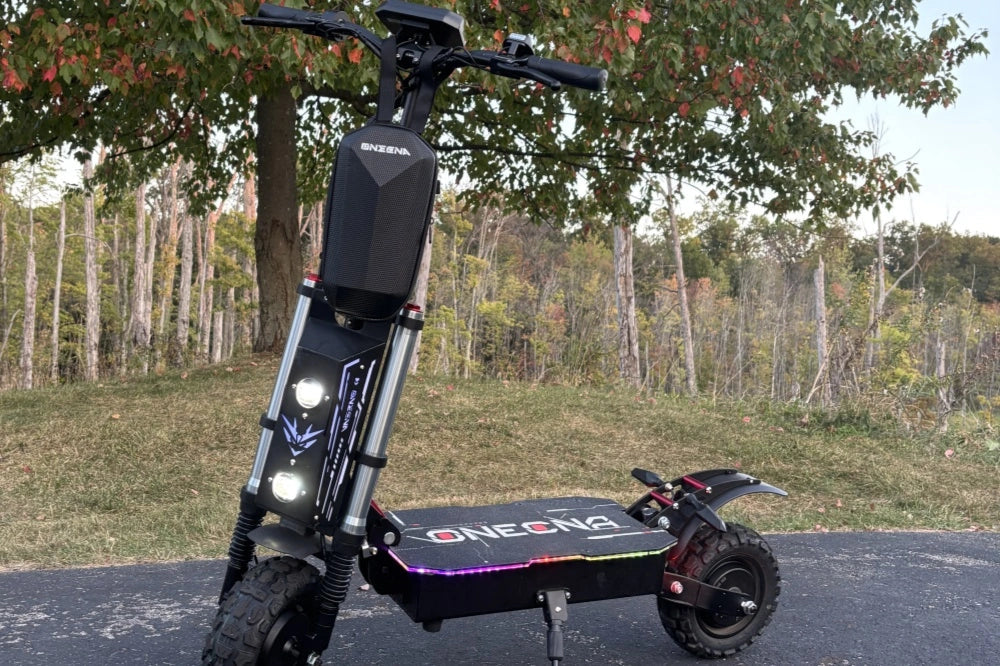
A high-performance e-scooter is designed around different priorities: maximum speed, maximum range, maximum power output, and capability on challenging terrain. The engineering trade-offs that enable these capabilities — larger motors, bigger batteries, heavier frames, more complex suspension systems — make high-performance scooters heavier, bulkier, more expensive, and more demanding to manage than commuter models.
High-performance scooters typically weigh 50–90+ lbs, have top speeds of 40–65+ mph, and offer 30–75+ miles of real-world range. They don’t fold into a convenient package, they require secure storage, and they’re not practical to carry. They’re designed for riders who need capability that commuter scooters can’t provide — not for riders who just want to go faster than they need to.
Why Getting This Wrong Is an Expensive Mistake
The most common mistake in the electric scooter market is buying for the specs you think you’ll want rather than the use case you actually have. This goes in both directions.
Riders who buy a high-performance scooter for urban commuting often find that the weight makes it impractical to carry, the size makes it difficult to store, the charging time is inconvenient for daily use, and the power is more than they can safely use in traffic. They end up with a scooter that’s impressive on paper but frustrating in practice.
Riders who buy a commuter scooter for use cases that exceed its capabilities — longer commutes, hilly terrain, heavier riders, mixed surfaces — find that the scooter underperforms, range anxiety becomes a daily problem, and the motor struggles on grades that a more powerful scooter would handle easily. They end up replacing the scooter sooner than expected.
Both mistakes are expensive. The goal of this guide is to help you identify which category actually fits your situation before you spend the money.
The Real Differences: A Spec-by-Spec Breakdown

| Feature | Commuter E-Scooter | High-Performance E-Scooter |
|---|---|---|
| Motor Power | 250–800W (single motor) | 1500–7000W+ (dual motor) |
| Top Speed | 15–28 mph | 40–65+ mph |
| Real-World Range | 12–25 miles | 25–60+ miles |
| Weight | 20–40 lbs | 50–90+ lbs |
| Tire Size | 8–10 inch | 10–12 inch (off-road tread) |
| Suspension | None or front only | Dual (front + rear) |
| Brakes | Mechanical disc or drum | Hydraulic disc |
| Portability | High — folds compactly, carriable | Low — heavy, requires storage |
| Charge Time | 3–6 hours | 8–12 hours |
| Hill Climbing | Up to ~15% grade | Up to 35–45% grade |
| Terrain | Smooth pavement, light gravel | Pavement, gravel, dirt, trails |
| Price Range | $300–$800 | $800–$3000+ |
| Best For | Daily urban commuting | Performance, off-road, long range |
The Commuter E-Scooter: What It Does Well
Commuter scooters are optimized for a specific set of conditions that describe the majority of urban electric scooter use: flat to moderately hilly pavement, distances under 15 miles each way, riders who need to carry or store the scooter at their destination, and daily use that requires reliable, low-maintenance operation.
Portability Is the Core Advantage
The defining advantage of a commuter scooter is that you can actually carry it. A 25–35 lb scooter can be carried up a flight of stairs, lifted onto a bus or train, stored under a desk, and loaded into a car trunk without assistance. This portability unlocks use cases that heavier scooters simply can’t serve: multi-modal commuting (scooter + transit), office storage, apartment living without dedicated storage space, and travel.
For riders whose commute involves any combination of public transit, stairs, elevators, or shared storage spaces, portability isn’t a nice-to-have — it’s a requirement. A scooter that’s too heavy to carry conveniently stops being used in those situations, which defeats the purpose of owning it.
Daily Reliability Over Peak Performance
Commuter scooters are designed to be used every day without drama. Shorter charge times (3–6 hours vs. 8–12 hours for high-performance models) mean you can charge overnight and have a full battery every morning. Simpler mechanical systems mean less maintenance and fewer things to go wrong. Predictable, manageable power delivery means the scooter behaves consistently in traffic, which is more important for daily commuting than maximum acceleration.
Where Commuter Scooters Fall Short
The trade-offs are real. Commuter scooters struggle on grades above 15%, which is a problem for riders in hilly cities. Range is adequate for most urban commutes but becomes limiting for longer routes or riders who want to use the scooter for recreational riding beyond their commute. Heavier riders (above 200 lbs) will notice more performance degradation on commuter scooters than on higher-powered alternatives. And the smaller tires and limited suspension make rough pavement and unpaved surfaces uncomfortable.
The High-Performance E-Scooter: What It Does Well

High-performance scooters are built for riders whose use cases exceed what commuter models can handle. The additional cost, weight, and complexity are justified when the use case genuinely requires the additional capability — and unjustified when it doesn’t.
Power That Translates to Real-World Capability
The most meaningful advantage of a high-performance scooter isn’t top speed — it’s power headroom. A scooter with 3000–7000W of peak power can maintain speed on steep grades, handle heavier riders without significant performance degradation, and sustain higher speeds without the motor working at its limit. This headroom makes the scooter more capable and more durable over time — a motor that’s rarely pushed to its limit lasts longer than one that’s frequently at maximum output.
Dual-motor setups, common in high-performance scooters, also provide better traction on loose or uneven surfaces by driving both wheels simultaneously. On gravel, dirt, or wet pavement, this makes a practical difference in stability and control.
Range That Eliminates Anxiety
High-performance scooters carry larger batteries — often 1500–2500Wh compared to 500–800Wh in commuter models. This translates to real-world range of 30–60+ miles, which eliminates the range anxiety that affects commuter scooter riders on longer routes or in cold weather. For riders with commutes over 15 miles each way, or who want to use their scooter for recreational riding beyond commuting, the larger battery is a genuine practical advantage.
Where High-Performance Scooters Fall Short
Weight is the primary limitation. A 70–90 lb scooter is not portable in any meaningful sense — it requires secure storage, can’t be carried up stairs, and needs a vehicle with adequate cargo space for transport. Charging time is longer, which requires planning for daily use. The higher price point means the cost of ownership is significantly higher. And the additional power requires more skill and attention to ride safely — a 60 mph scooter demands more from the rider than a 25 mph one.
How to Choose: A Practical Decision Framework
The right scooter is the one that fits your actual use case, not the one with the most impressive specs. Work through these questions in order — your answers will point clearly toward one category or the other.
Question 1: Do you need to carry the scooter?
If your commute involves stairs, public transit, office storage, or any situation where you need to physically lift and carry the scooter, you need a commuter model. No high-performance scooter is practical to carry. If you have secure storage at both ends of your commute and don’t need to carry the scooter, this constraint doesn’t apply.
Question 2: How far do you actually ride?
Calculate your realistic daily riding distance, including any recreational use beyond commuting. If your total daily distance is under 20 miles, a commuter scooter’s range is adequate. If you regularly ride 20–40+ miles per day, or if you want range headroom for cold weather and varied conditions, a high-performance scooter’s larger battery is worth the trade-offs.
Question 3: What terrain do you ride on?
Flat urban pavement: commuter scooter is fine. Moderate hills (up to 15% grade): commuter scooter handles this. Steep hills (above 15%), gravel, dirt, or mixed surfaces: high-performance scooter is the appropriate choice. Be honest about your actual terrain — not the terrain you occasionally encounter, but the terrain you ride on regularly.
Question 4: What is your rider weight?
Riders under 180 lbs: commuter scooters perform adequately. Riders 180–220 lbs: commuter scooters work but show more performance degradation on hills and at higher speeds. Riders above 220 lbs: a high-performance scooter with a higher max load rating and more powerful motors will deliver meaningfully better performance and longevity.
Question 5: What is your actual budget?
A good commuter scooter costs $400–$800. A good high-performance scooter costs $1000–$2500+. If your use case is genuinely commuter-level, spending $1500 on a high-performance scooter doesn’t improve your experience — it just costs more. If your use case requires high-performance capability, buying a $500 commuter scooter and finding it inadequate is also a waste of money.
When a Commuter Scooter Is the Right Answer
A commuter scooter is the right choice when your primary use case is daily urban transportation on predominantly flat terrain, your commute is under 15 miles each way, you need to carry or store the scooter at your destination, and you want a low-maintenance, reliable daily driver that doesn’t require significant physical effort to manage.
It’s also the right choice for first-time electric scooter riders who are still developing their skills and comfort level. A commuter scooter’s manageable speed and predictable handling provide a better learning environment than a high-performance scooter’s more aggressive power delivery.
Specific scenarios where a commuter scooter is clearly the right answer:
- You commute 5–12 miles each way on flat city streets and need to bring the scooter into your office
- You use a combination of scooter and public transit and need to carry the scooter on buses or trains
- You live in an apartment without dedicated storage and need to bring the scooter inside
- You’re buying your first electric scooter and want to learn on something manageable before upgrading
- Your budget is $400–$800 and you want the best scooter for that budget in your use case
When a High-Performance Scooter Is the Right Answer
A high-performance scooter is the right choice when your use case genuinely requires capabilities that commuter scooters can’t provide: longer range, more power for hills or heavier riders, capability on mixed terrain, or sustained higher speeds. It’s not the right choice simply because you want the most impressive scooter available.
Specific scenarios where a high-performance scooter is clearly the right answer:
- Your commute is 20–40+ miles round-trip and range anxiety on a commuter scooter would be a daily problem
- Your route includes sustained steep grades (above 15–20%) that would significantly slow a commuter scooter
- You ride on mixed terrain — pavement, gravel, dirt paths — where larger tires and dual suspension make a practical difference
- You are a heavier rider (220+ lbs) who has found commuter scooters underperform under your weight
- You have secure storage at both ends of your commute and portability is not a constraint
- You want to use the scooter for recreational off-road riding in addition to commuting
The Middle Ground: Mid-Range Scooters Worth Considering
The commuter vs. high-performance framing is useful, but it’s not a binary choice. There’s a meaningful middle ground occupied by mid-range scooters that offer more capability than entry-level commuter models without the weight, cost, and complexity of full high-performance machines.
Mid-range scooters typically feature 800–1600W motors (single or dual), 10–11-inch tires, dual suspension, and batteries in the 800–1200Wh range. They weigh 35–55 lbs — heavier than commuter scooters but lighter than high-performance models — and offer real-world range of 20–35 miles. They handle moderate hills and mixed terrain better than commuter scooters, while remaining more manageable than full high-performance machines.
For riders whose use case falls between the two categories — moderate hills, commutes of 15–25 miles, occasional mixed terrain — a mid-range scooter often provides the best balance of capability, weight, and cost. The ONECNA GT7, for example, sits in this space: 800W motor (1600W peak), 720Wh battery, 10-inch pneumatic tires, and app connectivity, at a weight of ~38 lbs. It’s more capable than a basic commuter scooter but more manageable than a full high-performance machine.
The key question for mid-range scooters is the same as for any category: does the capability match the use case? A mid-range scooter that’s heavier than you need is still a worse choice than a lighter commuter scooter that covers your actual use case adequately.
FAQ — High-Performance vs. Commuter E-Scooters
Is a high-performance scooter better than a commuter scooter?
Neither is objectively better — they’re optimized for different use cases. A high-performance scooter is better for riders who need more power, range, or terrain capability than a commuter scooter can provide. A commuter scooter is better for riders who need portability, daily reliability, and manageable weight for urban use. Buying more scooter than your use case requires doesn’t improve your experience — it just costs more and adds inconvenience.
Can I use a high-performance scooter for daily commuting?
Yes, but with significant trade-offs. High-performance scooters are heavy (50–90+ lbs), have long charge times (8–12 hours), and require secure storage. If your commute involves carrying the scooter, using public transit, or storing it in a small space, these trade-offs make daily use impractical. If you have secure storage at both ends and don’t need to carry the scooter, a high-performance scooter can work for commuting — though it’s often more than necessary for typical urban routes.
What speed do I actually need for commuting?
For most urban commuting, 20–25 mph is adequate and appropriate. This speed keeps up with traffic in bike lanes and on secondary roads, is fast enough to cover meaningful distances efficiently, and is slow enough to be manageable in traffic. Top speeds above 30 mph are rarely useful in urban commuting contexts and require more skill and attention to ride safely. Buy for the speed you’ll actually use, not the maximum speed available.
How much range do I actually need?
Calculate your realistic daily riding distance and add 30–40% as a buffer for cold weather, headwinds, and battery degradation over time. If your daily commute is 10 miles round-trip, a scooter with 15–18 miles of real-world range is adequate. If your commute is 20 miles round-trip, you need at least 28–30 miles of real-world range to ride comfortably without anxiety. Remember that advertised range figures are typically 25–35% higher than real-world range — apply a 65–75% multiplier to any manufacturer’s range claim.
Does rider weight affect which type of scooter I should choose?
Yes, significantly. Heavier riders (above 200 lbs) experience more performance degradation on commuter scooters — reduced range, slower hill climbing, and more motor strain. For riders above 220 lbs, a mid-range or high-performance scooter with a higher max load rating and more powerful motors will deliver better performance and longer motor life. Check the max load rating of any scooter you’re considering and ensure it comfortably exceeds your weight.
Are high-performance scooters legal on public roads?
This depends on your jurisdiction. Most high-performance scooters have top speeds that exceed legal limits for electric scooters in most US states and many other countries. In most jurisdictions, electric scooters are limited to 15–25 mph on public roads. High-performance scooters can typically be ridden in lower speed modes that comply with local limits, but the scooter itself may be capable of speeds that are illegal in your area. Check your local regulations before purchasing, and use speed modes to stay within legal limits where applicable.
What’s the most important spec to compare when choosing?
Weight and real-world range are the two most practically important specs for most buyers. Weight determines whether the scooter is actually usable in your daily context — if it’s too heavy to carry when needed, it limits your use cases significantly. Real-world range (not advertised range) determines whether the scooter covers your actual riding distance with adequate buffer. Motor power, top speed, and suspension are secondary considerations that matter more for specific use cases (hills, off-road, heavier riders) than for typical urban commuting.
When should I consider upgrading from a commuter to a high-performance scooter?
Consider upgrading when your commuter scooter consistently falls short of your needs: range anxiety on your regular route, motor struggling on hills you ride frequently, performance degradation that’s affecting your daily experience, or a change in use case (longer commute, new terrain, recreational riding) that exceeds the commuter scooter’s capabilities. Don’t upgrade based on wanting more speed than you actually use — upgrade based on a genuine capability gap between your current scooter and your actual needs.
Share:
Comparing the Speed and Range of GT7, GT8 PRO, and GT9
Foldable E Scooter for Adults: Best Portable Electric Scooters in 2026