




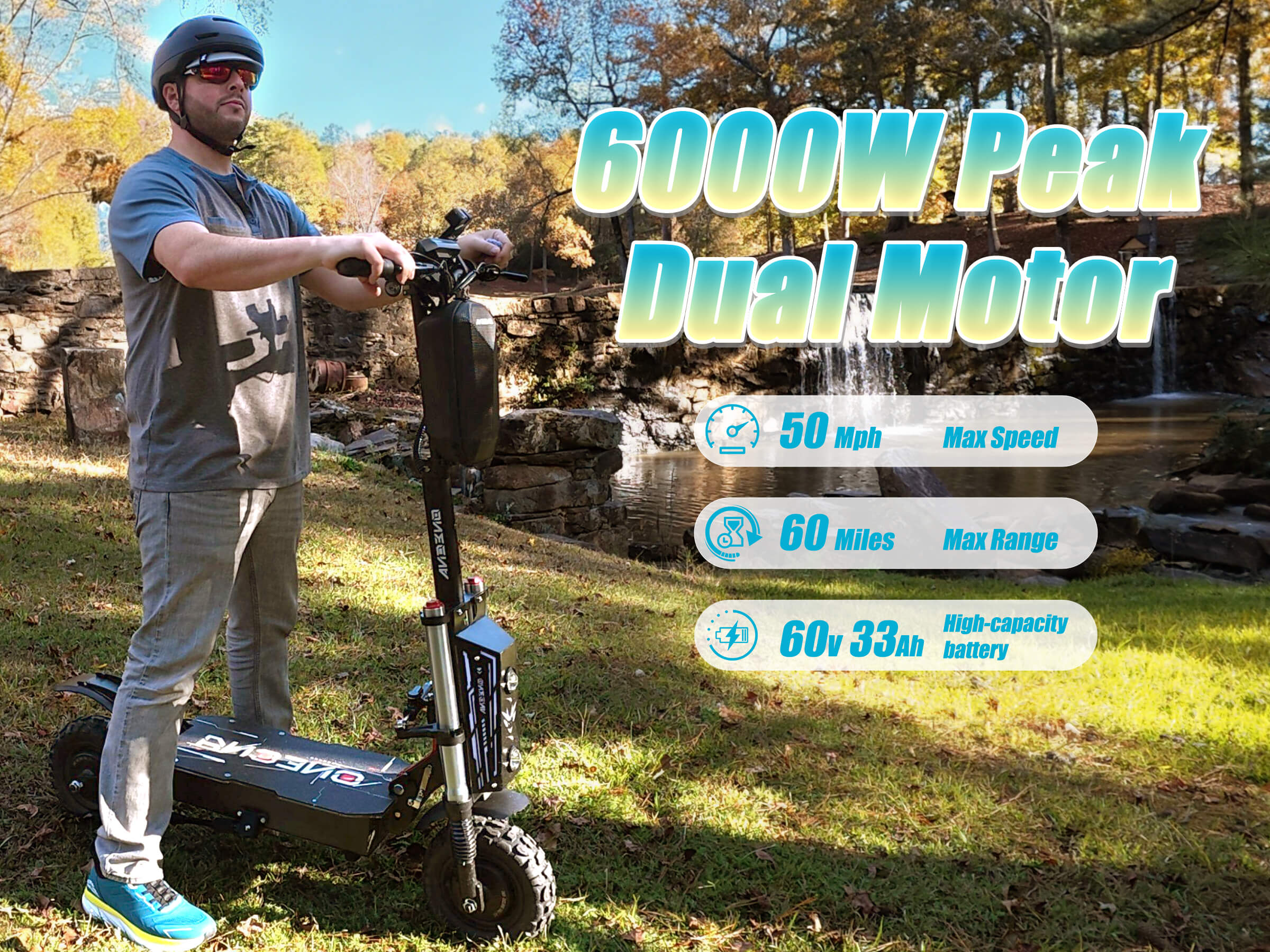
How Fast Can an E Scooter Go? Everything You Need to Know Before Buying
How fast can an e scooter go? For most adult riders, the answer ranges from 15 mph to over 50 mph — but the right speed depends on your terrain, local laws, and riding purpose. Whether you're commuting through city streets or exploring off-road trails, understanding e scooter speed before you buy can save you from a costly mismatch. This guide covers the what, why, how, and when of electric scooter speed — no sales pitch, just the facts.
What Does "E Scooter Speed" Actually Mean?
When a manufacturer lists a top speed, they're usually referring to the maximum speed on flat pavement with a 165 lb (75 kg) rider, in ideal conditions. Real-world speed is almost always lower — affected by rider weight, road surface, wind, battery charge level, and riding mode.
There are two numbers worth paying attention to:
- Rated top speed — the manufacturer's claimed maximum
- Sustained cruising speed — the speed you can comfortably hold for extended distances
For most buyers, cruising speed matters more than peak speed. A scooter that hits 45 mph for 10 seconds but struggles to hold 28 mph uphill isn't the same as one that cruises at 35 mph all day.

Speed Ranges by Scooter Category
Electric scooters span a wide performance spectrum. Here's a practical breakdown:
| Category | Typical Top Speed | Best For |
|---|---|---|
| Entry-level / Commuter | 15–20 mph | Short city trips, beginners |
| Mid-range | 20–30 mph | Daily commuting, mixed terrain |
| Performance / Dual Motor | 30–50 mph | Long-range, hills, heavier riders |
| High-performance / Off-road | 45–65+ mph | Off-road trails, experienced riders |
For context: the ONECNA GT8 PRO, a dual-motor 6000W scooter, is rated up to 50 mph — placing it firmly in the performance tier. That kind of output is designed for riders who need consistent power on hills or longer suburban routes, not just flat-road sprints.
What Affects an E Scooter's Top Speed?
Speed isn't just about motor wattage. Several factors interact to determine how fast your scooter actually goes:
1. Motor Power (Watts)
More watts = more torque and higher potential speed. Single motors (250W–1000W) are common in commuter scooters. Dual motors (2000W–6000W+) are found in performance models and make a significant difference on inclines and at sustained high speeds.
2. Battery Voltage
Higher voltage systems (52V, 60V, 72V) allow motors to spin faster. A 72V system will generally push a scooter faster than a 48V system with the same motor, all else being equal.
3. Rider Weight
Every extra 20 lbs can reduce top speed by 2–5 mph on a mid-range scooter. High-power dual-motor scooters are less affected because they have torque headroom to compensate.
4. Terrain and Gradient
A 5% incline can cut speed by 30–40% on a single-motor scooter. Dual-motor designs handle grades much better, maintaining closer to rated speed on hills.
5. Tire Type and Pressure
Pneumatic (air-filled) tires roll faster and absorb road vibration better than solid tires. Proper inflation reduces rolling resistance and helps maintain top speed.
6. Riding Mode
Most scooters have Eco, Normal, and Sport modes. Eco mode limits speed to extend range. Sport mode unlocks full power. Always check what mode the manufacturer used when quoting top speed.

Legal Speed Limits: What the Law Says
This is where many buyers get surprised. In most U.S. states, electric scooters are legally capped at 15–20 mph on public roads and bike lanes — regardless of what the scooter is capable of.
United States (General Overview)
- Most states: 15–20 mph max on public roads/bike paths
- California: 15 mph on bike paths; no license required under 15 mph
- Texas: 35 mph on roads with speed limits ≤ 35 mph
- New York City: 20 mph max; registration required for Class C e-scooters
Europe
- UK: Currently legal only on private land (as of 2026 trials ongoing)
- Germany: 20 km/h (12.4 mph) max on public roads
- France: 25 km/h (15.5 mph) max
Key takeaway: A scooter capable of 50 mph doesn't mean you'll ride it at 50 mph legally. High-speed scooters are often used on private property, closed tracks, or rural roads where local rules permit. Always check your local regulations before riding.
💡 Tip: Many performance scooters include a speed limiter or PIN-locked speed modes so you can set a legal cap for everyday riding while retaining full power for appropriate situations.
How to Choose the Right Speed for Your Needs
The best speed for you isn't the highest speed available — it's the speed that matches your actual use case. Here's a simple decision framework:
Choose 15–20 mph if:
- You ride exclusively in urban bike lanes or shared paths
- You're a beginner or returning to riding after a long break
- Your commute is under 5 miles on flat terrain
Choose 25–35 mph if:
- You commute on mixed roads with some traffic
- Your route includes moderate hills
- You carry cargo or are a heavier rider (200 lb+)
Choose 40 mph+ if:
- You ride on private land, rural roads, or closed courses
- You need consistent power for off-road terrain
- Range and sustained performance matter more than portability

When Does Higher Speed Actually Matter?
Speed matters most in three real-world scenarios:
1. Keeping Pace with Traffic
On roads with 25–30 mph speed limits, a scooter that tops out at 18 mph becomes a hazard — you're slower than cars and can't accelerate out of dangerous situations. A scooter with a 30–35 mph capability gives you a meaningful safety buffer.
2. Hill Climbing
Speed and torque are related. A scooter that struggles on a 10% grade will slow to 8–12 mph even if it's rated at 25 mph on flat ground. Dual-motor scooters maintain speed on inclines because they have torque reserves — this is where wattage matters more than top speed spec.
3. Longer Commutes
If your commute is 10+ miles, a faster scooter doesn't just save time — it also tends to have a larger battery, better suspension, and more durable components. Speed tier often correlates with overall build quality.
Riding Fast Safely: What You Need to Know
Speed is only useful if you can control it. Here's what changes as speed increases:
Braking Distance
At 15 mph, a typical e scooter stops in about 15–20 feet. At 30 mph, that distance roughly triples. Hydraulic disc brakes — standard on performance scooters — significantly outperform mechanical drum brakes at higher speeds.
Suspension
At 20 mph, a pothole is an annoyance. At 40 mph, it's a crash risk. Front and rear suspension isn't a luxury on fast scooters — it's a safety requirement. Look for dual suspension systems if you plan to ride above 30 mph regularly.
Tires
Wider pneumatic tires (10–11 inches) provide better grip and stability at speed. Narrow solid tires are fine for slow urban riding but become unpredictable above 25 mph on uneven surfaces.
Protective Gear
At 25 mph+, a full-face helmet, wrist guards, and knee pads are strongly recommended. The physics of a fall at 30 mph are significantly more severe than at 15 mph — gear that feels excessive at low speed becomes essential at high speed.

FAQ: How Fast Can an E Scooter Go?
How fast can a standard e scooter go?
Most consumer electric scooters are rated between 15 and 30 mph. Entry-level models typically top out around 15–18 mph, while mid-range commuter scooters reach 25–30 mph. Performance and dual-motor models can exceed 40–50 mph.
Is 30 mph fast for an electric scooter?
Yes, 30 mph is considered fast for everyday urban use and exceeds the legal limit in most U.S. cities and European countries. It's appropriate for suburban roads, private property, or jurisdictions with higher speed allowances.
What is the fastest electric scooter available?
As of 2026, the fastest production electric scooters can exceed 60–70 mph. These are high-voltage, dual-motor machines designed for experienced riders on private or closed-course terrain — not for public roads.
Does motor wattage directly determine top speed?
Not directly. Wattage determines torque and power output, which affects how well a scooter maintains speed under load (hills, heavier riders). Top speed is also influenced by battery voltage, controller settings, and wheel size. A 500W scooter can be tuned to go faster than a 1000W scooter in some configurations.
Can I increase my e scooter's top speed?
Some scooters allow speed limit adjustments via app or PIN settings. Hardware modifications (changing controllers, batteries) are possible but void warranties, may be illegal on public roads, and can create serious safety risks. We don't recommend it unless you have technical expertise and are riding on private property.
How does rider weight affect e scooter speed?
Heavier riders experience more drag and require more torque to maintain speed, especially on inclines. A 165 lb rider may hit a scooter's rated top speed; a 220 lb rider on the same scooter may see 10–20% lower real-world speeds. Dual-motor scooters are significantly less affected by weight variance.
What speed is safe for a beginner?
15–20 mph is a comfortable and manageable range for new riders. It gives you enough time to react to obstacles, and braking distances remain short. As you build confidence and familiarity with your scooter's handling, you can gradually explore higher speeds in safe environments.
Are fast e scooters street legal?
It depends on your location. In most U.S. states, e scooters are limited to 15–20 mph on public roads and bike paths. Scooters capable of higher speeds can still be ridden legally on private property or in jurisdictions with more permissive rules. Always verify local regulations before riding.
Share:
High Speed E Scooter Buying Guide: How to Choose the Right Model
California E Scooter Laws 2026: Rules, Speed Limits and Safety Requirements